Key takeaways
- Set each weight and each dealbreaker before the sales demonstrations begin.
- Compare the $60,000 first-year enterprise quote with its $150,000 three-year subscription and setup total.
- Have an ordinary requester and contract owner perform the handoff themselves.
Which contract decisions should your shortlist solve first?
At Juniper Motion, Purchasing has an urgent problem that signatures alone cannot solve. The controller wants to know whether an equipment-maintenance renewal is still avoidable. The signed master names a term end, an amendment shortens the notice window, and the operations manager who negotiated both has moved departments. Meanwhile, Sales can already send an order for signature in minutes. The buying brief begins with the controller’s question because that is where staff are losing time and options.
Interview the people who actually touch the agreement. Ask a requester for the last two questions they had to email Legal. Ask the administrator to show how they find a governing amendment. Ask Finance for an example of a price that changed after signature. Turn each story into one input, one action and one observable result. “A clerk can show the amended deadline and the person responsible for notice” is something a vendor can demonstrate. “Smart lifecycle management” leaves everyone free to imagine a different result.
Choose three jobs for the first release. Juniper chooses requester intake, approval after a substantive revision, and renewal ownership. A request to integrate three accounting systems goes onto a later list until Finance names the downstream decision and a person to support it. Consult the contract management workflows by business role when deciding who should participate. The shortlist should reflect the people who own these jobs today.
Weight the daily work before collecting quotes
Juniper assigns 30 points to workflow completion, 25 to renewal handling, 20 to administration, 15 to access and 10 to three-year cost. For each category, reviewers score from one through five. One means the demonstrated route breaks into manual work outside the agreed process, three means the operator finishes with assistance, and five means the intended user completes it independently and leaves usable evidence. Scores two and four capture intermediate performance. Define cost bands against the approved budget before opening commercials.
A weighted score is the sum of each category’s score multiplied by its weight as a decimal. An enterprise option rated four on workflow earns 1.20 points from that category alone. In the fictional worksheet, the enterprise, existing e-sign-only route and mid-market finalist finish at 3.55, 2.50 and 3.90 respectively out of five. Those numbers rehearse a decision; replace them with independently observed scores for each product and use confirmed quotes before issuing a recommendation.
Set mandatory checks alongside the score. Juniper requires a restricted employment agreement to stay inaccessible to an ordinary requester and a departed administrator’s renewal tasks to have a working handoff. An unresolved mandatory test pauses selection even if the mathematical total looks attractive. Write down who can clear each check and what proof they will retain.
Three finalist routes under the sample weights
| Option | Worked score / 5 | Evidence that could change the choice |
|---|---|---|
| Enterprise CLM | 3.55 | Prove a mandatory integration and obtain deployment staffing in the quote. |
| Current e-sign plus existing tools | 2.50 | Show the amended deadline and responsible owner in an independently maintained register. |
| Mid-market CLM | 3.90 | Confirm edition, access and a repeatable handoff before approving a pilot. |
Bring three options to the same cost horizon
Juniper has a fictional enterprise quote for $45,000 per year plus a one-time $15,000 setup charge. That makes $60,000 in year one and $150,000 across three years if the annual price holds. Neither figure includes Juniper’s staff time, future implementation work, taxes or hypothetical increases. Label each unknown on the comparison so a low subtotal cannot silently become an approved budget.
Have the e-sign owner estimate what it takes to maintain the existing repository, validate amendments and send renewal notices alongside the signature tool. If those tasks are already done well with very little effort, staying put is a credible finalist. If nobody performs them, assign a named owner and estimate the time needed before calling this route inexpensive. For the mid-market bid, obtain a written quote for the same term, user mix, migration scope and required controls. Confirm which role can operate the workflow on the quoted plan.
Use the contract software comparison guides to organize follow-up questions, then attach the dated proposal and the remaining assumptions to the purchase memo. Ask what changes if a second department joins in year two or you need to export executed documents at the end of year three. A vendor’s answer may change both the financial forecast and the staffing request.
Run the same approval and renewal test in ContraxAware
Give each finalist the same fictional signed agreement, amendment and unsigned revision. Ask a contract administrator to identify the current record. Then ask a department head to show which version Legal approved and a renewal owner to identify the date when someone must act. Use a test account with the proposed production permissions. Have the presenter stop driving before the administrator repeats the exercise.
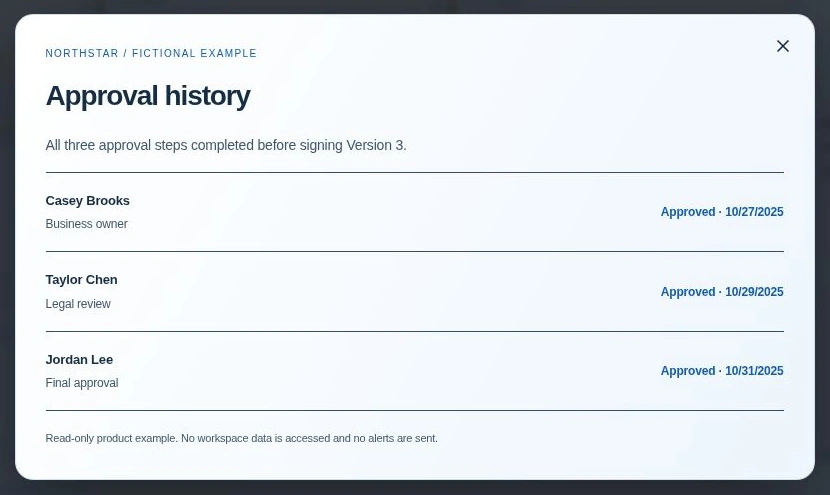
The Northstar screenshot below comes from an actual ContraxAware product screen with fictional training data. The approval history records business, legal and final decisions against version 3. For your test, change a commercial term on a new draft and ask which document the prior decisions cover. Capture the version and approving parties your evaluator sees. A signed file, an approval badge and a note in an email all answer different questions.
Review the plan and feature matrix and the pricing page before recording a capability as included. A successful demonstration of a feature is evidence of behavior in that environment. Require the written offer to identify the edition, support and implementation scope that deliver the same result for your users.
 View full-size screenshot
Write the decision the CFO and general counsel can sign
Open the memo with a recommendation and a boundary. Juniper can recommend a supervised mid-market pilot for supplier agreements with one administrator and one backup. State which processes remain in the existing signature tool during that pilot. Give the controller a date to see the first reconciled renewal list. A two-system transition needs a named source for each action or both systems may send reminders for the same deadline.
Record one reason the runner-up could still win. The enterprise proposal becomes more attractive if an approved acquisition introduces a required integration or an access model the mid-market finalist cannot demonstrate. Staying with e-sign becomes more attractive if the team confirms that its external register already produces reliable renewal evidence at a sustainable cost. Procurement should preserve these conditions in the purchase file so the decision can be revisited without starting the whole selection again.
Finish with an owner for each remaining gap, a date to close it and the evidence that releases funds. A dated screenshot can close a usability question. A negotiated order form closes a licensing question. An independent rerun by the incoming administrator closes an ownership question. That distinction makes the software decision intelligible to the people who must live with it.
For the full product scope behind the scoring matrix, see ContraxAware’s contract management software.
Mid-Market CLM Evaluation & Weighted Scoring Matrix
Set weights before demonstrations. Score observed evidence from 1 to 5, record the decision owner, and track mandatory tests separately.
Preview a completed worksheet row
- Criterion
- Workflow
- Weight %
- 30
- Enterprise (1–5)
- 4
- E-sign only (1–5)
- 2
- Mid-market (1–5)
- 4
- Evidence to retain
- Requester repeats the handoff
- Decision owner
- Legal operations
Frequently asked questions
How many vendors should a 180-person company evaluate?
Pick enough credible alternatives to expose the trade-offs. Juniper’s three options include its current signature arrangement, so the team can explain why changing tools creates sufficient value. Give every finalist a fair chance to demonstrate the required work.
Who should own the final score?
Give individual reviewers the first vote in their own areas. Legal operations owns the consolidated evidence, Finance owns the cost assumptions, and an accountable sponsor decides which unresolved issues block a purchase. Retain disagreements alongside the totals.
What if the company has very few new contracts?
Check the workload after signing. A business with few new agreements can still have supplier deadlines, rate changes and evidence requests. Compare the cost of handling those jobs reliably in the existing system with the new quoted service.
When should a purchase become a pilot instead?
Choose a pilot when the proposal fits the budget but a consequential operational question remains open. Specify the files, participants, completion condition and end date. Release expansion funding only after the owner shows the promised result.