Key takeaways
- Prepare the answer key before vendors receive the files. Include a missing event and an unsigned proposal.
- A supplier earned full decision credit for identifying an unknown deadline in this example.
- Stop the evaluation for a restricted-file disclosure even if the overall score looks strong.
Can the next administrator repeat the vendor’s demo?
At fictional Maple Foundry, a software vendor extracts a date from a clean master agreement in seconds. Last spring, Maple renewed a supplier using a date that an amendment had changed. The operations manager asks the presenter to step aside. Can the person who actually manages that supplier find the current term and get it to the renewal owner?
Maple sends all three finalists a signed supply agreement, its signed amendment, a SaaS order form, a services statement of work and an unsigned proposed replacement. Each vendor gets identical setup time, roles and instructions. Procurement keeps the answer key, including one deadline the files cannot establish.
Prepare a six-task answer key
The procurement lead and counsel agree on six expected decisions. For each, write the file, paragraph and acceptable response. A signed amendment moves a notice period from 90 days to 45. The services document starts a clock at acceptance, an event absent from the packet. Credit the person who identifies the missing evidence. Keep the answer key with the evaluators until the session ends.
Six tasks to run at every vendor demo
| Demo task | Expected evidence | Successful handoff |
|---|---|---|
| Original notice period | Supply agreement §8 specifies 90 calendar days. | Flag the signed amendment before entering a deadline. |
| Current notice period | Signed amendment §2 changes this supplier to 45 days. | Route the revised term and its source to the renewal owner. |
| Subscription price | Order Form A sets the rate at $1,000 per month. | Give Finance the amount, currency and billing interval. |
| Acceptance trigger | The statement of work ties the clock to acceptance. The acceptance record is missing. | Ask the project owner for acceptance evidence. Leave the due date pending. |
| Replacement status | A later proposal is unsigned. The signed order is available. | Identify both and deliver the executed copy separately. |
| Requester access | The requester can open the permitted agreement and its supporting passage. | Repeat the lookup under the requester role and record any restricted material disclosed. |
Give each observer one job
Ask a contract manager to record navigation and corrections. Counsel checks which text supports each conclusion. A business requester attempts one permitted lookup. Use identical permissions and examples across vendors. If one vendor needs a file converted or a term manually entered before the demonstration, record that preparation and the staff time. It may be entirely workable, but it belongs in the buying decision.
Make the handoff worth a point
Award one point per task for a correct decision, one for evidence the operator can reopen and one for handing a usable result to the right person. A missing acceptance record earns full decision credit when the operator identifies the gap. For an access test, score only the evidence the requester is allowed to see. Treat disclosure of a restricted document as a separate purchase blocker even if the total looks good.
One finalist earns all six decision points and all six source points. It drops two handoff points. Nobody received responsibility for the corrected renewal, and Procurement received an unsigned draft after the reviewer correctly identified the signed one. Have the finalist repeat those two tasks with your operator at the keyboard.
Run the same live comparison in ContraxAware
In Review & Confirm, ask the evaluator to open the original beside one extracted term, identify the passage and decide whether the field is safe to use. A second evaluator then repeats the contract review test and delivers the result to the renewal owner. Keep the two scores separate if the answer is right and the handoff fails.
Use the same roles when you compare contract management software. Capture the saved version in the contract management system so the buying committee can reproduce the disputed result. For evaluation guidance, see NIST’s AI measurement playbook.
When comparing AI contract management software, ask the operator to open Contract Map, find the signed amendment and hand its revised notice period to the renewal owner.
For the full workflow, read how to build a contract software buying scorecard.
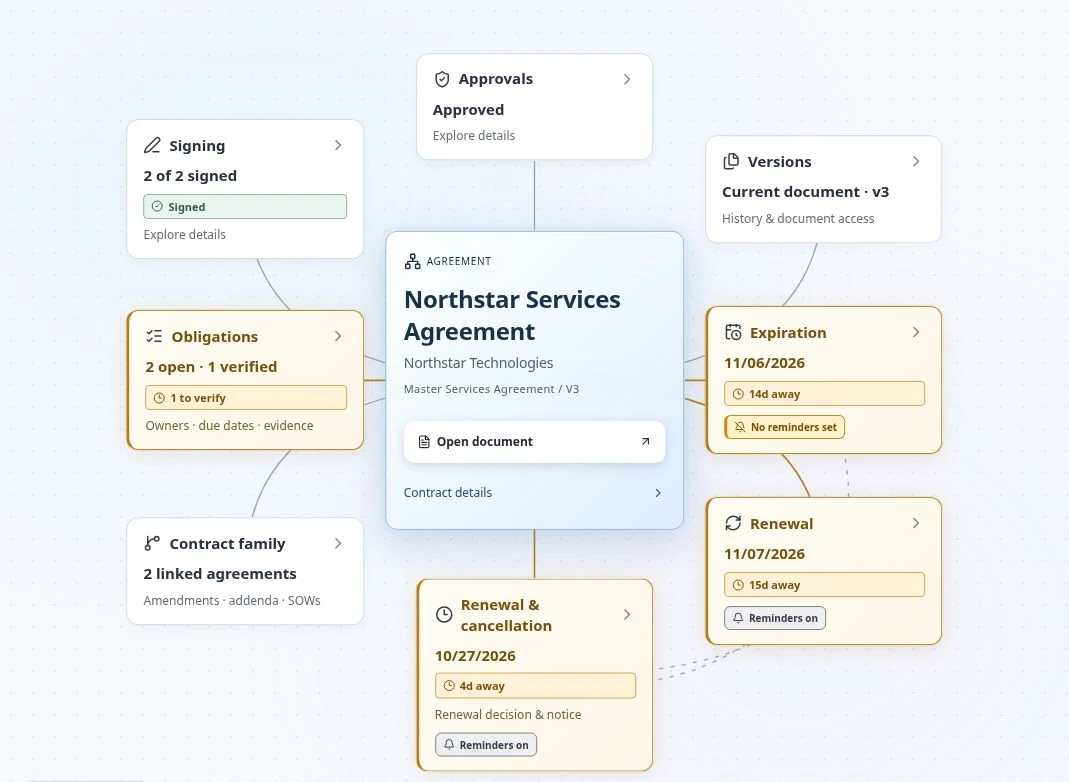 View full-size screenshot
Follow a draft through review, signing, and handoff
78 seconds. This visual tour uses real ContraxAware screens from several fictional training records. The draft, completed agreement, and renewal examples are different records.
Read the video transcript
- 0:00
The introduction identifies the screens as real and the agreements as fictional.
- 0:06
A Harborline SaaS example keeps proposed contract details beside the source wording for a reviewer to check.
- 0:15
A Northstar unsigned draft shows saved service-level and renewal comments beside the current clean version.
- 0:25
The approval setup connects the reviewer and request to a saved version. The demonstration request has not been submitted.
- 0:34
A separate completed training record shows the signed agreement, signing evidence, and completion certificate in its history.
- 0:44
A Harborline renewal example shows its notice calculation and timeline. Recording a decision does not deliver notice.
- 0:53
Two open Northstar obligations show a fixed reporting date and a commitment triggered by signing.
- 1:03
Contract Map connects the unsigned draft, approval and signature steps, obligations, and proposed dates.
- 1:12
The closing screen points readers to the full 99-problem guide.
Five-contract CLM vendor comparison scorecard
Score each point 0 or 1, then total the six rows out of 18. Use the same roles, files, tasks and scoring rules for every finalist.
Preview a completed worksheet row
- Document and live task
- 1. Supply agreement — find original notice period
- Point 1 — correct decision
- 1 if 90 calendar days is identified as the original requirement.
- Point 2 — supporting passage
- 1 if signed supply agreement §8 is opened.
- Point 3 — usable handoff
- 1 if operator marks the term as subject to the signed amendment.
- Target / 3
- 3
- Observed / 3
- 3
- Reviewer
- Procurement lead
- Evidence or retest
- Operator opened the master and identified the amendment before scheduling.
Frequently asked questions
Should a vendor see the packet beforehand?
Use the same preparation window for everyone. Then keep one fresh task for the live session so you can observe how your operator works without rehearsed clicks. Supply only material approved for each vendor to handle.
How do we use the results in a buying meeting?
Bring the original scorecard, the unresolved tasks and the person who performed the handoff. Ask each finalist to address its most expensive miss. A missing citation on a key deadline can matter more than a small difference in the total score.
What should we do when our department has no clean test data?
Build fictional records that preserve the difficult relationships. Keep names and prices invented. Have someone familiar with the work verify that all references resolve, the intended dates are calculable and the open question genuinely lacks evidence.
Can two vendors tie on the overall score?
Yes. Retest the highest-consequence task with a fresh but equivalent document. Compare time spent on corrections, who owned those corrections and whether the next user could complete the work. Keep commercial pricing in a separate column.