Key takeaways
- Twenty-nine accepted records do not resolve a material uncertainty about a scheduled deadline.
- The hold should identify affected contracts and nominate the person who reconciles their reminders.
- A release decision covers only the tested contract family, language, workflow and supervision.
What must the team verify before the pilot goes live?
Fictional Harbor Ridge pilots renewal extraction on thirty low-complexity software subscriptions in one department. Its legal operations lead proposes a four-week supervised release covering the same contract family. The proposal excludes leases, amendments with handwritten edits and non-English documents until separate testing. Procurement has a manual renewal tracker and can return to it if an operator spots a material issue.
The team agrees three checks before the pilot begins. Every proposed deadline must link to supporting language or go to an unresolved queue. No unverified date may become a live reminder. A second reviewer must be able to correct a date and confirm the downstream reminder. Twenty-nine records pass review. The thirtieth has a 45-day notice period in the signed amendment and a 90-day period in the original. The operator catches the discrepancy but cannot explain which reminder was actually scheduled.
Contain the unresolved reminder
Open the actual scheduled reminder and compare it with the verified term and notice rule in the signed amendment. Until the dates reconcile, the renewal owner uses the manual tracker for this agreement. Check every record processed through the same amendment path. If the team can establish a narrower unaffected group, document its boundary and the evidence for supervised release. If the failure cannot be isolated, hold the wider release.
Release, hold or retest each workflow separately
| Acceptance criterion | Observed evidence | Decision or next action |
|---|---|---|
| Release boundary | Thirty low-complexity software subscriptions in procurement. | Limit rollout to the stated contract family and team. |
| Material miss | Original says 90 days; signed amendment says 45. Scheduled date remains uncertain. | Hold the affected group and reconcile downstream reminders. |
| Restart evidence | Independent reviewer checks the corrected date and sees the resulting reminder. | Obtain owner acceptance and schedule a fresh sample review. |
Assign the first month’s controls
Assign one person to inspect unresolved records each workday and another to sample completed ones. Name the ops manager who can pause ingestion and the representative who will contact users if a date changes. Keep the watch list short enough to finish. Record how reviewers will discover a source document replaced during the pilot and how they will repair affected records.
Set a restart test and a decision date
Keep the original failed case, the corrected record and the reminder it produced. Ask a reviewer outside the setup team to repeat the test on a second amended agreement. The reviewer should verify the date, receiving owner and downstream alert. At the end of four weeks, the sponsor records one decision: expand to a named group, extend supervision, or return the workflow to the manual tracker.
Test the handoff beyond the AI answer
Open the agreement record and trace one verified field into the review or follow-up process. Have a second authorized person locate the source and current owner. Record the evidence alongside the pilot acceptance decision.
Use the acceptance criteria to compare contract management software across reviewers. Choose a real post-signature handoff and trace it through the contract management system before agreeing to rollout.
Trace the amended notice date in Contract Map, then ask the renewal owner to show the alert they will receive. That handoff tests whether the AI contract management software supports the contract lifecycle management process Procurement plans to release.
For background, see NIST AI Risk Management Framework Playbook · Manage.
For the full workflow, read how to plan the handoff from pilot to contract owners.
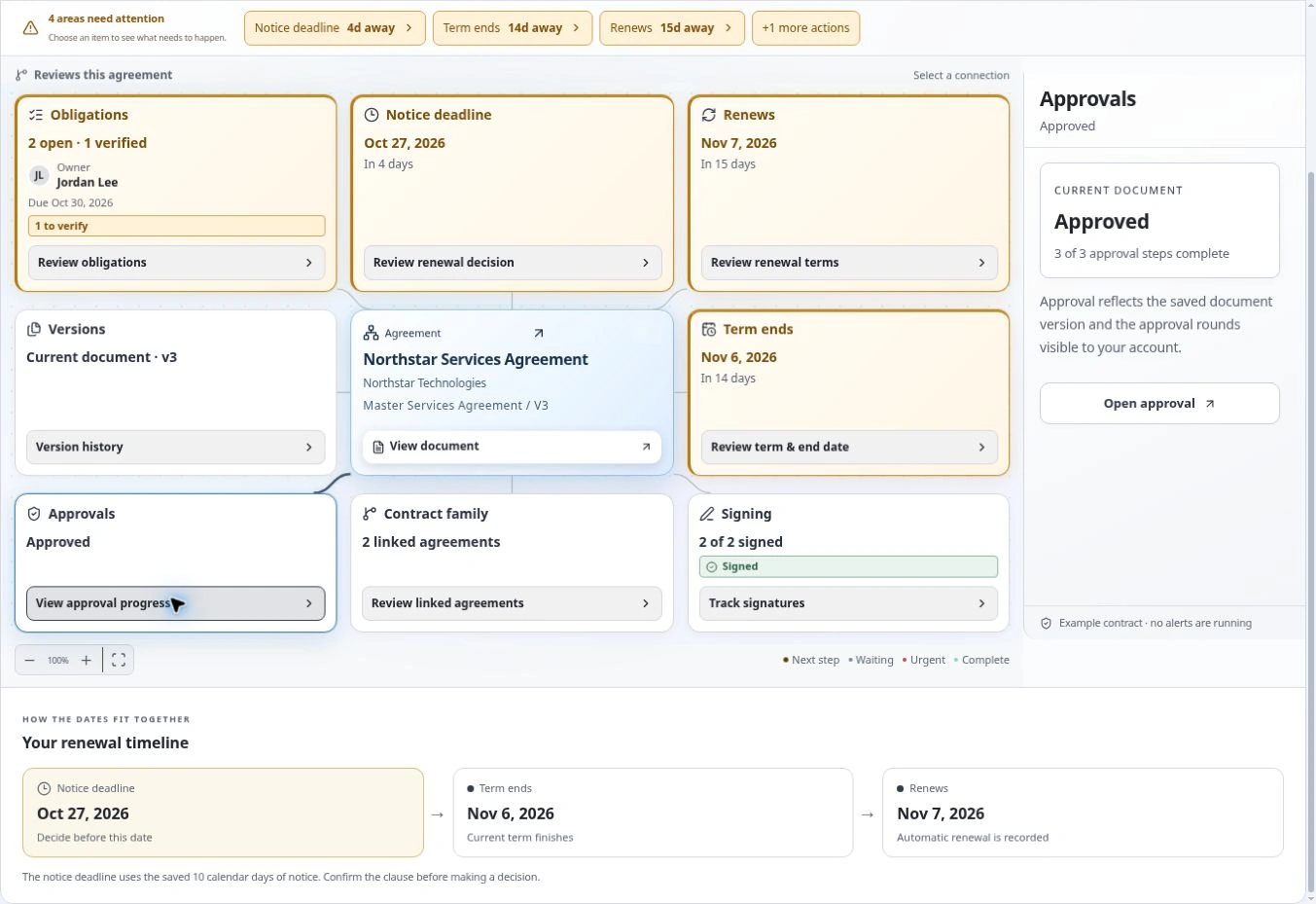 View full-size screenshot
AI contract operations release decision record
Set scope, evidence and owner before the pilot. Record each miss, the fallback, and a repeatable test that authorizes restart or expansion.
Preview a completed worksheet row
- Release check
- Verified dates
- Pilot boundary
- Thirty simple software subscriptions; procurement only.
- Expected evidence
- Verified source or unresolved status for each proposed renewal date.
- Observed evidence
- 29 handoffs accepted; one amendment changed the notice period.
- Disposition
- Retain evidence for the 29; isolate affected records.
- Owner
- Legal operations lead
- Restart or next review
- Sample accepted records before opening a second department.
Frequently asked questions
Does every AI use need the same acceptance thresholds?
Select thresholds based on the downstream consequences. A search aid that helps a reviewer locate text warrants different controls from a date field that schedules a contractual notice task. Document the choice.
Who records the final decision?
Have the accountable business owner record scope, date, unresolved risks, assigned mitigations and the next review. Keep a copy alongside the evaluated configurations and examples so a later owner can explain precisely what the pilot established.
Should we switch off the old tracker when the pilot starts?
Keep one clearly designated source for operational decisions in each phase. During parallel testing, assign reconciliation to an owner and tell users exactly where to act so duplicate reminders do not trigger duplicate notices.
What if a new software version arrives during the pilot?
Record when the change occurred and which workflows it affects. Retest the relevant difficult cases before treating results from the two configurations as interchangeable. Give the release owner the evidence and any new unresolved items.