 ContraxAware
Core chapter 14 of 18
Change Management and Team Adoption
Launch a process that people can understand, use and improve.
Executive summary
- Watch somebody do the work. A colleague can finish a demonstration and still email the next contract to Legal because they cannot find the right starting point.
- Teach the first useful task for each role. Give the learner a realistic decision, a practice agreement, and clear evidence that they handed the work to the right person.
- Use transactions as the denominator. Count eligible requests across every channel. Counting sign-ins cannot tell you where the agreements actually went.
- Make one change and check its effect. Record the obstacle, its owner, the intended outcome, and what you saw when a different learner tried the revised process.
Part A · The Why
Diagnose the actual adoption problem
Stakeholder needs and current workarounds
When a department says it needs contract management training, ask to see the last agreement that caused trouble. Have the requestor show how they found the document and whom they contacted. Then have the receiving manager show what arrived. A requestor may call an email a successful handoff while the manager spends the afternoon finding the right attachment.
Draw the route the agreement really took. Include the shared mailbox, the colleague who quietly fixes supplier names, and the analyst who checks the renewal date in a spreadsheet. Identify which steps protect something valuable. If the analyst’s private spreadsheet is the only place anyone records notice delivery, retiring it before assigning that job elsewhere would remove a working control.
Ask what would make the new route worth using tomorrow. A plant manager may want a visible owner for an urgent repair agreement. Legal may want the counterparty draft and a business contact. An executive sponsor may care whether a decision will reach them before a deadline. Give each role an exercise that answers its question.
Incentives, trust and perceived administrative burden
A workaround can be rational. A buyer who emails a known colleague gets an immediate human acknowledgment. If submitting through a portal leaves the buyer wondering whether anybody saw it, telling people to comply adds little. Give the receiving team a response practice it can keep. Let the first group see what happens to an actual request before expecting the wider organization to change its habits.
An extra required field may have a cost that no manager sees. Suppose a site supervisor must call Finance to find a cost code before asking for preliminary review. The supervisor now has two tasks and may carry the agreement directly to a familiar buyer. Decide whether Finance needs that code at submission or after identifying the purchase. Moving one question can accomplish more than another training meeting.
Explain how pilot observations will be used. Capture which question failed or which handoff stalled. Avoid publishing a league table of struggling individuals. People disclose useful workarounds when the facilitator can fix the process and the sponsor treats honest reports as evidence.
Sponsor, champions and local process owners
Assign three jobs explicitly. A sponsor can resolve competing priorities across departments. A local process owner can change the rules, service expectations and responsibilities for their team. A champion can sit beside a colleague for five minutes, observe a problem, and bring it back. A popular volunteer cannot change the purchasing authority matrix just because everyone asks them for help.
Write a one-page agreement for the pilot. Identify the eligible transactions, participating team, usual channel, backup for absences, decision deadline, and the conditions for continuing or pausing expansion. Give each unresolved issue a named decision maker. When the champion is away, somebody else should still know who can correct a permission, approve revised wording, or explain the receiving team’s response target.
Teach by role and moment of need
Short task-based lessons and realistic practice
Build a lesson around a question a colleague expects on the job. “Get this supplier draft to the right reviewer and show me how you will follow up” is a task. “Look through all the menu items” is a tour. A good exercise has a starting state, an intended action, a checkable result and an exception that forces a small judgment.
Use different entry points for different people. A requestor practices describing a need and recognizing a successful handoff. A manager verifies the source and assigns the next owner. A department approver practices finding the version under review and recognizing a decision beyond their authority. A post-award owner identifies due evidence and follows up. The learner can return to a short reference at the moment that task first becomes real.
Accessible instructions, captions and reference aids
Write directions someone can follow with the sound turned off or the screenshot enlarged. Put the action before its explanation. Match the wording on the actual screen. When a choice changes a sensitive setting or sends something externally, explain the decision and give a practice alternative. A learner should be able to read the directions without guessing what the demonstrator happened to click.
Crop or enlarge a reference image only when the remaining context still shows where the learner is. Supply descriptive text and the values the learner is meant to verify. For video, provide accurate captions and a short transcript with the steps in order. For keyboard users, allow time to navigate and use their ordinary setup. Ask colleagues what accommodations they need before scheduling the session.
Test the material by giving it to someone who missed the original meeting. Can they identify the starting agreement, find the important value and describe what happens next? Correct the instructions if they work only while the original trainer is present.
Support, feedback and learning without blame
Give the team one dependable place to ask for help and identify when it is monitored. Ask for the task, expected outcome, actual outcome and approximate time. In production, a record reference is usually enough for authorized support staff to locate the issue. Steer colleagues away from copying confidential terms or personal information into a broad support channel.
Separate urgent assistance from later improvement. If a renewal decision is due that afternoon, assign the owner a way to complete the real task. Then examine why the person became stuck. Record the temporary workaround, its limits, and who can retire it. Without that last step, the workaround becomes a second permanent process with a different record of the truth.
Measure sustained use and outcomes
Activation versus meaningful task completion
Define a transaction and its finish line. For an intake pilot, count a request when it has the correct source, business owner and receiving queue or person. Getting access or logging in is a prerequisite. Passing that finish line is evidence someone accomplished useful work. Write down which canceled requests, duplicates and out-of-scope agreement types you will exclude and why.
For channel use, count every eligible distinct request in the same period, including email and other routes. If 24 of 40 came through the portal, its share was 60%. A request submitted in the portal and copied to the buyer by email is one transaction. Give it a consistent primary channel and separately record that an additional message was needed. This preserves the evidence of friction without double counting demand. Measuring digital take-up
Time to competency, errors and exception volume
Choose a definition of independent success before observing anyone. For the practice submission, the learner must deliver the right unsigned draft to the assigned reviewer and identify how to follow up, within the session and without a facilitator supplying the next step. Record assisted completion separately. Someone who asked a necessary policy question can still demonstrate competent use if that question is exactly what the process calls for.
Measure at least one quality outcome with time. A four-minute submission pointing to the wrong legal entity is an error. Record its consequence and whether the system, the requestor, or the next reviewer caught it. Separate normal exceptions such as a supplier’s amended terms from avoidable errors such as a mislabeled field. An increase in logged exceptions can mean colleagues are finally finding the problems that used to disappear into email.
Define time to competency as the interval from a specific learning start to a demonstrated task standard. A learner passing one guided exercise establishes a different fact from the same person completing two later requests on their own. Choose the observation that fits the risk and label it honestly.
Baselines, segmentation and continuous improvement
Take a short baseline before changing the process. Compare like work, access, roles and channels in the next period. A month with a large acquisition may fill the queue with complicated agreements and make average cycle time look worse. Segment it by agreement type or treat it as a known difference. Preserve the underlying counts alongside percentages, especially when a team handles few contracts.
Check how the result looks to people who did not finish. If four slow participants abandon a test, the median time among the remaining finishers can fall even though the service got worse. Pair successful-task time with the fraction who completed and a count of abandoned tasks. Small pilots help locate problems. They cannot establish company-wide performance or prove that a single change caused an observed difference.
A fictional case about a busy portal and an empty queue
Bellhaven Components rolled out a new intake process to one purchasing team. The manager saw that every buyer had signed in. The corporate inbox still collected supplier contracts. During a single four-week period the team reconciled 40 eligible distinct requests with the receiving queue. Of those, 24 began in the portal and 16 arrived another way. Several portal users also emailed the buyer because they could not tell who owned the next action.
The team clarified the handoff message and the receiving manager’s responsibilities. In a later four-week period with a similar mix, 32 of 40 requests began in the portal, or 80%. Portal use increased by 20 percentage points. To investigate why, the owner observed practice tasks and asked why people returned to email.
In the first practice group, four of eight people finished independently. Their times were 8, 10, 12 and 14 minutes, with a median of 11. In the later group, six of eight finished independently in 4, 6, 7, 7, 8 and 10 minutes, with a median of 7. Report both the excluded attempts and the different people in the two groups. These figures are a worked example for an administrator designing a measure.
Did the pilot change how work got done?
Bellhaven’s fictional before-and-after observations use two four-week periods and two groups of eight practice users.
- 60% to 80%Eligible requests via portal
24 of 40 distinct requests used the portal in the first period. The second period had 32 of 40.
- 4 of 8 to 6 of 8Independent task success
A learner finished when the right draft reached the responsible reviewer without prompting.
- 11 min to 7 minMedian successful task time
Timing covers independent finishers. Four attempts fell outside the first median and two outside the second.
The groups were small and had different participants. Report the counts with the times and investigate where the remaining requests went.
Part B · The How
During a pilot, watch someone outside the implementation team use the contract management software to answer a real question. Can they identify the owner of an expiring agreement and explain what that person needs to do next?
Run a focused ContraxAware pilot
Choose one team and representative agreement types
Choose a team with an actual recurring decision and a manager willing to own the receiving work. For a purchasing pilot, include one incoming supplier draft and one company-template request. Add a renewal lookup if one of the team’s main frustrations is finding a deadline. Keep each case small enough that the observer can check the output against an agreed answer. ContraxAware implementation guidance
Give learners practice accounts or approved training access appropriate to each role. Prepare fictional agreements and keep external recipients out of exercises that only need an internal observation. Identify which steps could send messages, request signatures, or issue notices. For those steps use an authorized test destination or stop at the prepared state and record what a live decision would require.
Configure a minimum useful process
Identify the agreement type, source document, responsible business owner, receiving manager and next action. Use the suitable ContraxAware intake form or draft review for the task. Include the information the receiving person actually uses. For the Northstar managed services draft, a supplier name, customer name, draft status and a source for the proposed commercial facts are a useful start.
Write down the expected result before the pilot begins. For example, the receiving colleague can identify Northstar Technologies as supplier and Casey Brooks as business owner from the fictional source, distinguish the unsigned draft from a signed copy, and name the person who will investigate an unresolved question. If the receiving person has to look in private email for any of those answers, inspect the form or the handoff.
Observe a new requestor and a daily contract manager
Seat the requestor and receiving manager separately or let them work in sequence with their own access. Give the first learner the goal and record which labels cause hesitation. After submission, ask the manager to locate the item and explain what they can do next using only the information that arrived.
An administrator has special knowledge and often special permissions. If the requestor fails, check whether the intended role can actually see the type or source that the administrator used during setup. If the manager fails, look for a missing receiving owner or an ambiguous title. Give one hint only after recording where assistance became necessary. Then let them finish.
Provide role-based onboarding
Practice request, review, approval and post-award tasks
Set up four short assignments. For intake, a colleague submits a fictional supplier draft and identifies where to follow it. For review, a manager verifies a proposed supplier name and one figure against the source. For approval, an approver identifies the saved draft and their decision authority. For post-award, an owner distinguishes a renewal notice cutoff from term expiration and identifies the responsibility that follows.
Make the role handoff the finish line in at least one session. A manager should be able to tell the business owner, “I have your supplier wording. I need the project contact to confirm system access. I will check back tomorrow.” Ask the recipient to restate what they will provide and where the result belongs. Give credit for a clear documented next action even when an honest open question prevents further progress.
Use screenshots from the exact training dataset
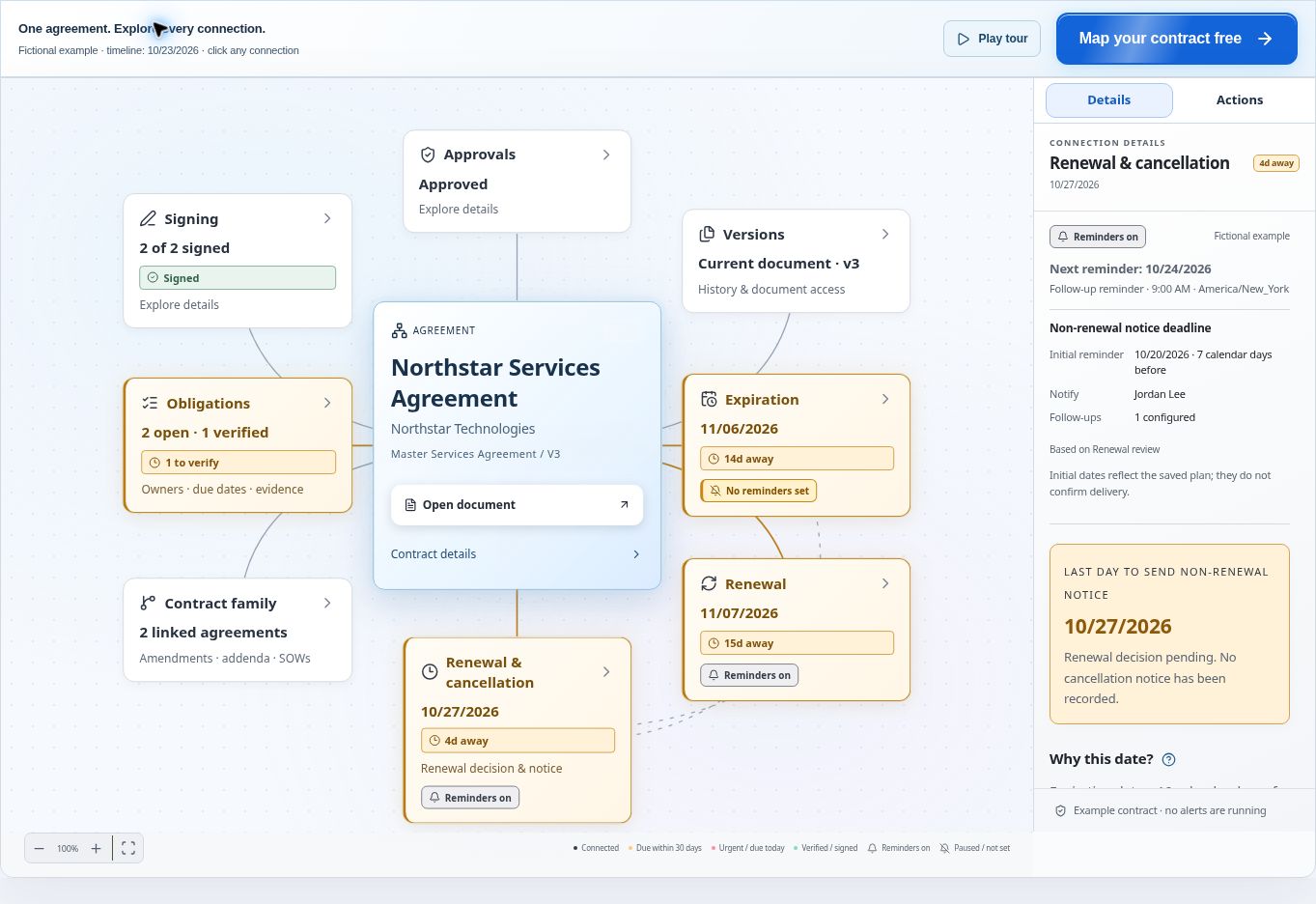
Use the Northstar map capture for a read-only exercise about a configured reminder. It is a separate historical, fictional post-award example. The displayed timeline is October 23, 2026. Its signing tile and version belong to that example. Teach the unsigned draft with the corresponding draft image in the earlier chapters.
- Locate Renewal & cancellation on the map. It is already selected in this capture. Read its date, October 27, 2026.
- In Details, find Non-renewal notice deadline. Under Notify, identify Jordan Lee. Under Initial reminder, read October 20, seven calendar days before the cutoff.
- Read Next reminder and compare its October 24 date with Expiration, November 6. Ask the learner what evidence would establish that a notice actually reached the other party.
Why this matters. The example shows a saved reminder setup. An employee may recognize every date and still mistake a scheduled alert for evidence of delivery. Have the learner name the governing wording and the delivery record they would need before marking the real-world action complete.
Offer optional checks with explanations and unlimited retries
After a role task, give the learner a new decision using the same concept. For the map exercise, ask whether an initial reminder date is enough to close the nonrenewal work. An effective explanation identifies the type of evidence the team would still need. Let the learner revisit the source and try again.
Keep optional knowledge checks available to learners who want practice. A colleague who can perform the task may prefer to move along and return later. If the organization eventually offers formal certification, define the assessment, passing standard, permitted help and evidence separately. The ability to complete a short practice question establishes a narrower claim than readiness to administer the entire contract portfolio.
Refine the rollout
Collect friction reports and prioritize causes
Group reports by where the work stopped. “I can’t submit” may mean an unknown required value, a form that requires a document the requester never received, a role problem, or an unavailable service. Record one reproducible example and look for others with the same cause. The most popular proposed feature is sometimes a workaround for a label the team can fix today.
Rank issues first by possible consequence, then by how often they occur and how much effort they cost. A confusing signer role that could send the wrong person a document deserves attention even if it appears once. A spelling mistake in help text might be easy enough to correct immediately. Assign an owner, due date and retest for the selected change. The retest turns reported pain into an observable improvement.
Update forms, help text and ownership
Change one important part of the experience at a time when practical. If the source of confusion is “business owner,” try “Who here will decide whether the supplier delivered what we bought?” Keep the receiving definition stable so the answer reaches the same place. Test with a fresh colleague while the data and task remain comparable.
Give the receiving team the same change explanation. If they still ask whether “owner” means the signer, they may overwrite the right answer after submission. Review current open work for any entries affected by the original ambiguity. Update the short role aid and retire the stale copy. A revised screen alongside an unchanged training handout can generate a second wave of support questions.
Publish an operational handover and review outcomes
The handover belongs to the team that will operate the process. Give them the purpose, eligible types, receiving owner and backup, the support route, the most common exception, the current learning material and the measure they will review. Include the last known-good practice example so the next administrator can check a later change.
Agree when the sponsor will revisit the evidence. Read out the numerator and denominator for channel use and the result of the independent task. Discuss which obstacles remain and whether the next team has different constraints. Continue with a comparable team when the current process can be supported in ordinary working hours. Retain access to a suitable assistance route for staff who need help completing a task.
Practice a twenty-minute observation
Allow two minutes to explain the exercise and what notes you will keep, eight for the learner’s primary task, four for a handoff or evidence check, and six to discuss what felt unclear. Prepare the source and expected outcome beforehand. Ask the learner to show what they would do next. Note the first hesitation, any wrong turn and whether they finished independently. The GOV.UK service manual provides a longer guide to moderated usability testing.
Propose three changes from what you actually observed. One might correct a field label, one might give a receiving owner a follow-up time, and one might remove a duplicate request for information. For the advanced trial, reconcile a week of eligible requests against email and the workspace. Count unique transactions, identify who initiated each channel, and trace a handoff. High login volume with low portal use now leads to a testable question about where the work left the process.
John's Builder Note
I like to hand a new user a real task and sit quietly. The moment they turn toward me for a translation is the moment I want to understand. Sometimes I need to change a label. Sometimes the business itself has never agreed who owns the next decision. Adding a button will leave that second problem exactly where it was.
Questions from the field
How many people do I need before I can fix an obvious problem?
One repeatable observation can justify a small reversible correction, especially when an access or wording error is plain. Verify it with another person. Estimating how common the problem is across the company requires a broader, representative sample.
Should an emailed request count as a failure?
First determine whether the request was eligible for the new route and whether the approved process permits assistance or an exception. Count the channel consistently. Investigate why a person chose it before you classify the underlying cause.
Optional knowledge check
Choose your answer, then open the explanation.
Show answer
Successful completion of a meaningful task with acceptable errors. Adoption should connect to work and outcomes. Activity alone can coexist with ineffective processes.
Show answer
To identify actual hesitation and workarounds. Observation reveals concrete obstacles that broad satisfaction questions may miss.
Show answer
No; use feedback and retries to support learning. For this guide, optional checks are learning aids. Formal certification, if introduced, is a separate clearly described assessment.