 ContraxAware
Core chapter 15 of 18
Your 30–60–90 Day Contract Manager Action Plan
Build a sequenced action plan with owners, evidence and realistic dependencies.
Executive summary
- Start with the next irreversible decision. Find the agreements whose notice, pricing or service commitments need attention before you finish organizing the portfolio.
- Prove a small operating routine. Choose a representative pilot, name the people who will do the work and ask someone else to reproduce the result from your evidence.
- Measure the same population twice. Count verified owners, deadlines and completed actions against a defined starting group. Keep exceptions and exclusions visible.
- Give the operation a home. By day 90, someone should run the weekly review, somebody else should cover an absence, and a sponsor should know when a decision comes to them.
Part A · The Why
First 30 days — discover and stabilize
Inventory critical agreements, people and immediate deadlines
Imagine taking the job on a Monday. The CFO wants a supplier list by Friday. An operations manager mentions that a service might renew “sometime next month.” Start with the manager. You can improve the supplier list on Monday. The date for serving nonrenewal notice might pass on Thursday.
Ask Finance for active suppliers and recent recurring payments. Ask Legal where signed documents and amendments live. Ask department leads which agreements would put a delivery, patient service, manufacturing line or customer commitment at risk if interrupted. The answers describe different parts of the portfolio. Keep the source and the date you obtained each list.
Build your first queue around decisions. Give each entry an agreement, action, latest safe decision date, named owner and source. An unknown deadline on a critical service deserves a person and a near-term investigation date. A blank calendar cell gives the team nothing to do.
Assess permissions, ownership and data quality
Pick ten records across at least two departments. Ask a business owner to open their agreement and ask an authorized reviewer to find its governing amendment. Give both people permission to speak freely about the workaround they normally use. A folder that opens for the administrator may be inaccessible to the person who has to act.
Test ownership by asking the person what decision they own. A name copied from an old purchasing form might belong to the original requester, a former employee or someone authorized to order supplies but unable to authorize a renewal. Record the person who accepts the task and the role that should inherit it when they leave.
Give every sampled field a source or a reason it remains uncertain. Inspect party, document status, governing version, notice requirement and accountable owner. Correct easy errors immediately. Put ambiguous terms through the organization's authorized review process. A confident guess costs more to unwind after a reminder goes out.
Establish a baseline and an urgent-risk register
Define a measurement before anyone hears a target. For ownership coverage, count in-scope records with an active employee who has accepted responsibility, divided by all in-scope records in the starting cohort. Record the identifiers, measurement date and evidence rule. This lets a colleague repeat the count when staff or software change.
Keep urgent issues in a small register. Each entry needs a cause, exposed decision, latest action date, interim safeguard, owner and next check. “Renewals are risky” is difficult to assign. “Operations must identify the signed amendment governing the refrigeration agreement before Thursday’s notice review” gives a person and an outcome.
Keep commercial decisions with people who have authority. An administrator can locate the notice clause, confirm the delivery address and arrange time with the owner. Authority to end a service or commit another year's spend comes from the company's delegation rules. Record who decided and what they authorized.
Days 31–60 — pilot and prove
Migrate a representative portfolio and validate key data
A convenient sample usually contains yesterday’s neatest files. Build a pilot that includes an amendment, an unsigned draft, a scan with weak text, a cancelled agreement still receiving invoices, and a contract whose counterparty has changed its name. Include one ordinary, well-kept agreement to establish the straightforward path.
Write a short acceptance test before import. Count the source files, distinguish documents from agreements, preserve the originals and check a sample against signed evidence. A master agreement and two schedules can be one relationship with three source documents. Reconcile each document to a destination or a specific open exception.
Set aside a few cases the person configuring the pilot has never seen. Have a colleague look them up from a business question, such as “Which document authorized the new fee?” Their search terms may reveal an identifier or naming convention your clean-up team overlooked. Add the missing cue where it will help the next reader.
Test intake, approval, signing and post-award controls
Run a complete exercise in a training space using fictional people or approved test accounts. Begin with an incomplete request. Have the requester supply the missing business fact, an approver decide on a specific version, and a designated test signer complete the permitted practice route. End with a person assigned to monitor a post-award commitment.
Write the expected artifact next to every handoff. An approval has a decision maker, outcome and version. A completed signing exercise has the resulting practice document and its evidence. A certificate-of-insurance task has an owner, due date, requested evidence and the reviewer who checks it. Merely reaching the next screen settles none of those questions.
Repeat one step with a deliberate exception. Let a test approver return the draft for a corrected amount. Ask whether the original decision, correction and later review remain distinguishable. An administrator who can explain the exception can help the business recover when an actual deal takes the same turn.
Train a pilot team and correct observed friction
Give each participant one job they recognize. The requester describes a purchase, the approver confirms its cost center and the administrator finds the evidence. Hand over the keyboard. Watch where the person pauses, chooses an unsuitable value or asks what a term means.
Distinguish a learning issue from a design issue. If one new user overlooks an unfamiliar control, a short instruction may help. If four people stop at the same required question because they do not know the answer at intake, change the timing or find a better source for the field.
Repeat the exercise after the change with a colleague who has not seen the proposed solution. Record elapsed time, whether the result was correct and how much assistance was needed. A faster task that leaves the wrong owner on the record is an unsuccessful trial.
Days 61–90 — operate and improve
Roll out proven routines and ownership
Expand one manageable group at a time. Give the department lead the entry criteria, training materials and named backup from the pilot. Ask that lead to explain where work arrives, who checks it and where unresolved issues go. A sentence they can repeat without you is a good test of the handover.
Make a coverage plan for absences. Name the backup for reviewing notices, the person authorized to assign a temporary owner and the channel for urgent decisions. Confirm that the backup can retrieve the source under their own account. Someone else's password is never a workable continuity plan.
Review performance, renewals, COIs and exceptions
Start the weekly meeting with work that could become impossible to recover. Sort by the date the business can still do something, including time for internal review and delivery. For an insurance certificate, distinguish when evidence must arrive, the period it covers and whether the appropriate reviewer has accepted it.
Investigate a quiet queue. A report can show zero overdue certificates because every obligation was satisfied, because due dates were never entered or because your filter hides unassigned items. Pick a known obligation and trace it forward. Then pick an upcoming report entry and trace it back to the source.
Show counts alongside percentages. Four overdue evidence requests in a group of five tell a different story from four in a group of four hundred. Keep urgent individual exceptions in view even when broad coverage improves.
Set governance cadence and a prioritized improvement backlog
Give the weekly operations review, monthly management review and quarterly policy review different decisions. Weekly participants assign current work. Monthly participants remove persistent bottlenecks and allocate capacity. A quarterly policy group decides which rules, roles or approval thresholds need formal change. Cancel duplicative meetings when the same people make the same decision twice.
Give each improvement a problem, an example, an owner and a test. Rank it by the consequence of delay, the number of people affected and the work needed to fix it. “Make the system easier” gives a sponsor little to authorize. “Remove a duplicate address request and repeat five intake trials” can be estimated and tested.
The UK government publishes a contract management playbook and professional standards. The standards give public-sector examples of technical and relationship skills. A private employer can use them to start a development conversation and select the responsibilities appropriate to its own business.
A fictional case from a regional manufacturer
Beacon Fabrication has 430 employees and a new contracts administrator, Mina. She chooses forty active supplier agreements from two plants. On day one, twenty-two have an owner who acknowledges the role. Finance wants the entire drive migrated. The plant manager also reports a coolant-service renewal due for decision in seven days.
Mina asks Procurement to find the signed coolant agreement and amendments that morning. The contract owner checks the notice terms with Legal and verifies that a replacement service can be available on time. The authorized manager makes the decision, and Procurement retains the required delivery evidence. Mina gives Finance a pilot migration date and records why the urgent review took precedence.
By day ninety, thirty-six of the same forty agreements have verified owners. Coverage moved from 55 percent to 90 percent, a gain of 35 percentage points. Four remain open with named remediation owners. Fourteen other agreements discovered during the rollout go in a separate incoming cohort. Including those discoveries only in the second denominator would make it impossible to see what happened to the original forty.
Part B · The How
Create the working plan with ContraxAware evidence
Use portfolio views to identify current priorities
- Name the review population. Start with one department, one defined agreement group and a date. Record the selection rule so a second administrator can retrieve the same group.
- Trace one item to the document. In the Northstar training capture, read the opening line in Original document. Under About this agreement, Where is it in the process? shows Draft — needs review. Put it in the draft exercise group.
- Find the decision behind the date. Section 2 of the sample gives October 27, 2026 as the notice receipt cutoff and November 6 as the end of the current term. Use the sample to rehearse distinguishing the dates. Record genuine upcoming work from your own verified portfolio.
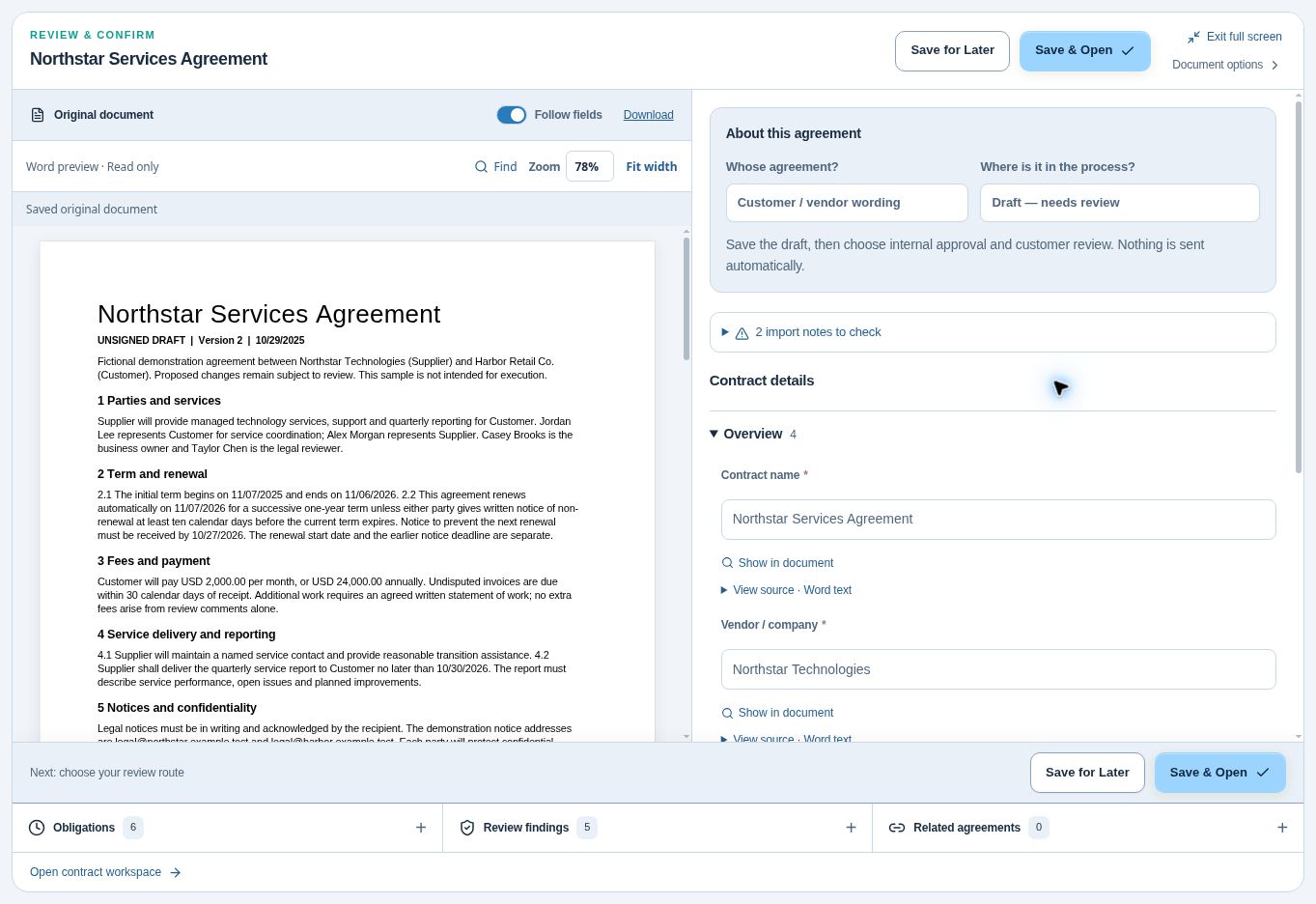
A list of contracts due to expire is a starting point. An agreement can need a notice decision before its expiration date appears in your current review window. Check the contract renewal tracking workflow and test a known date against the selection you use.
Assign contract and obligation owners
Begin with the business owner who can direct the service relationship. Assign each obligation separately to the role that can produce or obtain the evidence. For an insurance renewal, an operational administrator might obtain the certificate, an insurance specialist might check it and a department manager might resolve a supplier delay. Write down the handoff between them.
Use one test item to prove that everyone understands the assignment. Ask the person receiving it to locate the source, state what evidence is required and explain whom they would contact when it is missing. An assigned name on a screen is only the start. Their ability to act completes the handoff.
Use contract obligation tracking to plan what evidence belongs against the work. The Northstar draft contains a proposed change to an insurance limit. Ask the reviewer to distinguish a proposed limit from an agreed requirement before using any certificate to close an obligation.
Track project milestones in an approved planning tool
Keep the rollout plan where the project team already manages dependencies. Give each deliverable a durable identifier and reference the corresponding ContraxAware record within the team's access rules. The plan describes organizational work such as obtaining a policy decision or scheduling training. The contract record carries the evidence about the agreement.
A colleague should be able to answer two questions from a task. What will be different when it finishes? Who can accept that outcome? For a renewal pilot, the answer could be a business owner independently finding a checked notice deadline and naming the authorized decision maker. “Configure reminders” alone gives the colleague no way to judge completion.
Run weekly operating reviews
Check upcoming decisions, approvals and overdue evidence
Prepare three short queues before the meeting. The first covers decisions approaching their internal action dates. The second contains requests waiting for a specific approval. The third covers evidence due or overdue, including COIs and service reports. Pick one record from each queue and check its current document and owner.
Ask the reviewer for the earliest useful intervention. If a service report is due on Friday, a reminder on Friday night offers no help to the manager who needs to obtain it. If a backup approver is needed, check that the delegation permits substitution before changing the route. A queue is valuable when it gives somebody time to act.
Update the risk and issue register
When an uncertain event might affect a decision, describe the risk. Once something has happened, describe the issue and the recovery task. A missing delivery confirmation after notice was due is an issue. The possibility that a future notice will arrive late is a risk. Each calls for a different next action.
For an open COI issue, record what was requested, what arrived and what still needs a qualified review. Give a date for the next supplier follow-up and a trigger for escalation. Respect access limits when referencing attachments. A broadly shared task list can carry a controlled record reference without duplicating a confidential document.
Document decisions and follow-up owners
Write decisions while the participants are present. Include the agreement, decision, authority, evidence considered, person responsible for follow-up and next date. Read back ambiguous wording. “Proceed” can mean issue a purchase order, start negotiation or request a signature. Use the verb that authorizes the actual next action.
Close a task when its acceptance evidence exists. Receiving a supplier email may finish the follow-up task while leaving a coverage review open. Separating those two items gives credit for work completed and prevents the unresolved insurance question from disappearing.
Demonstrate readiness at day 90
Present verified records and completed practice workflows
Ask a colleague to select three records from the pilot. Let the ordinary user retrieve the governing document, show the next action and explain the owner. Include one exception. Everyone should see what a usable record looks like when some information remains unknown.
Show an approval and a signing exercise separately, each with its own practice evidence. Show one post-award task from requirement through independent verification. Training artifacts prove that the team rehearsed the process. Keep them clearly identifiable so they never appear as completed transactions in an operational report.
Compare outcomes against the baseline
Recalculate the original metrics on the same population. List the starting numerator, ending numerator and denominator. For cycle times, define the start, stop and treatment of pending work. A quick set of completed requests can conceal several old cases still sitting open. Report the age of the oldest open request alongside completed-case timing.
Invite the sponsor to inspect one record behind a favorable number. If ownership coverage improved, let them ask an owner about their next decision. If missing COIs fell, retrieve one accepted item and its review evidence. The inspection turns a dashboard number into a claim somebody else can check.
Agree the next improvement and escalation cadence
End the review with a decision. Confirm the weekly chair and backup, the date of the next management review and which exception goes to whom. Pick one improvement for the next month, define the test and identify what the team will stop doing to make room.
Practice building a ten-deliverable plan
Use these ten deliverables for a fictional pilot. Adapt days to capacity and identify the person who accepts each result. Keep the evidence alongside the item so the plan survives a change in personnel.
- Day 3, sponsor. After naming the pilot department, approve its scope and decision authority in writing.
- Day 7, procurement lead. Using the first supplier list, verify the next urgent notice and record the authorized decision or interim action.
- Day 14, administrator. After source access is granted, reconcile the pilot inventory and list every missing document.
- Day 21, department lead. Using that inventory, name contract owners and backups. Retain acknowledgments.
- Day 30, analyst. Freeze the cohort and baseline ownership, deadline verification and overdue evidence counts.
- Day 42, migration lead. After agreeing on field definitions, reconcile the imported pilot documents to their sources.
- Day 52, business owner. Using approved test identities, complete one returned approval and one separate signing exercise.
- Day 60, insurance reviewer. Using a defined requirement, inspect one fictional COI and record acceptance or a reason for follow-up.
- Day 75, department backup. After training, run the weekly review under your own account and assign each exception.
- Day 90, sponsor. Compare the frozen cohort, inspect a sample, accept the operating owners and fund one next improvement.
Prove the handoff at each milestone
Beacon Fabrication follows the same forty agreements through its fictional 90-day pilot.
- Day 30 · 22 of 40Discover and stabilize
Freeze the cohort. Twenty-two owners have accepted responsibility. Give each urgent deadline a decision maker.
- Day 60 · Test handoffsPilot and prove
Reconcile documents, rehearse a returned approval and demonstrate how an insurance evidence exception reaches its reviewer.
- Day 90 · 36 of 40Transfer the routine
A backup runs the review. Thirty-six records have verified owners. The remaining four have named remediation owners.
Verified ownership rose from 55% to 90%, a gain of 35 percentage points. Later discoveries stay in a separate cohort.
For the advanced challenge, the sponsor asks for a thousand-file migration while an important renewal decision falls next week. First verify the governing notice language, assign an authorized decision maker and schedule the next check early enough for delivery. Preserve the source inventory and schedule a small migration pilot once the immediate exposure has an owner. A passing plan shows who can act today, what evidence will establish completion, and the date when the deferred work returns.
John's Builder Note
My first question on a project is simple. If I come back on Friday, what will someone be able to do that they cannot do today? “Find our next notice, show me the clause and name the person deciding” is an answer worth building around. The software can earn its next field after that.
Questions from the field
What if I inherit an urgent issue halfway through the plan?
Reorder the work. Document the exposure, authority and interim control, then tell the sponsor which planned task moved and when it will resume. The day numbers are a management aid.
What if the department refuses to name a contract owner?
Give the sponsor the decision that lacks an owner and the date it is needed. Request a named interim owner with authority to route the decision. Keep the record in the unassigned count until somebody accepts ongoing responsibility.
Optional knowledge check
Choose your answer, then open the explanation.
Show answer
Address the immediate risk with an owner and interim control. A roadmap should accommodate urgent risk. A controlled temporary process can protect the decision while implementation continues.
Show answer
An owner, due date and acceptance evidence. Clear responsibility and observable completion criteria let the team evaluate progress honestly.
Show answer
Review outcomes and agree the next operating cadence. Contract management is ongoing. The first 90 days should establish sustainable routines and a prioritized improvement cycle.