 ContraxAware
Core chapter 16 of 18
The Buyer’s Guide to Contract Management Software
Choose software using your requirements, repeatable evidence and three- and five-year ownership costs.
Executive summary
- Buy for a specific job. Turn requests for “better contract management” into tasks an ordinary employee can complete, with a starting document and an observable finish.
- Agree on dealbreakers before the demo. Keep security, export and other genuine approval conditions separate from a weighted fit score. Unknowns deserve another test.
- Use the same evidence for every vendor. Give each finalist the same tasks, roles, sample data, clock and time to answer. Preserve individual reviewers’ judgments.
- Price the full operating choice. Compare written quotes over three and five years, including implementation effort, integrations, usage and exit. Name the person responsible for each unresolved cost.
Part A · The Why
Choose the right category before the vendor
Lightweight repositories, mid-market CLM and enterprise suites
Start with a contract that caused trouble. Did somebody miss a notice date because the signed copy lived in email? Did an approval sit in three inboxes while everyone assumed somebody else owned it? The first problem calls for reliable retrieval and dates. The second calls for an accountable handoff and evidence of the decision.
A lightweight repository can be a sensible fit for a small team that receives signed agreements, needs reminders and has little drafting volume. A mid-market contract lifecycle management system may suit a team that also handles intake, review, approvals, signatures and ongoing obligations. An enterprise suite deserves consideration when several business units, languages and systems must participate under common governance.
Treat these categories as questions about the work. Vendors cross boundaries and package features differently. A repository-oriented product may offer approval and signing in a higher tier. An enterprise platform may be appropriate for a small central team if its operating perimeter is large. Test the edition, staffing model and scope you can actually buy.
Workflow complexity, scale and administration capacity
Count people who do the work, agreements in storage, requests per month and cases needing exceptions. A portfolio of twenty thousand archived agreements and five new requests per month has different demands from a portfolio of two thousand agreements with two hundred monthly requests and frequent negotiation.
Ask who will maintain a field, approval rule or integration after launch. Give a finalist a modest change to make during the trial, such as assigning a backup for one approval route. Record the administrator’s permissions, elapsed time and any outside services required. A demonstration of setup tells you more about the operating model than a diagram of the finished process.
Write down the consequences of outgrowing the first implementation. Could the organization add a department under existing policies? Would a new form, language or identity provider require a different edition? Ask which change can be done by a trained administrator, which needs support and which requires a new statement of work.
Fit, trade-offs and disqualifying requirements
Define a gate as a condition the buyer genuinely cannot waive without a named authority. Examples include preventing a requester from seeing another department's restricted agreement or producing a usable export at termination. Give the gate an owner, a test and a rule for handling incomplete evidence.
Keep preferences proportional. A polished dashboard may deserve points for usability, but the color of a renewal chart seldom justifies excluding a vendor. If somebody calls a capability essential, ask which policy or business decision fails without it. The answer often reveals a simpler requirement the team can test.
Bring security into the evaluation early. Ask your security lead which risks matter to the intended use and what assurance they need before approval. The NIST Small Business Quick-Start Guide helps frame risk discussions. Product features and marketing badges do not tell the buyer whether its own access model, backup needs and incident process are covered.
Run an objective comparison
Weighted requirements and separate must-have gates
Use a short list of consequential tasks. Give each one an importance weight from one to five. Write the acceptance condition in plain language. “Track renewals” allows everyone to claim success. “A purchasing colleague can retrieve the applicable notice cutoff and its source without administrator help” gives the observer something to check.
Score observed fit from zero to five. Zero means the requirement is unsupported. Three means the planned task meets the team's defined need. A missing response stays unrated. Mark an item inapplicable only when its business purpose genuinely falls outside scope, and give the same opportunity to every finalist.
Calculate weighted fit on rated, applicable items. Multiply each mean rating by its weight, add the products, then divide by five times the sum of the rated weights. Multiply by one hundred for a percentage. Always show weighted coverage beside it. One excellent result on a weight-five requirement in an evaluation carrying twenty total weight points covers only 25 percent.
Identical demo tasks, evaluators and evidence standards
Send each finalist the same sanitized package and the same schedule. Specify the starting account, role, source documents and definition of success. Invite the person who will use the software after purchase to drive the keyboard. Give every vendor the same opportunity to clarify an ambiguous instruction.
Choose an observer and a timekeeper. The observer records what happened, including preparation the vendor did beforehand. The timekeeper starts at the same first screen or business event and stops only when the requested outcome is visible. If one presenter begins with a completed import and another begins with an empty workspace, report those observations separately.
Separate discovery from assessment. A vendor may show an attractive additional feature after the timed exercise. Record it as a candidate requirement. If the group decides it matters, define the test, invite both finalists to run it and document the change in weights. That keeps a late demonstration from rewriting the rules for one contender.
Click efficiency, completion time, error rate and accessibility
Count interactions for the same successful task. Capture elapsed time and observed errors as separate measures. One fewer click is useful when people can still identify the correct supplier and governing document. A single fast click that approves the wrong version counts as a failed task.
Define how you will count typing, keyboard navigation, repeated attempts and background waiting. For example, count deliberate control activations separately from free-text typing, and include waiting in elapsed time. Use the same convention for each vendor. Keep a short observer note when the person needed hints or had to switch to an external application.
Ask a participant to repeat a common task using their normal access method. That might mean keyboard navigation, browser zoom or a screen reader. Record successful completion, visible focus, understandable labels and obstacles. Route specialist accessibility questions to the appropriate reviewer. One volunteer completing one task cannot establish an accessibility standard across an entire product.
Model cost and implementation risk
Subscription, users, contracts, storage and AI allowances
Request a quote in a common currency, with the edition, term, payment schedule, start date and expiry of the quote. Specify current and expected contract volumes, paid users by role, signature use, storage and AI usage. Establish how the provider measures each unit. An archived agreement, an amendment and a draft might count differently under different offers.
Ask what happens one unit above the allowance. The contract may permit a published overage, require a tier change or leave the amount for negotiation. A volume band should be modeled at its next threshold as well as its current level. A low year-one subscription can move materially when a team adds another department.
Integrations, migration, training and internal administration
Give the vendor a concrete integration. Specify the source system, direction, identifiers, frequency, error owner and expected result. A connector can be included while third-party subscriptions, historical backfill or custom mapping carry separate costs. Ask two questions in writing. Who builds the first connection? Who fixes it when a field changes?
Price internal effort even if vendor onboarding is included. A subject expert must distinguish executed agreements from drafts, approve permission groups and settle ambiguous renewal data. Record hours and a fully loaded internal rate. Split one-time implementation effort from the recurring time an administrator expects to spend on maintenance.
Make the implementation estimate testable. Ask both finalists how long it would take to deliver the same first usable portfolio, and what they need by which dates. Note buyer dependencies such as clean source files, identity setup and reviewer availability. A launch estimate that depends on immediate answers from Legal belongs beside that assumption.
Three- and five-year scenarios, exit cost and uncertainty
Create a base case and a sensitivity case in undiscounted dollars. Add one-time setup to each year’s recurring costs and one exit allowance at the end of the selected horizon. Start annual increases in year two. If Finance wants present value, give them the annual cash flows, dates and their chosen discount rate.
Distinguish three states in your model. A confirmed included item can be zero. A quote is a stated amount with a scope and a date. An unknown requires an owner, due date and an explicit scenario range. Keep the published subtotal labeled as partial if any material costs are missing.
Treat exit as an operational test. Ask for sample documents and associated metadata exported from a test account. Check how identifiers attach amendments, notes, evidence and dates to the correct records. Estimate time for validation and transfer, even if the provider offers a standard download at no extra charge.
A fictional case of two successful demos
At Summit Packaging, the legal lead prefers one finalist's editing experience. Procurement prefers the other's renewal queue. Both presenters got through the original demo. When a new administrator repeats the exercise, she finds the signing copy quickly in both systems but can trace a changed notice clause to its amendment in only one.
The team checks the pilot data. One vendor received the amendment before the demonstration and the other never received it. Procurement corrects the package, resets both tasks and records revised observations. The lesson is uncomfortable and useful. A measured difference can be entirely the buyer's doing. Keep the evidence needed to detect it.
Part B · The How
Give each vendor the same sample agreement. Start with the ContraxAware contract management software overview to choose a workflow for the demo. If you’re evaluating AI contract management software, include an amended clause and score whether a reviewer can trace the answer to the signed text.
Evaluate ContraxAware alongside alternatives
Compare ContraxAware, ContractSafe, Juro and Icertis using dated official evidence
I founded ContraxAware. The Software Buying Guide identifies it as the operator's featured product. Apply the same scoring rules, evidence standards and gates to every provider. The following observations come from official vendor pages reviewed November 19, 2026. Recheck the pages and written offers before purchasing.
- ContraxAware. Its official pricing lists Complete at $400 per month billed annually, or $4,800 per year, and Enterprise at $1,000 per month billed annually, or $12,000 per year. Both list unlimited contracts and users. Migration assistance, onboarding and standard integrations are included in the stated scope. Confirm third-party fees, custom work and any required identity setup in the quote.
- ContractSafe. Its pricing page ties the choice to feature package and active-contract volume. Compare the repository and reminder tier with the package needed for your approval and signing requirements. Obtain a quote at your planned portfolio size.
- Juro. Its pricing questionnaire asks about contract volume, types, AI needs and integrations. Submit a consistent operating profile when requesting quotes. Have your own user test one third-party agreement as well as an agreement generated from a template.
- Icertis. Its contract lifecycle management platform describes central records, governed processes and connections to enterprise systems. Ask which modules, implementation services and integration responsibilities are in the proposed scope. Compare an achievable first deployment with the same milestone requested of the other finalists.
Test repository, renewal, COI, approval and signing with the same dataset
- Retrieve the source. Give the tester the Northstar Services Agreement draft and its two legal entities. Have them find the supplier, governing text and draft status. Record whether they can distinguish Northstar Technologies from its customer, Harbor Retail Co.
- Check the notice. Ask for the date by which written notice must arrive and the clause supporting it. The expected date in the fictional Northstar draft is October 27, 2026. It expires November 6 and would renew November 7. Score the source and the correct interpretation.
- Test the COI exception. Supply a separate practice requirement and a fictional certificate with a mismatched named insured. Ask who reviews the discrepancy and how another user knows it remains open. Northstar's proposed insurance edit supplies no accepted insurance requirement for this test.
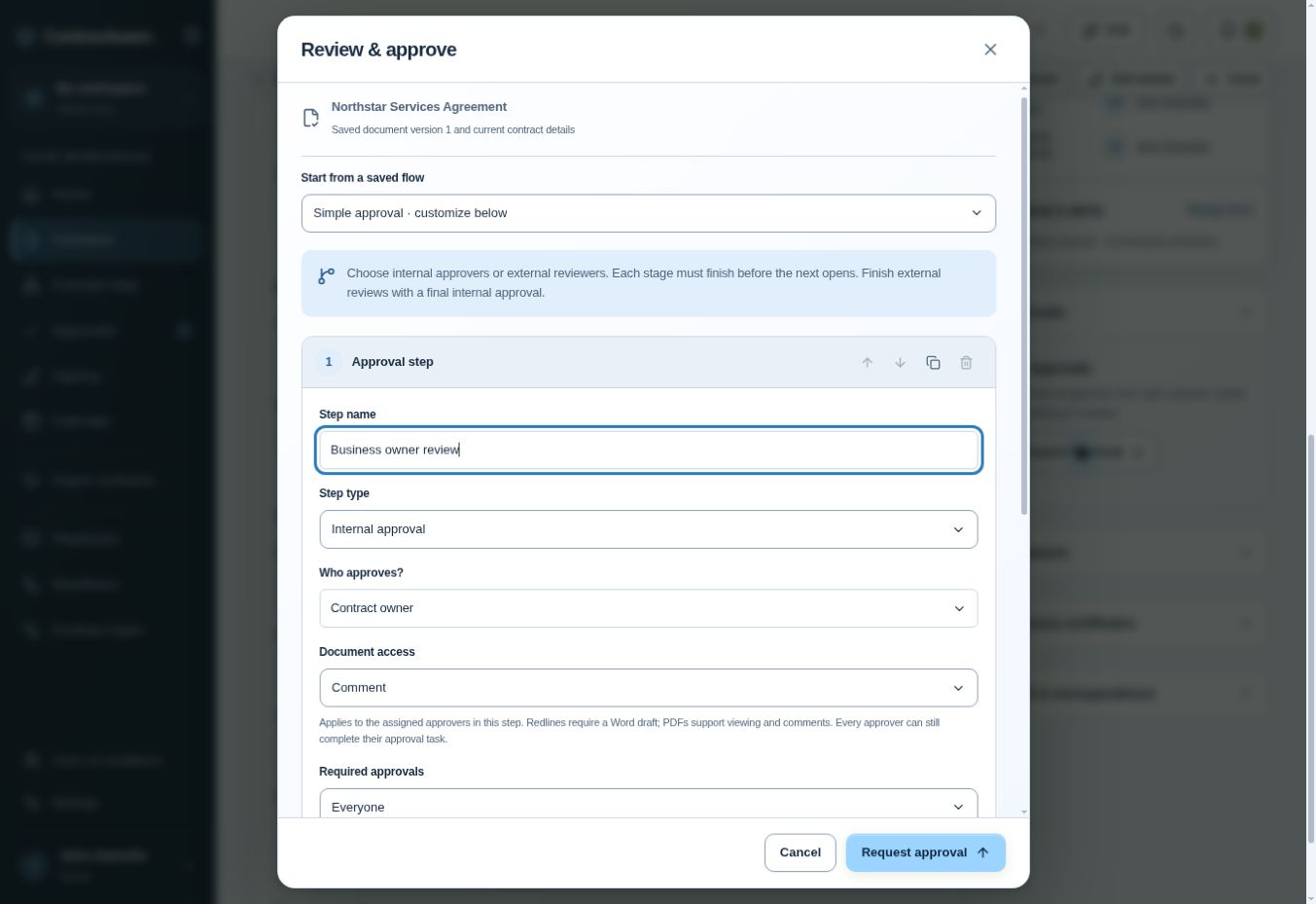
- Inspect approval. In the separate Northstar Review & approve capture, Step type shows Internal approval, Who approves? shows Contract owner, and Document access shows Comment. Ask the test user to identify the decision maker and access level before proceeding in their own training environment.
- Prove the signature outcome. Use a clearly marked practice agreement and authorized test recipients. Ask who signed which version and where the finished copy and signing evidence can be retrieved. Record what the evaluator can open after the exercise.
Label demonstrated, documented, quoted and unverified capabilities
Date each note and identify its source. A written vendor document supports a documented product claim. A commercial quote supports a price or entitlement under stated conditions. A presenter completing the task supports a demonstrated capability. Your own tester repeating it supplies a different kind of evidence again.
Keep the guide's evidence selection and your note aligned. Record vendor documentation or a dated quote as vendor-stated evidence and identify which it is in the note. Record whether the vendor demonstrated the case or your team tested it. Leave an unsupported claim unverified. A screenshot of a configured approval cannot establish that the reviewer received it or completed it.
Use the Software Buying Guide workspace
Customize requirements and assign importance
Start an evaluation for the correct software category. Review the supplied checklist with the contract manager, Finance, IT and an end user. Remove irrelevant requirements, add your own tests and use a weight from one to five. Record any true must-have separately. Predeclare who can authorize an exception.
For the worked example, use four scored areas. Give source retrieval weight five, renewal handling four, approval evidence three and ease of administration two. These weights add to fourteen. Add two separate decision gates for adequate restricted-record access and a usable export. Retain a pass, fail or unresolved result for each gate.
Have teammates score independently before discussion
Ask the same evaluators to score the tasks individually before the debrief. The workspace averages numerical ratings for each requirement and then applies its weight. A team average can conceal different experiences. Read the individual notes when ratings differ by two or more points.
Compare fit with coverage. Unrated items are excluded from the arithmetic and reduce coverage. A requirement marked inapplicable by every recorded respondent is excluded from both. Coverage measures the applicable weight that received a score. Check the list of expected reviewers separately, particularly if the sole administrator has yet to contribute.
Keep demo notes, evidence and dissenting views
Write down the edition, starting role, sample version, task result, time, assistance and unresolved issue. Preserve the exact disagreement. “Legal liked it” says little. “Legal could identify the approved version, while the requester could not determine who acts next” identifies a task for a timed retest.
Keep sensitive proposals and recordings where the evaluation team is authorized to store them. A reference to an approved location is sufficient. Give every unanswered question one buyer-side owner and a date. Circulate the same clarification to all affected evaluators before changing a rating.
Build the decision record
Enter cost assumptions and sensitivity scenarios
Use fictional offers Elm and Pine, entirely separate from the four named vendors. Both use USD, flat recurring charges and a $1,000 exit allowance. Assume no incremental seats, taxes, financing or other charges in this exercise. Both use an internal implementation rate of $50 per hour.
Elm costs $6,000 annually for the subscription, $1,200 annually for a connector and $600 annually for usage. Recurring cost is $7,800. Vendor setup costs $2,000 and forty internal implementation hours cost another $2,000. Three-year TCO is $4,000 + 3 × $7,800 + $1,000 = $28,400. Five-year TCO is $44,000.
Pine costs $8,400 annually with the exercise’s connector and usage included. Vendor setup is $1,000 and twenty internal implementation hours cost $1,000. Three-year TCO is $2,000 + 3 × $8,400 + $1,000 = $28,200. Five-year TCO is $45,000. Pine costs $200 less at three years. Elm costs $1,000 less at five.
The lower-cost offer changes with the time horizon
Two fictional USD offers. Elm has $4,000 in setup and $7,800 yearly. Pine has $2,000 in setup and $8,400 yearly.
- $28,400Elm over three years
$4,000 setup + $23,400 recurring + $1,000 exit.
- $28,200Pine over three years
$2,000 setup + $25,200 recurring + $1,000 exit. Pine costs $200 less.
- $44,000Elm over five years
$4,000 setup + $39,000 recurring + $1,000 exit. Elm costs $1,000 less.
- $45,000Pine over five years
$2,000 setup + $42,000 recurring + $1,000 exit.
Each total includes exit once. The base case assumes flat recurring charges and excludes taxes, financing and the separate ongoing-labor sensitivity.
Apply must-have gates before weighted rankings
Assume all four applicable areas have evidence and both gates passed. In the order listed earlier, Elm scores 5, 4, 4 and 2. Its weighted numerator is 25 + 16 + 12 + 4 = 57. Divide by 70 for 81 percent, rounded. Pine scores 4, 3, 4 and 5. Its numerator is 54, or 77 percent.
Now suppose independent testing establishes that Pine cannot provide the required export. Record the failed gate and owner. Its 77 percent remains an accurate description of the four scored areas. The buyer cannot treat Pine as eligible unless its authorized decision maker resolves the gate. A missing export test calls for an unresolved gate and another test.
Record ownership disclosure, trade-offs and implementation acceptance criteria
Write one recommendation identifying the decision owner, selected edition, lost capabilities, price assumptions, implementation dependencies and unresolved terms. Attach the gate results, source dates and minority opinion. Disclose the directory operator's relationship to ContraxAware when sharing the report with people who did not attend the evaluation.
State what acceptance will look like. For example, both a procurement user and a backup must retrieve an executed sample and its applicable amendment, and the buyer must reconcile an export of the pilot batch. Name the buyer and vendor contacts, the date and the remedy or next decision if the test fails.
Practice running a thirty-minute comparison
Give each finalist five minutes for retrieval, five for renewal, five for the COI exception, five for the approval, five for signing evidence and five for questions. Set up the sample and practice recipients beforehand. Record unfinished tasks as unfinished and agree the same follow-up window. Deliver two completed observation sheets, gate decisions and a cost comparison.
For the advanced challenge, give administration weight five after the team documents a genuine change in staffing. Rerun both models. The denominator becomes 85. Elm earns 63 points, or 74 percent. Pine earns 69, or 81 percent. Preserve the original scores so the sponsor can see why the ordering changed.
Then suppose Elm requires four extra administrative hours monthly at $50 per hour. Its incremental operating cost is $2,400 annually. Add that recurring labor as a separately labeled supplement to the calculator, keeping one-time internal hours intact. The revised Elm totals are $35,600 and $56,000. Record the evidence for those hours before using them in a real recommendation.
John's Builder Note
Hand the keyboard to the person who will inherit the system. Ask them to change one everyday rule and explain how they know it worked. I want the evaluator to watch that minute as closely as the polished demonstration.
Questions from the field
Should we give an unpriced integration a zero?
Leave the quote unresolved. Show a low and high scenario with a labeled source for each assumption. Give someone the job of obtaining a written amount before approval.
Can one person run this evaluation?
Yes. Run the same timed tasks, log the evidence and keep the decision criteria frozen. Obtain a separate specialist review wherever security, insurance, accessibility or signing policy falls outside your authority.
Optional knowledge check
Choose your answer, then open the explanation.
Show answer
As an explicit unknown with a scenario or quote request. Zero creates false certainty. Preserve the unknown and show its possible effect on the decision.
Show answer
No; use the same rules and evidence standards. Ownership and featured placement must be disclosed. Buyer scores should reflect the buyer’s requirements and observed evidence.
Show answer
The same task, data, user role and completion criteria. Comparable tasks support meaningful results. Count successful completion, time and errors along with necessary interactions.