 ContraxAware
Advanced chapter 17 of 18
Advanced Contract Workflow Design
Design and test conditional workflows that handle exceptions without hiding accountability.
Executive summary
- Write the decision in one sentence. Name the input, the person authorized to act and the evidence that lets the agreement move forward. Draw the diagram after the people involved agree on that sentence.
- Give every exception a home. Missing information, an absent approver and a material edit each need a next owner. A reminder alone cannot make a decision.
- Test both sides of every boundary. If Finance must review amounts of USD 25,000 or more, test amounts below, equal to and above USD 25,000. Also test a blank amount and an agreement in another currency.
- Protect work already in progress. Keep the route version, document revision and approval decision together. Decide how existing requests will be handled before changing a production rule.
Part A · The Why
Design the decision model before the diagram
States, transitions, owners and entry/exit criteria
Start with an agreement sitting in someone's queue. Ask what must be true before that person can work, what decision they can make and what evidence the next person needs. “Legal review” names a department. “Assigned counsel reviews the identified liability exception on draft four and records a disposition” describes an activity you can supervise.
A state describes where a record stands. A transition describes an event that can move it. For a budget review, entry might require an amount, currency, cost owner and saved draft.
Exit might require the finance delegate's recorded decision on that amount and draft. An email asking for a review establishes that someone asked. It leaves the outcome open.
For each state, give one role responsibility for seeing the work through. Several people can contribute. One role must notice when the work stops.
Write down an alternate route for an unavailable owner and who can invoke it. This distinction matters most in the one quiet week each year when everyone's backup is on vacation too.
Risk, amount, entity and agreement-type branches
Turn vague policy into questions that two administrators would answer the same way. “Large purchases go to Finance” leaves them guessing. For this chapter's fictional policy, a managed service for the purchasing entity requires Finance when the committed service fees for the initial twelve-month term are USD 25,000 or more. A flagged contractual exception independently requires Legal.
Apply the questions separately. A USD 24,000 agreement with an insurance exception needs Legal. A USD 25,000 agreement with standard terms needs Finance.
A USD 25,000 agreement with an exception needs both. If your design stops after the first true condition, one of those two necessary decisions may disappear. Draw the four combinations before deciding how to route them.
Define unknown information explicitly. A missing amount is a request for clarification. Foreign currency needs a specified conversion source and date if the policy permits conversion at all.
A two-year agreement with a discounted first period may fall outside the training rule. Give cases outside its scope to an owner who can identify the applicable policy.
Separate policy rules from presentation and notifications
Keep a short policy record answering who needs to decide, under what conditions and with what authority. The operational design translates that rule into steps in the contract management system. A button label, color or email subject can improve usability. It cannot supply authority absent from the policy.
Write the notification last. A useful message identifies the agreement and version, the decision requested, the due date and where to see the evidence. Limit the contents to what the recipient needs. Copying sensitive commercial terms into a long distribution list creates a second disclosure decision unrelated to moving the work forward.
Distinguish the person receiving a reminder from the person who can approve. A department administrator can chase a late review. A budget manager may need to make the actual decision. A notice that adds an executive to the conversation should leave the decision authority intact unless a documented delegation changes it.
Handle the difficult paths
Return for changes, cancellation and material amendments
Give “return for changes” a recipient, a question and a re-entry condition. A requestor receiving “returned” cannot tell whether to correct a department code or renegotiate an indemnity. Capture the issue in plain language. Specify which reviewer must see the corrected material and which completed decisions remain relevant under the company's policy.
Define materiality by decision. A change to a renewal option may require Legal again while leaving an approved cost center untouched. A fee increase can invalidate Finance's decision on the prior amount.
Where the reviewers approved an identified document version, determine who must review the revised version before the release for signing. Preserve earlier decisions with their original context.
Cancellation is another exit. Identify who requested it, why, which pending work needs to end and whether anything was already communicated outside the company. An executed agreement raises different questions. Route a proposed change through the amendment process authorized for that agreement, retain the original and establish which obligations the amendment would affect.
Missing approvers, delegation and timeouts
An absent role and a slow reviewer are different problems. If nobody holds the required role, set an accountable administrator to obtain an authorized appointment or approved alternative. If the correct reviewer is simply late, a reminder and subsequent escalation can be appropriate. Neither situation creates approval by silence under this training policy.
A delegation should identify the principal, alternate, decisions covered, spending limit, dates and evidence of authority. A substitute authorized to approve ordinary purchases up to USD 10,000 cannot approve the USD 25,000 test case. The route should surface the mismatch while somebody still has time to address it.
Put real dates on a timeout test. Suppose a reviewer has two business days and the assignment arrives late on Friday. Which time zone, holiday calendar and due-time convention apply?
Have the process owner settle those questions. If the product configuration cannot express the chosen calendar, assign the time calculation and overdue check to a named queue owner.
Duplicate triggers, stale decisions and circular dependencies
The same request can arrive twice when a colleague retries after a slow response or resubmits a reminder. Before issuing a second review request, check the agreement, revision, rule version and pending decision. A retry should lead to one actionable assignment for that decision. Distinct reviewers required by policy still need distinct decisions.
Late responses present a different problem. A reviewer can approve yesterday's draft after a new draft has arrived. Keep that answer attached to the old version.
Tell the owner which current decision remains open. Reusing an older answer without checking its scope makes the newest file appear reviewed when the reviewer has never seen it.
Look for circular dependencies. A purchasing team might demand proof of insurance before approval while its obligations team only verifies evidence after signature. Both teams are waiting correctly under their own rules.
A designer must split the pre-award evidence check from the post-award verification or change the policy with the responsible owners. Each reminder will reach someone who is still waiting for the other team.
Govern automation over time
Versioned rules and change-impact analysis
Give the routing policy a name, version, effective date and owner. Put trigger conditions, evaluation inputs and outcomes into the record. A reviewer looking back six months should be able to establish why Finance was or was not asked on a particular agreement. The present version may be accurate yet irrelevant to that older decision.
When a threshold moves, identify open work by stage. A request awaiting intake may safely start under the new policy. One already approved may require a specific grandfathering or reassessment decision.
Make that call according to the authorized effective-date rule. Record what happens to urgent agreements and who can approve an exception to the transition.
Measure the impact before release. Count how many historical requests would be newly included or excluded if the proposed threshold had applied. Use representative records with appropriate access.
A change from USD 25,000 to USD 20,000 might double Finance's queue even though no screen looks different. Ask Finance whether it can absorb the additional work.
Test matrices, controlled rollout and rollback
Make each test row reproducible. Identify the agreement type, amount, exception flag, assigned roles, document revision, expected sequence and expected terminal state. Include what must remain unavailable before a gate clears. “Finance received an email” says little if the agreement could also advance without a finance decision.
Introduce the new route to one team with an identified backup process. Agree on a pause condition, for example any missing required review or disclosure to an unintended participant. Define how new requests will be held and how people will find existing ones if the route is paused. A paper route can be an effective temporary control when the owners know how to operate it.
Keep the prior policy and routing specification. Reverting the configuration governs future actions according to your release plan. Previously sent notices, open agreements and recorded decisions still need individual attention.
Inventory the affected work, assign each open item and preserve the incident record. Check that users know where to look while the issue is corrected.
Monitoring queues, exceptions and unintended bypasses
Watch age in each state, the oldest unassigned item, returns by reason and discrepancies between required and actual reviewers. Count eligible agreements alongside approvals. Ten Finance approvals could mean every eligible request was covered or that ten of 100 were covered. The right denominator comes from the policy inputs, independently of the route history.
Read a small sample of files end to end. Check the input values, the evaluated route, the decision evidence and the version released. Include at least one cancellation, one return and one case with overlapping conditions.
The UK government's public-sector playbook offers a useful perspective on assigning contract-management responsibilities and governance. Adapt the approach to your own authority and scale. UK Contract Management Playbook
A fictional case of the disappearing second approval
A regional facilities buyer tests eighteen fictional service requests. Its first design asks whether a request has a legal exception and, if so, sends it to Legal. Only requests without an exception reach the value test.
Of the eighteen, four exceed the value threshold and contain an exception. All four travel to Legal. None reaches Finance.
The team catches the gap by comparing eligible requests with completed decisions. It redraws the two questions as independent requirements. Where both apply, the contract manager gathers both decisions on the same version before proceeding. Where an owner changes the price during review, the manager repeats the value test and checks the effect on earlier decisions.
The pilot owner adds a regression case with overlapping conditions. She also checks a missing amount, an out-of-scope entity and a canceled request. The four corrected cases are evidence about the revised test. They tell her little about agreements excluded from the test set, so she keeps the independent coverage check after release.
Two independent rules produce four review routes
Fictional managed-services policy. The owner reviews every request. Finance reviews initial-year committed service fees of USD 25,000 or more. Legal reviews flagged wording exceptions.
- OwnerUSD 24,000, standard terms
Neither additional condition applies. The release owner checks the recorded decision.
- Owner + FinanceUSD 25,000, standard terms
An amount exactly at the threshold activates the Finance requirement.
- Owner + LegalUSD 24,000, exception
The wording exception independently activates Legal even below the Finance threshold.
- Owner + Finance + LegalUSD 25,000, exception
Both conditions apply. Collect both decisions on the applicable saved revision before release.
An unknown amount follows a clarification path. Set a next owner, obtain the missing input and then evaluate both rules.
Part B · The How
Model the advanced process in ContraxAware
Build the smallest route that expresses the approved policy
Prepare a one-page routing specification for the fictional purchasing team. It requires owner review for each service agreement, Finance for initial twelve-month committed service fees of at least USD 25,000 and Legal for a flagged wording exception. Assign an administrator to hold requests with missing or out-of-scope inputs. The final release owner checks every applicable decision.
Give the visual workflow designer the approved conditions and intended handoffs. If you use its AI-assisted drafting capability, inspect every proposed condition and destination. A sentence such as “send exceptions to Legal” leaves the simultaneous Finance decision unspecified. Work through one overlapping case before accepting the draft design. ContraxAware visual workflow designer
Start with one routine route in a designated training workspace. Use a permissioned fictional agreement, a saved draft and training participants. Keep external sending outside this exercise. If the needed test roles belong to different people, arrange the practice session together so the evidence shows who performed each action.
Configure supported branches, roles and escalation behavior
Use the Northstar approval setup as a reference for the ordinary owner step. The image begins inside Review & approve. It shows a saved sample document version and current contract details. These labels belong to the approval setup shown here.
- In Start from a saved flow, inspect Simple approval · customize below.
- Under Approval step, read Step name. For this sample it is Business owner review.
- Check Step type and Who approves?. The selected values are Internal approval and Contract owner.
- Check Document access and Required approvals. The sample shows Comment and Everyone. Decide whether those settings match the training policy before using a live route.
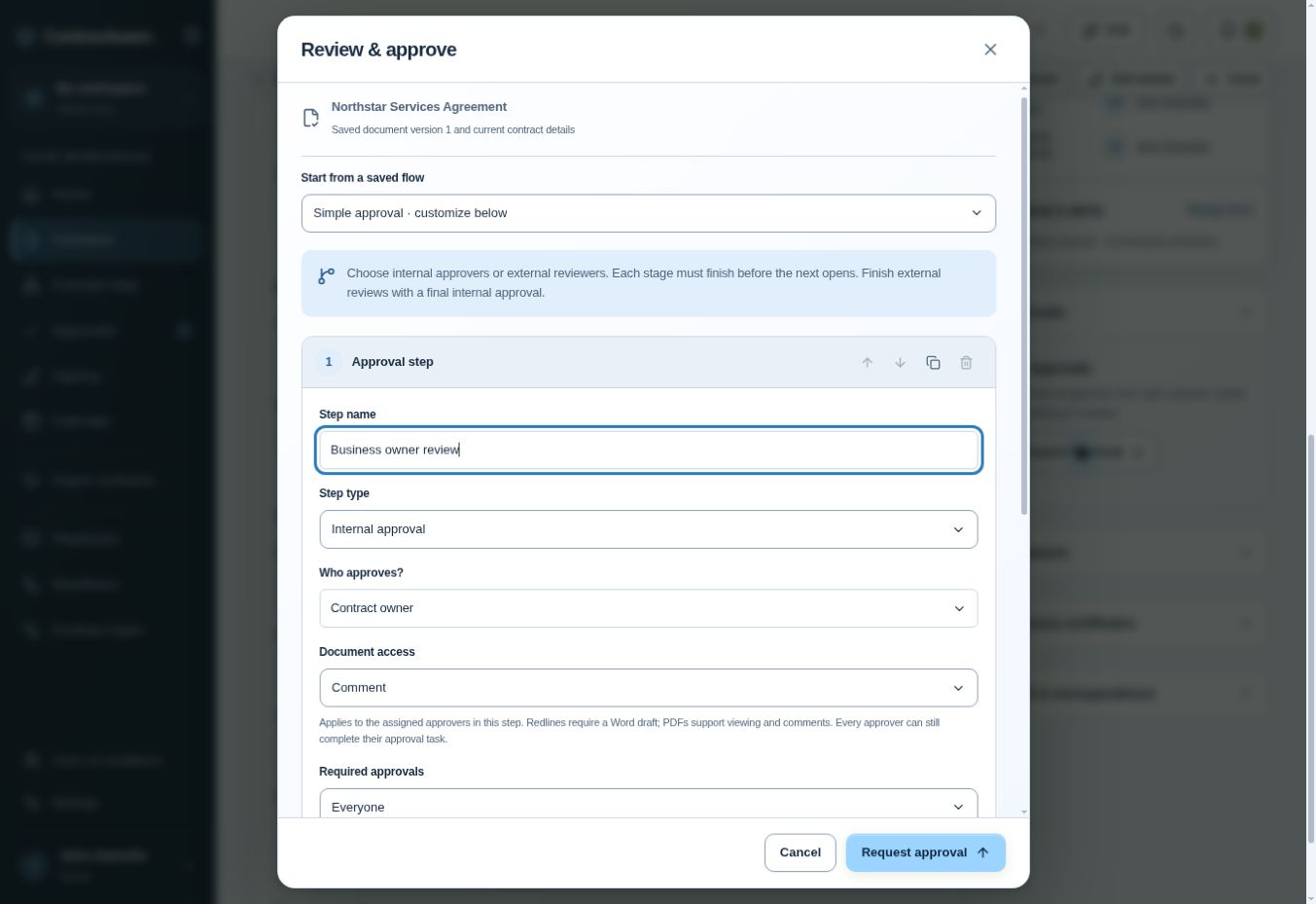
Why this matters. A participant can have comment access and still be required to make a decision. Giving somebody access to text and delegating a decision are separate settings to check. The screenshot records a setup before submission. Use a separate training run to establish how conditional branches and overdue handling actually behave. ContraxAware approval workflows
Record any unsupported rule as an explicit manual control
Suppose Finance's policy uses an exchange rate fixed on the request date. If the needed conversion or holiday convention cannot be verified in your workspace, write a manual control. Name the analyst, the input currency, the approved rate source and date, the calculation and where to retain the evidence. Keep the request at the applicable gate until the reviewed input is available.
Test the handoff just as you would test an automatic branch. Give a trainee an agreement quoted in another currency. Ask them to identify the calculation owner, retrieve the calculation and state which threshold applied. If the trainee must call the designer to discover the next action, improve the control before releasing the route.
Test from every role
Exercise ordinary, boundary and exception cases
- Ordinary service. Set a separate fictional control agreement to USD 24,000 with no exception. Expect owner review only before final release under this illustrative policy.
- At the boundary. Test USD 24,999.99, USD 25,000.00 and USD 25,000.01 without a wording exception. Finance is required for the last two.
- Overlapping rules. Use USD 25,000 and a flagged liability deviation. Expect both Finance and Legal to decide on the saved revision before release.
- Incomplete input. Remove the amount. Expect the request to wait for clarification with an owner. Record which action restores an evaluable amount.
- Northstar draft. The initial-year fee is USD 24,000. If the training owner flags the proposed insurance change as an exception, the illustrative route asks for Legal. That flag is an exercise input.
Repeat an applicable case with the finance role unfilled and one with a delegate whose authority is too low. For each row, record what actually happened in the workspace alongside the prediction. If the designed fallback needs a human, demonstrate that handoff and record the actual human decision.
Verify permissions and the approved document version at transitions
Use distinct authorized training identities for requestor, reviewer and administrator. Read the exact agreement or version description each sees. Check whether a reviewer can perform the assigned task and see only the information intended for that role. Record the document version in the evidence log at assignment and decision.
Add a material fee change to a separate fictional draft after preparing its route. Compare the amount used by Finance with the saved revision intended for release. An older decision can remain part of history while review of the new amount is outstanding. Confirm that the final release owner can identify both facts without relying on a colleague's memory.
Confirm the next action when a branch returns or fails
Return one test request with a specific correction. Have the requestor state the change, amend the training copy and hand it back. Ask the next reviewer to identify the new revision and show which earlier decision needs reconsideration. Mark the case incomplete if the correction appears in a comment while the old file continues forward.
Cancel a second test request while it has an outstanding internal assignment. Review any remaining actionable items and record the person responsible for closing or reconciling them. Repeat a submission on a third test record and count the resulting open decisions. One decision requested twice should produce one accountable piece of work for that purpose.
Release and operate safely
Validate with fictional data before production changes
Record the expected outcome before each run, then capture the actual outcome, tester, date and evidence location. Preserve a baseline copy of the policy and sample inputs. A screenshot of a diagram proves what someone drew. A run through assigned roles shows how people and software handle that case together.
When a test fails, classify it. An incorrectly configured threshold goes back to the designer. An unassigned backup belongs with the role owner.
A disagreement over whether an exception requires Finance belongs with the policy owner. This keeps teams from rewriting working software to solve an unresolved business decision.
Approve the configuration and train process owners
Ask the policy owner to sign off on route scope, authority and exceptions. Ask the people who operate each queue to demonstrate a normal handoff and an overdue or returned item. Give the process owner the evidence package, effective date, known manual steps and rollback contact. A worksheet with named decision owners can be more valuable than a long announcement.
Schedule the first coverage review before opening the route to the pilot team. Give the new administrator one realistic prompt. “A buyer has raised the amount during Legal review. Find the next decision and show me its owner.” A successful answer should rely on the record and policy, without needing the original designer in the room.
Monitor bottlenecks and revise rules with a documented change record
Compare eligible requests with completed required reviews. Show counts waiting, completed and legitimately canceled separately. Examine age as well as averages. One unassigned insurance exception can age unnoticed while dozens of routine purchases make the average cycle time look healthy.
When a rule changes, record the problem, affected inputs, proposed outcome, approving person and effective date. Rerun the applicable boundary and exception cases. For commitments that genuinely depend on a preceding verification, teach the operations owner how to identify that prerequisite and its evidence. ContraxAware contract obligation management
Practice finding the dead end
Build a test sheet with six named cases covering ordinary routing, the exact threshold, a legal exception, an absent approver, a material edit and cancellation. For each, provide the starting revision, input, required decision, expected owner, actual result and evidence. Have another person run the sheet without a briefing.
Then inspect a route that requires a verified certificate before signing while the evidence-verification task can only start after signing. Mark the two dependencies. In the exercise answer, Risk performs a separate pre-sign evidence review or authorizes an exception.
Post-sign administration tracks the continuing certificate obligation. Have both owners approve the distinction and test a request with a missing certificate.
John's Builder Note
I start with the person who inherits the exception on Friday afternoon. If they can see the document, the open question and who can decide it, a short route will do real work. Another box on a diagram earns its place only when it changes an actual decision or handoff.
Questions from the field
Should Finance and Legal work in parallel?
They can when each can decide independently on the same saved version. If Legal's changes affect price or Finance's decision changes the scope of liability, specify which decision must be revisited and who checks the final revision.
Is an overdue review automatically an escalation?
It becomes one when someone with assigned responsibility receives and acts on it under the approved procedure. Record the recipient and expected action. A late badge by itself leaves ownership unresolved.
Optional knowledge check
Choose your answer, then open the explanation.
Show answer
Assign an explicit manual check and document its owner. A named person can perform the check, record the decision and hand it on until the rule can be implemented and tested.
Show answer
Ordinary, boundary, failure and exception paths. A diagram can look correct while returns, thresholds or missing owners leave real work stuck.
Show answer
To trace which policy produced a decision and manage changes. Rule history supports traceability and safe change management, especially when active work spans revisions.