Key takeaways
- Hosting needs a decision first because the translation amendment leaves its 60-day window intact.
- The translation receipt cutoff falls on Saturday, May 1, 2027. Give the owner time to arrange delivery.
- A proposed vendor-wide change belongs in the review queue until someone verifies it was executed.
Which notice period applies after the parties sign an amendment?
Flint Harbor buys hosting and translation from the same supplier. In this fictional agreement, both orders end May 31, 2027, and the supplier must receive notice at least 60 calendar days before the end of the term. A signed amendment reduces the notice period to 30 days for translation order TR-14. Hosting is order HS-09.
In mid-April, Procurement asks when notice is due. The AI quotes the amendment accurately and says there are still two weeks to act. That answer works for translation. Hosting’s April 1 deadline has already passed. If Flint Harbor intended to cancel hosting, its contract owner now needs to check the renewal terms and available options. Changing a reminder cannot fix a missed receipt deadline.
Ask for one answer per order
Give the reviewer the two orders, the master, and the amendment. Ask: “For each order, show the term end, days of notice, last day for receipt, and the sentence that sets the interval.” Require a row for HS-09 even if the AI reports no change. That row is where a reviewer can catch a supplier-wide answer.
Which date goes on each order?
| Contract or order | Term and supporting text | Decision or next action |
|---|---|---|
| Hosting HS-09 | Master agreement, 60 calendar days; term ends May 31 | Plan for receipt by April 1, 2027 |
| Translation TR-14 | Signed amendment, 30 calendar days; same term end | Plan for receipt by May 1, 2027 |
| Draft covering all orders | Redline circulated after signature; no evidence of execution | Refer to owner for status before changing either row |
Check the sentence that sets the scope
Open the signed amendment and locate the order reference. Read the revised interval together with the original renewal and notice provisions. If the exhibit refers to a former order number, obtain the cross-reference from the owner before changing an alert. A matching counterparty name by itself tells you very little about which services the parties meant.
Separate the decision from delivery
For future cycles, have the hosting owner schedule the internal review ahead of the April 1 cutoff and name the person who will arrange delivery. Record the designated recipient and permitted method from the agreement. May 1 falls on a Saturday in this example. Flag that for the translation owner to plan earlier delivery and have counsel resolve any uncertainty about timing.
Check what the next person sees
Open each ContraxAware record and inspect the saved renewal terms and any attached source wording. Hand the two rows to someone who missed the negotiation. Ask them to explain why the earlier date belongs to hosting and to point to the line that makes translation different. Keep the delivered notice and its receipt after the owner acts.
Follow the amendment to the current notice period
Open the parent agreement and its linked amendment. On each order, save the notice interval and the evidence for its scope. Use the renewal workflow in your contract management system to check that HS-09 comes up for action first.
Ask a colleague to trace the two different dates back to the signed terms using this source-clause verification exercise.
Trace HS-09 and the translation order back to the master in Contract Map, then check which order the signed amendment names.
For the full workflow, read how to build a renewal calendar from signed notice terms.
 View full-size screenshot
Follow a notice deadline and its source obligation
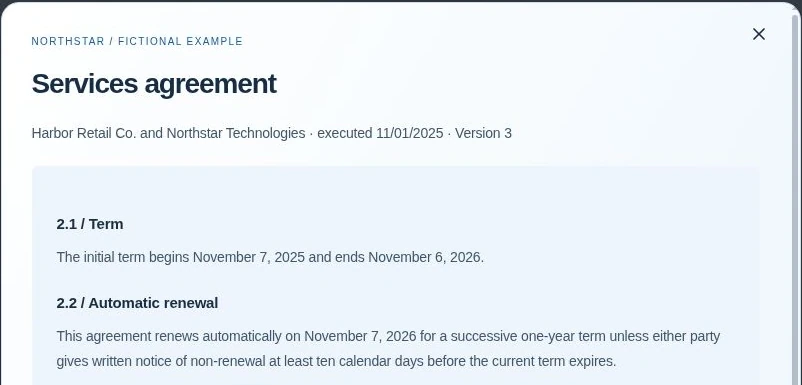
22 seconds. The Northstar training agreement shows how a notice deadline, an obligation owner, and source wording appear in Contract Map.
Read the video transcript
- 0:00
The Northstar agreement appears in Contract Map.
- 0:04
Selecting a tile reveals the details of a connected record.
- 0:08
The notice deadline falls before the next term begins.
- 0:12
Notice is due October 27. The next term starts November 7.
- 0:15
The obligation shows its owner, due date, and source clause.
Order-by-order notice reconciliation worksheet
Read each order and its signed changes. Subtract the verified interval from term end and record delivery evidence separately.
Preview a completed worksheet row
- Order or item
- HS-09 hosting
- Document evidence
- Signed master notice provision; no applicable executed change in packet
- Status and scope
- Original 60-day term applies to hosting
- Term end
- 2027-05-31
- Notice interval
- 60 calendar days
- Receipt cutoff
- 2027-04-01
- Owner
- Hosting owner
- Follow-up
- Plan decision and delivery before April 1; retain receipt.
Frequently asked questions
Can the supplier's renewal email settle the question?
Keep the email as correspondence and check it against the agreement. If the contact suggests a different deadline, ask the contract owner to reconcile the discrepancy before anyone relies on it.
What if the calculation looks correct but applies to the wrong order?
Reopen the affected records, attach the order-specific sources, and check who received alerts based on the previous date. A corrected field alone may leave an old task on someone's calendar.
Who should verify the amendment scope?
The owner familiar with the purchase can confirm which service the order covers. Refer unclear drafting, conflicting agreement language, or a disputed change in scope to the authorized legal reviewer.
What should go in the notice register?
Use a separate row for each order, with its term end, verified interval, controlling text, calculated cutoff, delivery rule, internal decision owner and receipt evidence.