Key takeaways
- Separate 25 frequent operators from 125 occasional requesters when asking for a price.
- Use an eight-week pilot and a four-hour weekly administration budget as buyer constraints in this example.
- Make both finalists show adoption, exception handling and ownership under the proposed configuration.
When does a 500-person company actually need enterprise CLM?
At fictional Cinderline Components, a controller argues for enterprise software because the business now employs 500 people. The procurement director has a different concern. Her one administrator can offer half a day each week after launch, and nobody else has agreed to maintain routing rules. Their decision turns on the shape of the work: two legal entities, one purchasing interface with an owner, 25 people who run contracting tasks and 125 people who occasionally submit a request.
Separate requirements already approved by management from the architecture somebody hopes to build. Cinderline’s second legal entity needs its own permission boundary. Procurement needs a reliable way to connect a supplier record to the contract it approved. A future plan to coordinate sourcing across twelve countries has no funded project, owner or deadline. Preserve the idea in the roadmap. Score the two-entity separation and the live purchasing handoff in the current procurement.
An enterprise platform earns its complexity when a funded requirement depends on enterprise-scale functionality. For example, Icertis documents an SAP Ariba integration that can synchronize amendments, documents and commercial line items. If those are the records your business buys against, your ERP owner should bring a representative sourcing award and an amendment to the evaluation. Get edition, dependency and services details directly from the supplier. Icertis’s SAP Ariba integration overview.
Price the deployment in days people must show up
Give both finalists the same eight-week pilot target. Cinderline wants two department coordinators to submit a request, counsel to approve the correct revision, a delegated backup to find the signed file, and Finance to see who owns the next notice. List the prerequisite for each result. A planned launch on Friday is of little value if the identity team cannot approve access until the following Wednesday.
Request a written plan that separates vendor configuration from customer work. Who cleans vendor names? Who grants test access? Who maps the buyer and contact fields? For the integration, ask the owner to create an example with a blank supplier ID and document where the rejected entry goes. A supplier should be able to show what an exception looks like under its proposed design and tell you whose queue receives it. Keep unresolved dependencies beside the schedule.
Ironclad’s documentation for its Salesforce integration describes configuring workflow and field mappings and testing synchronization. That detail can be a virtue when Sales needs a concrete workflow inside Salesforce and has a Salesforce administrator available. It also gives a buyer a practical test to run before committing time. Use the contract software comparison resources to collect questions, and confirm actual edition and implementation duties with the finalist. Ironclad’s Salesforce setup guide.
Measure the ordinary Tuesday after implementation
Ask a legal operations lead from your team to perform four routine changes in the configured pilot. Replace a departing approver, update a renewal escalation, give the new subsidiary a restricted requester role and restore a wrongly edited field mapping. Record active minutes, specialist assistance and which records were affected. Settle who has authority to publish each change. A quick switch in an administrator account can have a very different production approval path.
Cinderline has four active administration hours in an ordinary week. Give that time an actual calendar owner and preserve some room for unexpected failures. Suppose access changes consume 75 minutes, routing updates take 45, and investigation of two failed handoffs takes another 80. That is 200 minutes, leaving 40 minutes for other tasks. Time the equivalent jobs in both systems and record when a vendor ticket or technical specialist is required. The figures here illustrate a test, not operating hours for any named product.
Ask both providers what happens when the administrator is unavailable. Have a backup repeat a change using only the handover notes and the permissions the company will actually grant. The ability to operate safely on a Tuesday afternoon and cover a colleague’s vacation is worth documenting next to a long list of settings.
Fit tests to run under each finalist’s quoted plan
| Buying decision | Enterprise finalist | Mid-market finalist |
|---|---|---|
| Deployment | Assign a specialist to each required configuration and show the critical path. | Name the customer inputs and quoted services needed for the first working flow. |
| Administration | Run the same four changes and record any dependency on partners or IT. | Run those changes with the ordinary administrator and a backup user. |
| Adoption and cost | Quote 25 operators and 125 requesters; run ten uncoached submissions. | Price the same mix, confirm edition limits and repeat the same requester test. |
Model requester adoption and the exact mix of licenses
Ask sales teams to quote the same population. Cinderline has 25 operators who manage records and another 125 occasional requesters, for 150 potential users. Do not assume all 500 employees need paid full seats or that every occasional role is included. Obtain written definitions for requesters, viewers, approvers, administrators, external signers and service accounts. Price the next 50 requesters as a separate scenario. Usage allowances, minimums, implementation services and renewal terms belong on the same page.
Run an adoption exercise with ten first-time requesters. Give them a representative supplier request and the information a colleague normally possesses, then let them work without a coach. Cinderline sets a local target of eight finished requests with enough information for Legal to act. A submitted form that sends the contract manager back to the requester for the supplier’s identity still needs repair. Mark exactly where the user stopped or guessed and ask whether a label or a shorter form would fix it.
Use the ContraxAware pricing page and feature matrix to prepare edition questions. Confirm in writing what the quote includes for the role mix you tested. A lower subscription can lose its advantage if staff have to reenter every request; a higher quote can earn its place if it reliably eliminates work in a system employees already use.
Inspect one real handoff before recommending either platform
For a ContraxAware comparison, use the Northstar Contract Map screenshot below. The fictional training record connects a saved version with related agreements, completed signatures and open obligations. Ask an operator to identify the next open obligation, find its source and pass it to the person doing the work. Then give a requester limited access and repeat only the lookup appropriate for that role. The screenshot provides a starting point; your pilot must establish permissions and outcomes in your chosen configuration.
Summarize both finalists on one decision page. Give credit for the two-entity boundary only after the team tests it. Give credit for the purchasing interface when the integration owner can reproduce both a successful transfer and a failed one. Give credit for sustainable administration when the backup has completed a change under the proposed support model. State the unresolved licensing assumptions and who will reconcile them with each order form.
Cinderline should choose enterprise capability if the mandatory integration or separation requires it and someone can support the design. A shorter mid-market implementation deserves to win when it can deliver those outcomes within the team’s time and adoption budget. Revisit that decision when an acquisition funds a third entity, a new ERP rollout is approved or the weekly workload consistently exceeds four hours. Those events are stronger buying signals than an employee headcount milestone.
Check how the business contract workflow handles the handoffs your shortlist must demonstrate.
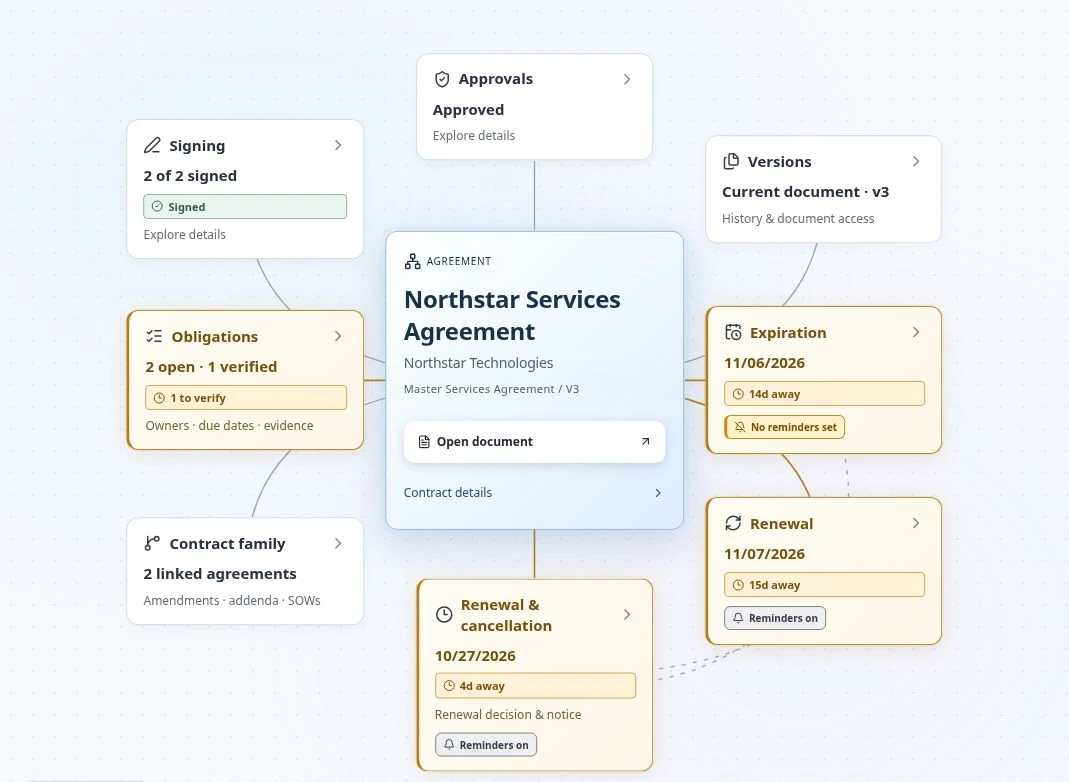 View full-size screenshot
Enterprise vs. Mid-Market CLM Fit & Complexity Scorecard
Test both finalists against the same constraint. Record live evidence or a written quote, assign an owner, and list unresolved items before selection.
Preview a completed worksheet row
- Fit test
- Deployment
- Pilot assumption
- 8 weeks
- Buyer acceptance evidence
- First flow completed in proposed edition
- Enterprise finalist
- Await live evidence
- Mid-market finalist
- Await live evidence
- Owner
- Project lead
Frequently asked questions
Does a 500-person business automatically need an enterprise edition?
Identify mandatory controls and how many teams actually administer the system. A company that needs a specific identity feature might need an enterprise edition of a mid-market product. A company with multiple deeply integrated procurement workflows might need a different architecture.
What does a credible deployment estimate include?
Ask for named tasks, elapsed weeks, estimated hours by role, prerequisites and a written acceptance event. Put your own resource calendar beside the plan. Delays often hinge on when source data, security approvals or business owners are available.
How should we compare occasional-user pricing?
Describe the actions each role must perform and request a line-item written quote for that mix. Check how the agreement handles seasonal increases, inactive users, role changes and people who submit only one request each quarter.
When does integration depth become worth the extra administrative work?
Assign a cost and an owner to a recurring manual error or duplicate entry. Then demonstrate the proposed integration correcting that problem under ordinary permissions. If it materially reduces recurring work and somebody can recover failed transfers, include that evidence in the decision.