Key takeaways
- Ask each finalist to price the same users, departments, migration workload, usage and support requirement.
- In the fictional example, a $500 monthly base becomes $8,400 of year-one recurring fees after adding seats and AI.
- Separate the $28,881 paid to the hypothetical vendor from $2,000 of internal setup effort before taking the budget to Finance.
What does a mid-market contract team actually pay?
Start with the service you expect to buy. A ten-person team that edits, approves and signs contracts has different pricing inputs from ten administrators who support another 300 casual requesters. The second buyer may need centralized identity controls, individual audit histories and an intake portal. Write down the actions each group must perform. Vendor labels such as contributor, guest and business user become meaningful when the supplier confirms in writing which role can perform each action.
The public prices below are US-dollar starting points checked on November 27, 2026. No invoice data or representative market average is available from those pages. ContraxAware Complete lists $400 per month billed annually, or $4,800 per year, with unlimited users and contracts. Enterprise lists $1,000 per month billed annually, or $12,000 per year, and adds centralized identity features. Both plans include migration and onboarding assistance. Ask what work your team retains when planning the conversion.
ContractSafe publishes a starting price of $450 per month on annual billing and $540 month to month, and describes its separate Jump Start service for human data extraction. Concord shows Essentials at $499 per month paid annually with five users, additional users at $49 per month and free viewers and guests. These examples illustrate different billable units. To compare them, have each supplier select the tier that delivers your mandatory workflow, identify any required additions and issue a dated quote.
Turn the seat count and AI allowance into a bill of quantities
Give the three bidders one demand sheet. In our fictional example, procurement needs ten paid users for the full first year, plus a group of requesters who must submit forms and read their own requests. Five users come with the platform. The other five cost $20 each per month. Procurement confirms in this example that the requesters need no paid seats. If a requester must gain approval rights for one assignment, ask whether that change triggers a full seat, a prorated charge or a different plan.
Inventory the workload behind an AI line item. Count source documents, pages, questions or credits using whichever unit the quote actually meters. Ask the vendor to price your first migration month and a steady month separately. For example, 2,000 incoming agreements can produce a very different initial bill from 30 additions each month thereafter. Ask what a retry consumes and what happens at the allowance limit. Finance can then tell whether a $100 monthly add-on is sufficient to meet the tested demand.
The fictional supplier quotes a $500 platform base, $100 for the five added users and $100 for an AI allowance every month. The recurring total is $700 per month, or $8,400 in year one. A $500 headline multiplied by twelve would leave a $2,400 hole in the first year's subscription budget. Enter the three lines individually in your working papers so a change in headcount does not silently change the AI estimate.
Build the implementation and renewal years separately
The fictional vendor charges $2,400 once for configuration and import support. The buyer allocates 40 internal hours at a loaded rate of $50 to map fields, check samples, train owners and accept the migration. Those $2,000 of internal effort belong in the ownership view. The vendor will invoice $10,800 for year one. Including internal time brings that year's total to $12,800. The distinction matters to a controller who needs an invoice budget and a department head who needs someone available to do the work.
The sample assumes a 5% increase on every recurring line at each anniversary. The year-two run rate becomes $8,820 and year three becomes $9,261. One-time installation and setup stay in year one. Add $8,400, $8,820 and $9,261 to get $26,481 in recurring fees. Adding implementation yields $28,881 paid to the vendor. Adding internal setup yields $30,881 over three years. This example assumes constant seat and usage quantities and excludes taxes, financing and any discount for paying earlier.
Read the renewal mechanism before copying that percentage. A cap, a fixed increase and a renewal at then-current list price are different inputs. Check whether a first-year discount disappears at renewal and whether uplift applies to the base only, add-ons or the entire package. If an order is silent, model a sensitivity and mark the rate unconfirmed. Have Procurement ask for renewal protection in writing before presenting it as a contractual ceiling.
Reconcile the illustrative offer in USD
| Cost component | Billing or valuation basis | Three-year amount |
|---|---|---|
| Recurring subscription | $8,400 → $8,820 → $9,261 | $26,481 |
| Vendor implementation | Once in year one | $2,400 |
| Internal setup | 40 hours × $50 | $2,000 |
| Ownership total | Vendor cash plus internal effort | $30,881 |
Make the vendor answer the expensive exceptions
Send one completed quote sheet back to each finalist. Have the account team confirm paid user definitions, additional environments, AI volumes, e-signature envelopes, integrations, API access and support hours. Ask which lines are mandatory at launch and which depend on future choices. Include the software already owned by the company where the service requires a third-party subscription, but count only the incremental cost attributable to this project.
For migration, inventory attachments, duplicate versions, amendments, signed copies and poor scans. Ask the implementation lead to specify who renames, deduplicates, imports, maps and verifies each category. An included migration service still needs someone in your business to decide which amendment governs. For a useful acceptance test, identify ten representative contract families and require the team to retrieve the governing agreement, current price and next deadline from each imported record. Give the approver authority to keep a failed family open.
Run a growth case beside the baseline. If three additional paid users join at the beginning of year two, use the relevant renewal-year seat price and the months actually billed. Run a second case with migration taking 60 internal hours rather than 40. At the assumed rate, the extra 20 hours add $1,000 to ownership cost. Review demand and controls with Procurement, then send both cases to Finance with the dates and assumptions that would change their choice.
Prove that the proposed price buys the required workflow
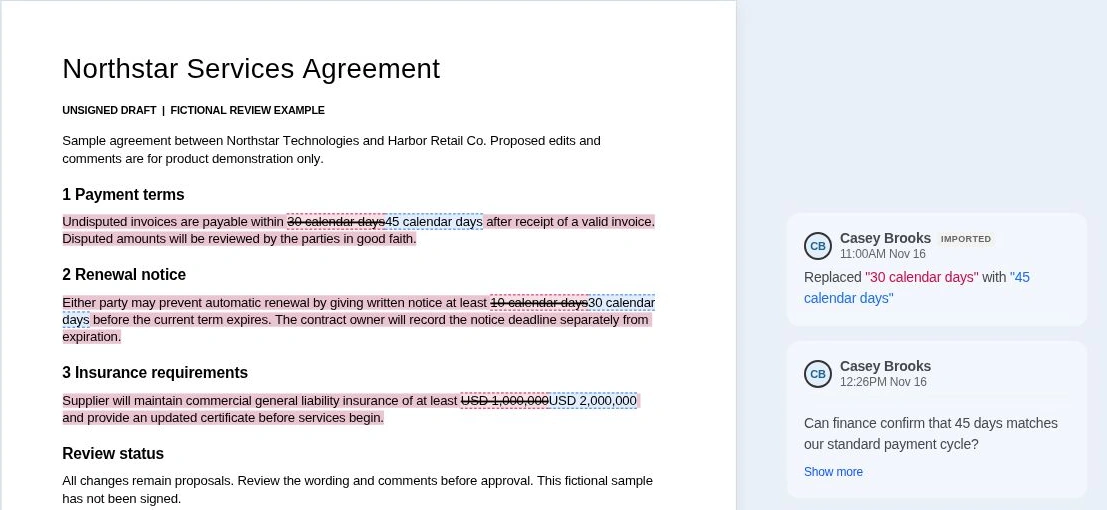
Use a fictional agreement for the demonstration. Give the vendor a signed payment term and a later proposed edit, then ask the reviewer to open the current wording, record Finance's concern and identify the person who can clear it. In the ContraxAware capture, an unsigned Northstar draft proposes changing payment from 30 days to 45, and a reviewer asks Finance to confirm. Have the seller identify exactly which purchased roles are needed to participate in that exchange.
Repeat the exercise with one ordinary requester and an approver. A demonstration run entirely from an administrator account can hide the cost of real participation. Keep the tested actions next to the quote, including the identity controls, data scope and edition the demonstration used. Where a seller needs a higher tier to complete a task, ask for an amended quote and rerun the ownership comparison. Bring the workflow and the three-year sheet to the final demo so the team can reconcile the buying decision with what it actually saw.
Use the same quote assumptions when you compare CLM alternatives.
For the full workflow, read how to compare the commercial terms of CLM offers.
 View full-size screenshot
3-Year CLM Total Cost of Ownership (TCO) Comparison Calculator
Replace fictional quote inputs and compare recurring fees, one-time vendor charges and internal costs across three contract years.
Preview a completed worksheet row
- Cost item
- Recurring vendor fees
- Basis
- ($500 + 5 × $20 + $100) × 12, then 5% annual uplift
- Year 1
- $8,400
- Year 2
- $8,820
- Year 3
- $9,261
- Three-year total
- $26,481
Frequently asked questions
How do I compare annual and month-to-month quotes?
Put both on the same twelve-month demand schedule, then compare the payment dates, cancellation terms and minimum commitments. A monthly equivalent shown beside an annual commitment tells Finance the annualized price. It does not determine when the supplier will collect the cash.
What counts as a paid seat?
Have the vendor classify your actual roles by permitted action. View-only access, submitting a request, redlining a draft and approving it can have different entitlements. Put the confirmed role definitions in the order so a department rollout does not depend on a slide from the sales call.
Should internal implementation time go into procurement’s budget?
Show it alongside the vendor cash in a separate ownership line. Finance can decide how to treat internal labor under its policies, while the project sponsor can reserve the people to do the work. A combined total alone hides that distinction.
Is the 5% annual uplift a market assumption?
It is a fictional contract term chosen to demonstrate compounding. Use the written uplift, applicable base, anniversary and discount language in the actual proposal. If the supplier gives no binding figure, show multiple outcomes and assign that open point to a negotiator.