Key takeaways
- Count an avoided renewal once and identify what the company would have bought without the intervention.
- Credit only the invoice lines whose variance, contractual basis and actual recovery Finance has verified.
- A reduction in active work can release staff capacity without lowering the cash payroll.
Which benefits will the CFO include in cash ROI?
Give each claimed benefit a counterfactual: what would this company have paid, and when, if the team had carried on with its existing process? Finance may recognize an invoice credit as recovered cash, accept a cancelled renewal as cost avoidance, and value staff hours as available capacity. Those are different classifications, even when the same process improvement contributed to all three. Let the controller approve which categories appear in the cash case and maintain the other outcomes alongside it.
In this fictional case, Alder Quay would have paid $18,000 in month eight for a subscription it no longer needs. Its business owner confirms the cancellation decision was made before the notice deadline, the vendor accepted the notice and the service required no replacement. A buyer also challenges an invoice discrepancy and obtains a $2,400 credit against an amount otherwise payable in month five. These two events reduce expected cash outflow by $20,400 in the example. Future renewals and hypothetical future credits remain outside the year-one total.
Start the model with a dated estimate and leave room for actual results. A contract manager can propose a benefit, but the owner of the budget should certify the comparison. If management had already approved cancelling the service before the new system was considered, the avoided spend belongs to that earlier decision. You can still measure whether the new workflow improved the evidence or reduced follow-up time.
Prove the $18,000 renewal decision and the $2,400 credit
For the renewal, gather the signed pricing schedule, current amendment, contract term, notice method and delivery instructions. Match the decision to an owner and document the date the vendor received or acknowledged notice, as appropriate to the agreement. Finance also needs a baseline showing what the company would have paid in month eight. If another product replaces the cancelled service, subtract its incremental cost. If the prior baseline already excluded the subscription, the incremental saving may be zero.
For the invoice issue, suppose a supplier adds an unverified 6% escalation to $40,000 in specifically affected lines. The potential difference is $2,400. Ask procurement to compare unit prices, quantities, effective dates and amendment scope with the invoice. An uplift may be permitted for one service and disallowed for another. Keep the $2,400 in a candidate column until Accounts Payable has evidence of the agreed adjustment and confirms it reduced the amount settled. In this case it does, in month five.
Preserve the link between the signed source and Finance's settlement record. If the vendor issues a credit memo that expires unused, the customer has not received the modelled $2,400 of cash relief. Likewise, a credit for a corrected invoice and the reduced payment on that same invoice are one economic event. Record one benefit ID and reference both pieces of evidence. Teams managing outbound contracts can use the sales contract workflow to test a separate revenue example, provided they can isolate realized margin and avoid counting a headline deal value as savings.
Measure fourteen hours of capacity without counting them twice
Time the same work before and after the change. Alder Quay samples 28 comparable requests per month. A manager previously spent a median 45 active minutes locating the governing terms, reviewing them and routing a response. The pilot takes 15 active minutes for the same completed request, including checking the source and making corrections. At a representative reduction of 30 minutes across those 28 requests, the planning estimate is 14 hours per month. Record the actual total per request in the pilot so Finance can replace an estimate with a measured result.
At a loaded labor rate of $50 per hour, 14 monthly hours over twelve months equal 168 hours, valued at $8,400. The team intends to use the time for supplier reviews. Payroll and staffing remain constant in this scenario. Show the hours, their assumed economic value and the intended use in the capacity section of the business case. Include coverage for training and lower first-month adoption in a conservative sensitivity rather than assuming every request will improve instantly.
If the team later reduces a paid contractor commitment, validate the cancelled invoice or actual decrease in hours billed. Reclassify the verified portion as cash and remove its matching value from the separate capacity estimate. Keep a short calculation record with the role, measurement dates, volume, sample mix and reviewer. Elapsed approval time can also improve when a request spends less time in a queue; waiting minutes and employee work minutes call for different measures.
Decide how each opportunity enters the model
| Outcome | Evidence in the fictional case | Year-one treatment |
|---|---|---|
| Cancelled renewal | Budgeted $18,000 payment and accepted cancellation | One $18,000 avoided payment in month eight |
| Invoice uplift corrected | 6% × $40,000 affected base; credit applies in month five | $2,400 credited once |
| Active work released | 28 requests × 30 minutes × 12 months | 168 capacity hours, valued separately at $8,400 |
Calculate net cash benefit, ROI and the payback month
The hypothetical offer costs $3,000 to set up in month one and $600 per month for twelve months. The year-one cash cost is $10,200. Subtract this cost from the $20,400 of verified cash benefit to get $10,200 net. Divide net benefit by program cost to get 100% cash ROI. Here, that means each dollar of cost yields two dollars of gross cash benefit and one dollar of net benefit. Capacity value sits outside the numerator. For real pricing, check the current plans and annual billing terms and enter the invoice dates from your quote.
Calculate payback using the actual monthly benefit pattern. Through month four, cumulative outflow is $5,400 and cash benefit is zero. In month five the $2,400 credit reduces the cumulative deficit to $3,600 after that month's subscription payment. At the end of month seven, cumulative costs are $7,200 and the cumulative benefit is still $2,400. The $18,000 avoided payment in month eight lifts cumulative net benefit to $12,600 after $7,800 of costs. Month eight is the first nonnegative month. At year end four further payments leave the $10,200 net shown above.
Run the decision without the largest benefit. If the cancellation would have happened anyway, only the verified $2,400 credit remains. Year-one net cash benefit falls to negative $7,800, and the program does not pay back within that year. That sensitivity gives the CFO a precise question to ask about attribution. An annual invoice paid upfront can also change monthly liquidity even when total annual cost is identical.
Demonstrate the notice workflow and verify the outcome in Finance
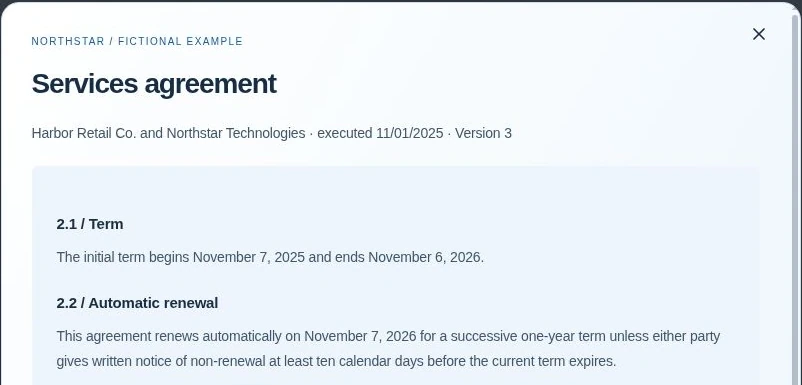
Bring one redacted agreement and its amendment to a contract renewal tracking demonstration. Ask the reviewer to open the executed source, identify the term end and trace the notice rule to the governing version. The pictured Northstar example shows separate term and written notice provisions. Check the linked amendment and the required notice method before assigning an owner. During the demo, ask who can identify an approaching decision and who will retain proof of the final communication.
Next, take the saved decision to the person who manages the budget. A reminder shows the team had an opportunity to act. The actual cancellation evidence, prior payment baseline and payment record support Finance's value calculation. If the document was renewed on different terms, model only the measurable difference and give the comparison a new evidence reference. For the invoice credit, have Accounts Payable locate the posting and reconcile it to the relevant supplier invoice. Use the workbook to bring the records together rather than expecting a contract screen to establish a bank transaction.
Apply the same cash-only payback test when you compare contract management alternatives.
For the full workflow, read how to verify the financial basis of a contract value.
 View full-size screenshot
CFO-Ready CLM ROI & Payback Period Calculator
Enter each verified benefit once in its expected payment month. Keep cash, program costs and released staff capacity on separate lines.
Preview a completed worksheet row
- Item
- Avoided subscription
- Classification
- Cash cost avoidance
- Basis
- One renewal
- Timing
- Month 8
- Year-one benefit
- $18,000
- Evidence
- Approved decision, notice delivery and cancelled renewal
Frequently asked questions
How do you calculate contract management software ROI?
For a cash case, subtract all included incremental cash costs from verified cash benefits for the same period, then divide the difference by those costs. Define the included categories with Finance and keep the baseline, timing and evidence visible so the result can be reproduced.
Can faster contract signing count as cash benefit?
Identify the specific economic change. A deal that closes one week earlier may affect cash timing, but its full contract value cannot automatically be attributed to the software. Have Finance verify any incremental contribution or timing effect using an agreed baseline.
Should the $18,000 avoided renewal repeat every year?
In this case it is a single avoided payment. A future year requires its own defensible baseline, including whether the organization would have resumed or replaced the service. Copying the same cancellation into every year overstates the contribution of the original decision.
What if the supplier has acknowledged the invoice dispute but has not issued a credit?
Report it as an open recovery opportunity with a responsible owner, supporting source clause and target follow-up date. Move it into realized cash benefit only when Finance verifies the effect on an actual settlement. Keep the original estimate for comparison with the final amount.