Key takeaways
- Give day-one requirements a pass condition, a named tester and a piece of evidence another person can reopen.
- Score the edition and configuration in the quote. Record onboarding tasks, dependencies and planned features separately.
- Make the three operational gates visible on the decision page even when a vendor earns a high total score.
Which contract management software requirements belong in your RFP?
Orchard Bench, a fictional regional services business, inherited a contract folder and a renewal spreadsheet. Its last supplier review opened with a disagreement. One manager thought a new notice period covered every office. Another had an unsigned draft on her desktop, and Finance had already used the old date for the budget. Procurement wants the new system to answer three questions with a colleague watching: which order changed, who can see it, and who will act before notice is due?
Take a recent incident to each stakeholder. Ask the buyer to bring the signed amendment, the administrator to supply two test accounts, and the contract owner to describe the reminder they expected. Turn each answer into a requirement with a clear ending. “Find the signed amendment from the affected order and identify the unaffected order” tells the vendor what to show. “Robust document management” leaves everyone free to imagine a different result.
Use the feature matrix as an inventory. It spans 14 areas, including intake, approvals, contract relationships and obligations. At the time of this review, its 104 rows identify 99 available capabilities, three configured during onboarding and two planned. Those are ContraxAware’s published statuses. Leave the response cells for every other vendor blank until it supplies its own evidence. A buying team can complete only the categories it will use.
Give each must-have a test someone else can repeat
Write the starting conditions, action and expected result in separate cells. For amendment linking, prepare a fictional master, two site orders, a signed amendment that changes only the first order, and a later unsigned draft. Ask a buyer who did not upload the files to retrieve the governing text for each site. Retain the path to the signed amendment and the unchanged second order. The file with the latest upload date makes a useful distraction.
For the permissions test, give a procurement account access to one supplier agreement and leave a separate compensation agreement restricted. Use harmless invented names and amounts. Sign in as the procurement user and try the exact restricted title in search and its direct link. Try the authorized record, too. A session that blocks everything can look reassuring while failing the buying team’s ordinary job.
For renewal alerts, use a signed sample with separate notice and term-end dates. Configure the decision owner and a backup, bring a test reminder due in an appropriate demonstration workspace, and ask the recipient to open the supporting contract. Capture the actual recipient and delivery evidence. When only the future schedule is visible, score scheduling and delivery separately. The renewal tracking workflow illustrates why both belong in the test.
Three day-one rows from the RFP
| Requirement | Vendor demonstration | Evidence to retain |
|---|---|---|
| Amendment linkage | Trace the signed change to just one site order. | Executed amendment plus the unchanged order. |
| Role permissions | Try permitted and restricted records as an ordinary buyer. | Two-account test with visible outcomes. |
| Renewal alert | Trigger a safe test reminder and open the permitted record. | Recipient, time and source for the deadline. |
Give planned features and setup-dependent controls their own rows
Before issuing the RFP, decide which conditions apply at launch and which can wait. A company that relies on its identity provider to remove former employees may need a working provisioning and removal test before signing. Another team with a tightly controlled pilot may choose a documented manual process while it evaluates enterprise onboarding. The security owner should record that decision and its review date. Neither team needs to buy a feature merely because the matrix lists it.
Ask the vendor to specify the quoted edition, configuration owner and implementation step for every conditional answer. ContraxAware’s inventory lists corporate SSO, company-managed MFA policies and SCIM provisioning as configured during Enterprise onboarding. It lists Outlook and Microsoft 365 integrations as planned. If one of those integrations is essential to daily work, write down the exact task, such as importing a message attachment. Decide whether a demonstrated alternative actually meets the requirement.
Keep the status vocabulary small. Use “demonstrated” when a tester has seen the agreed result, “partial” when a specific step remains open, and “unverified” for promises or skipped tests. Let the vendor attach supporting materials and correct factual errors. Keep the buyer’s acceptance decision with the reviewer who owns the work. Use the software comparison guides to identify questions for the shortlist.
Verify the access controls listed in the matrix
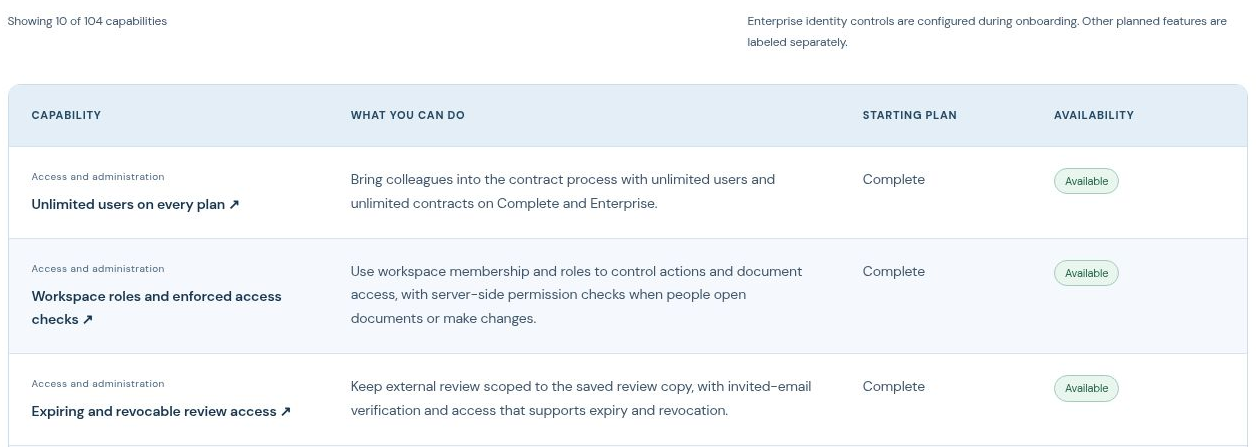
Filter the 104-capability Feature Matrix to Access and administration. The excerpt lists workspace roles and enforced access checks separately from expiring and revocable review access. Give each row its own test. Have a workspace member search for an agreement outside their assigned access, then try opening its direct link. With an invited reviewer, open a permitted review copy, revoke access and try the same link again. Record the account, expected result and observed result for each attempt.
The matrix identifies the starting plan and availability. The account tests supply the evidence for a pass. To test signature, open the executed copy. To test alerts, see what reaches the recipient. Store each observation against the relevant requirement so one impressive screen does not earn several unrelated passes. The general counsel workflow gives Legal a starting place for its own version and approval tests.
 View full-size screenshot
Use the completed matrix to make the buying decision
Put the day-one gates at the top of the decision meeting. If an account can still open the restricted agreement, pause that gate and give the vendor a dated retest. If reminder delivery depends on an administrator setting, ask the administrator to document the setting and rerun the same recipient test. Keep the original failed result beside the follow-up so a reviewer can see what changed.
Once the gates pass, compare the effort to run the workflows your team values. A buyer might recover the governing amendment in three clicks in one product and need a named administrator in another. Both might pass the functional test, yet one creates a queue every time a buyer asks a routine question. Record who must perform the task, what access they need and how often it happens. The procurement contract management workflow can help you choose a representative handoff.
Send each finalist the outstanding items and a decision date. In the award memo, cite the evidence for each gate, the price and edition tested, and any conditions of purchase. At kickoff, give the implementation lead the same files and test accounts. The final RFP then gives that person a ready-made acceptance test for the system the company actually bought.
104-Point CLM Requirements & RFP Checklist
Use each inventory item as a candidate requirement. Define the gate and evidence before requesting responses, then log what your tester observed in the quoted edition.
Preview a completed worksheet row
- Requirement ID
- R-01
- Capability
- Linked amendments, addenda, and statements of work
- Priority
- Day one
- Acceptance test
- Retrieve the signed change for one of two site orders
- Expected evidence
- Signed amendment and the unchanged second order
- Observed result
- Pending live test
- Owner
- Procurement
Frequently asked questions
Should vendors answer every one of the 104 requirements?
Select the rows that affect your purchasing decision. Send suppliers the same scoped list and explain which items are mandatory. Keep the unused rows for later planning so a feature nobody needs does not change the ranking.
How should we weight requirements?
Make an unacceptable outcome a gate. Weight the remaining preferences according to how often the task occurs and the cost of a workaround. Agree on those priorities before viewing proposals so a polished demonstration cannot quietly change the rules.
What counts as proof for an integration?
Agree on the direction, data type and end state. Ask to see one representative item make the trip using the quoted edition. Record any manual steps, additional charges and configuration responsibilities before marking the requirement complete.
Who signs off on a partial pass?
The person accountable for the operational risk should accept a workaround or request a retest. Give the decision an owner and a date, describe exactly what remains unresolved, and carry it into the purchase or implementation conditions.