Key takeaways
- Use days 1–3 to show that a renewal owner can find the signed notice requirement and act on time.
- On days 4–7, send one realistic request through the actual route and test a returned draft.
- During days 8–14, reconcile each archive batch and give the sponsor a precise list of what can enter service.
What can a contract manager actually put into service on days 1–3?
The CFO at fictional Alder Ledger has a practical reason to buy software. A vendor-renewal decision keeps reaching Finance after the spending team has already lost its chance to act. Start the clock at a short working session with the buyer, the records custodian and the person authorized to decide. Bring upcoming agreements, their executed amendments and the calendar the team uses today. If the documents are unavailable, log whose action will release them and put a date against it.
Have Procurement identify the service period, the event that renews it, the notice interval and the required delivery method for each selected contract. Someone other than the importer should open the signed wording and reproduce the cutoff. Give the business owner a planning date early enough to check budget, service performance and alternatives. The contract can require receipt by a certain day while the budget owner needs a meeting a week earlier. Save each date with its purpose.
Reserve day three for a live handoff. Ask the renewal owner to open the sample record, explain what action is due and identify the colleague who covers absences. If a signed amendment is missing, leave its existing calendar owner on duty. Record exactly which renewals passed the test so the department knows where to look tomorrow morning.
Follow one purchase request through its approval route on days 4–7
Give a requester a scenario they recognize, such as buying maintenance services from a new vendor. Have them enter the supplier, service description, owner and expected spend. Ask the contract manager to identify what information is genuinely necessary to route this request. A field that nobody uses to make a decision can wait.
Route the sample against the team's existing authority rules. Pick a transaction that needs both commercial review and budget approval, and have the actual role holders take part with sample data. Return the draft with one meaningful change. When the requester corrects the service scope, check the version, the responsible reviewer and the history a colleague can retrieve.
Use day seven to name the person who can release that route for a specific department. Keep one fallback submission channel and give its custodian the switch date so requests do not disappear between inboxes. Teams planning IT participation can use the IT contract management workflow to identify the technical owner who must receive an unusual software purchase.
Decide what can enter service
| Phase | Acceptance evidence | Action if the test fails |
|---|---|---|
| Days 1–3, renewals | Owner reproduces a current notice date and can act on the reminder. | Keep the existing calendar owner responsible for affected items. |
| Days 4–7, intake | A request reaches its authorized approvers, including after a correction. | Use the fallback channel and retest the route. |
| Days 8–14, archive | Inventory matches the files accepted, deferred or under review. | Hold affected files or batches and name the next reviewer. |
Reconcile archive imports in manageable batches on days 8–14
Start with an inventory export from the old system or a read-only list of the source folder. Give every file an identifier and its expected treatment. A second scan of the master may add little until someone notices a different signature page or rate exhibit. Decide who can settle that question before assigning the file a disposition.
Give the first batch a mix of clean PDFs, attachments and difficult names. Compare the imported files with the inventory, open a signed source, verify an amended field and check department access. Ask which failures the team can isolate. A missing page in one agreement calls for a record-specific hold; repeated assignment of restricted files to a broad audience warrants holding the wider release and retesting the access design.
Keep a separate row for files that arrive during the project. An amendment emailed on day ten belongs with its original and may change a renewal already live. Review the free contract migration assistance scope with the vendor before promising the archive can be finished inside this example window.
Use the reminder screen to prove the first release works
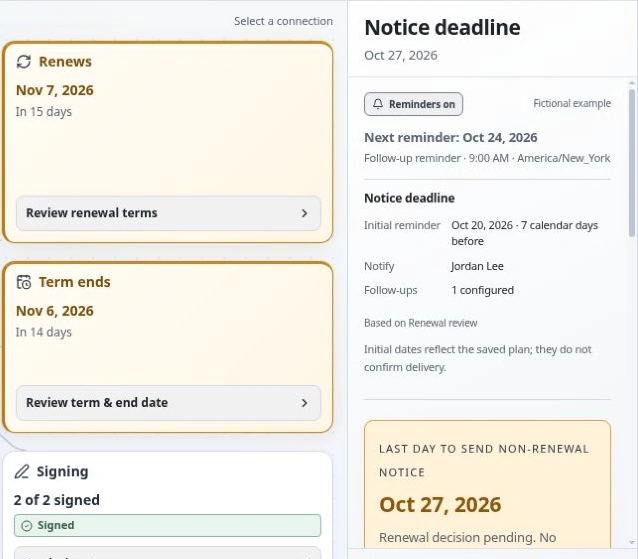
In the actual ContraxAware sample pictured here, the fictional Northstar agreement has a saved renewal reminder plan. The person testing can read the action deadline and the earlier planned reminders. Have the tester identify the recipient, trace the deadline to its clause in the sample, and explain which step would show that a notice was delivered. A configured alert and a delivered notice carry very different evidence.
Perform the exercise on your own pilot using ordinary access and a harmless test agreement. Record the action the tester completed unaided, where the source was found, and what needed a correction. Compare the result with the old calendar while the old owner is available. Route a problem with a particular source clause to its contract owner. Route a repeatable configuration problem to the implementation lead and retest each affected record.
For the operations contract management team, the acceptance record should identify the released workflow, covered agreements, open exceptions and backup owner. Add a handover time for the old process. Two people assuming the other calendar is authoritative can miss a deadline with both systems running perfectly.
 View full-size screenshot
Compare the two-week pilot with a stalled six-month enterprise rollout
Consider a second fictional deployment. At month six, the project has mapped fields for twelve departments, yet nobody can say which team owns a supplier's next notice. Security is waiting for a list of restricted records, Finance is waiting for an integration design and Procurement assumes Legal will clean up the archive. The elapsed time describes that project's dependencies. It provides a poor estimate for a department whose records and owners are ready.
Ask the steering group for the outstanding decision that prevents one useful workflow from opening. Distinguish a dependency that affects everyone, such as the required identity configuration, from a downstream improvement, such as next quarter's reporting integration. Bring the owner and an acceptable test to the next meeting. If the mandatory dependency remains unresolved, keep the relevant work in the established process and update the forecast openly.
A sponsor can then make a bounded commitment. For example, publish the verified renewal queue, release the tested intake route to one team, and leave unresolved archive families under their previous owners. That gives the next department a defensible estimate and tells leadership what additional staffing or decisions would change the calendar.
14-Day CLM Rollout & Data Migration Tracker
Enter a person, acceptance test and evidence for each phase. Keep the old-process owner on duty for agreements still awaiting release.
Preview a completed worksheet row
- Phase
- Days 1–3
- Deliverable
- Active vendor renewal queue
- Dependency
- Signed notice clauses and amendments
- Test evidence
- Colleague reproduces cutoff
- Owner
- Procurement lead
- Release decision
- Release verified records
Frequently asked questions
Is fourteen days a typical implementation time?
Fourteen days is a planning exercise for a bounded rollout. Ask the provider for a forecast that names your teams, source volumes, integrations, access requirements and the customer decisions it assumes. Use actual pilot results to update that forecast.
Which records should a small team bring to kickoff?
Bring active agreements with approaching decisions, the signed changes affecting those decisions and any spreadsheet or inbox currently driving follow-up. Include an easy record and a difficult one so the team learns where work will accumulate.
Can a department start before the full archive arrives?
It can use an identified and tested subset once owners understand which agreements are included. Keep the old work queue staffed for everything outside that boundary. Document where new arrivals go during the transition.
Who signs off on implementation?
The sponsor accepts the business scope, while the people accountable for records, access and deadlines confirm the tests in their areas. Record the reviewer, date, accepted subset, conditions and date for checking remaining items.