Key takeaways
- Record the vendor once, then identify the properties, services and local contacts covered by each signed schedule.
- Annualize a proposed increase using the volume at the affected properties. Give regional Finance the unit, volume and source for each number.
- Test the property manager, another property and regional Finance with separate accounts. Check both what they can open and which decision each can make.
What should a four-property operator ask a vendor to demonstrate?
Fictional Harbour Table Group operates Alder Hotel, Birch Hotel, Cedar Kitchen and Wharf Kitchen. The two hotels share a linen agreement, the point-of-sale system serves all four sites, HVAC service follows the equipment installed at each address, and a food distributor supplies the two restaurants. One supplier folder for each business leaves the regional team with four versions of what looks like the same vendor list. One group-level spreadsheet hides the differences in service.
Start the software demonstration at Alder’s front desk. The linen vendor has offered next year’s price, an extra $0.18 per occupied room-night. The current term ends October 31, 2026. The agreement requires written notice at least 60 calendar days before term end. Ask the property manager to find the signed terms, identify the other property affected and send the financial decision to the person authorized to make it.
Give Birch the same question independently. Cedar Kitchen should still be able to find its own food distributor agreement. Its manager has no operational need to see the hotels’ linen pricing in this example. Keep all four properties in the test. A demo with only the group administrator cannot tell you how useful the system will be to someone working the late shift at one property.
Build the vendor schedule around where the work happens
Create a record for the signed agreement and a row for each distinct set of property terms. The linen master has one shared notice obligation covering Alder and Birch. A list with a copy per hotel can make two managers think the other has replied. Name one regional decision owner and give each hotel its own contact for confirming delivery patterns. Keep any property-specific service schedule linked to the shared agreement.
Use the POS agreement to test the opposite situation. All four properties have access to the system, but a replacement terminal or a site-specific order may carry its own equipment commitment. Give the manager the service contact and the schedule for the local equipment. Ask the regional owner to find the wider support arrangement. A restaurant manager replacing a failed terminal needs both the right phone number and a way to avoid accepting a new term by mistake.
For HVAC, record which site and equipment the contractor services. For food supply, record which restaurant orders under which delivery schedule. Enter a renewal or notice date only when the signed document provides one or supplies the rule for calculating it. An empty date needs an owner and a source check before it turns into “no action required.” Use the operations contract management workflow to connect each unresolved item to the person who can get the missing schedule.
Calculate the group impact before routing the linen offer
Finance asks the hotels for the billing unit and a representative volume. Alder expects 1,800 occupied room-nights per month and Birch expects 1,400. At the proposed $0.18 increase, the monthly impact is $324 at Alder and $252 at Birch. The combined increase is $576 per month, or $6,912 over twelve months if volume holds. Save the occupancy assumption so Finance can rerun the calculation for a quieter season.
Harbour Table’s example policy requires regional Finance approval when the estimated annual increase exceeds $5,000 for the same supplier proposal. Neither property would cross that threshold on its own. Routing two separate requests would conceal the group commitment. Send one request for $6,912 with the hotel breakdown attached. Give the regional reviewer the current rate schedule, the vendor offer and the date by which the decision has to be made.
The notice deadline falls on September 1 under this sample’s calendar-day rule. Work backward from any contractual receipt and delivery requirements. Put an earlier internal decision date on the schedule so the team has time to obtain an address, prepare the notice and confirm receipt. Keep “Finance approved,” “notice sent” and “vendor received notice” as separate entries with their own evidence. It is entirely possible to have the first and still miss the deadline.
Which amount drives the linen decision?
| Scope of the offer | Annual increase at expected occupancy | Approval decision under the sample policy |
|---|---|---|
| Alder Hotel | 1,800 × $0.18 × 12 = $3,888 | Property confirms its input. |
| Birch Hotel | 1,400 × $0.18 × 12 = $3,024 | Property confirms its input. |
| One offer for both hotels | $3,888 + $3,024 = $6,912 | Regional Finance reviews the combined increase above $5,000. |
Walk the permissions from one property to the regional office
Ask an Alder manager to open the signed linen schedule and prepare a recommendation using the hotel’s volume. Switch to a Cedar manager and search for the linen vendor by name and by an exact rate phrase. Record which titles, excerpts and documents appear. Then give Cedar a positive test: find the food supplier’s delivery schedule for its own kitchen. Blocking a restricted file means little if staff also lose the agreements needed to run the restaurant.
Have regional Finance open the combined linen proposal and the evidence from both hotels. Give a property manager a final test using a change above the regional threshold. Can they submit what they know without releasing a commitment they lack authority to make? Ask the demonstrator to show the saved decision and its document version. Where a local manager covers another hotel during leave, test how temporary access ends when the assignment does.
Use Contract Map to follow a local schedule back to its agreement. Include the group owner, local contact, affected property and signed version in the handoff. A buyer can then compare the time and permissions required for the same task across systems without relying on a vendor’s feature checklist.
Inspect the approval step before the property sends it
The Northstar screen below shows an internal approval step, the selected approver role and the document access for that step. Ask your vendor to configure the equivalent of Harbour Table’s route in a test workspace. Have the hotel manager check the local volume, then have regional Finance review the combined proposal. Record who received the request and which version they could inspect.
Change one fact and run the demonstration again. Suppose the linen offer covers Alder only with the same monthly volume. Its annual increase would be $3,888. Under the group’s sample policy, it falls below the regional threshold. Ask the vendor to show how the manager chooses or triggers the appropriate route, including any manual action. The buyer should know exactly who must intervene on a quiet Tuesday and who can make the decision when the regional approver is away.
For the full workflow, read how to design an approval route for a regional decision.
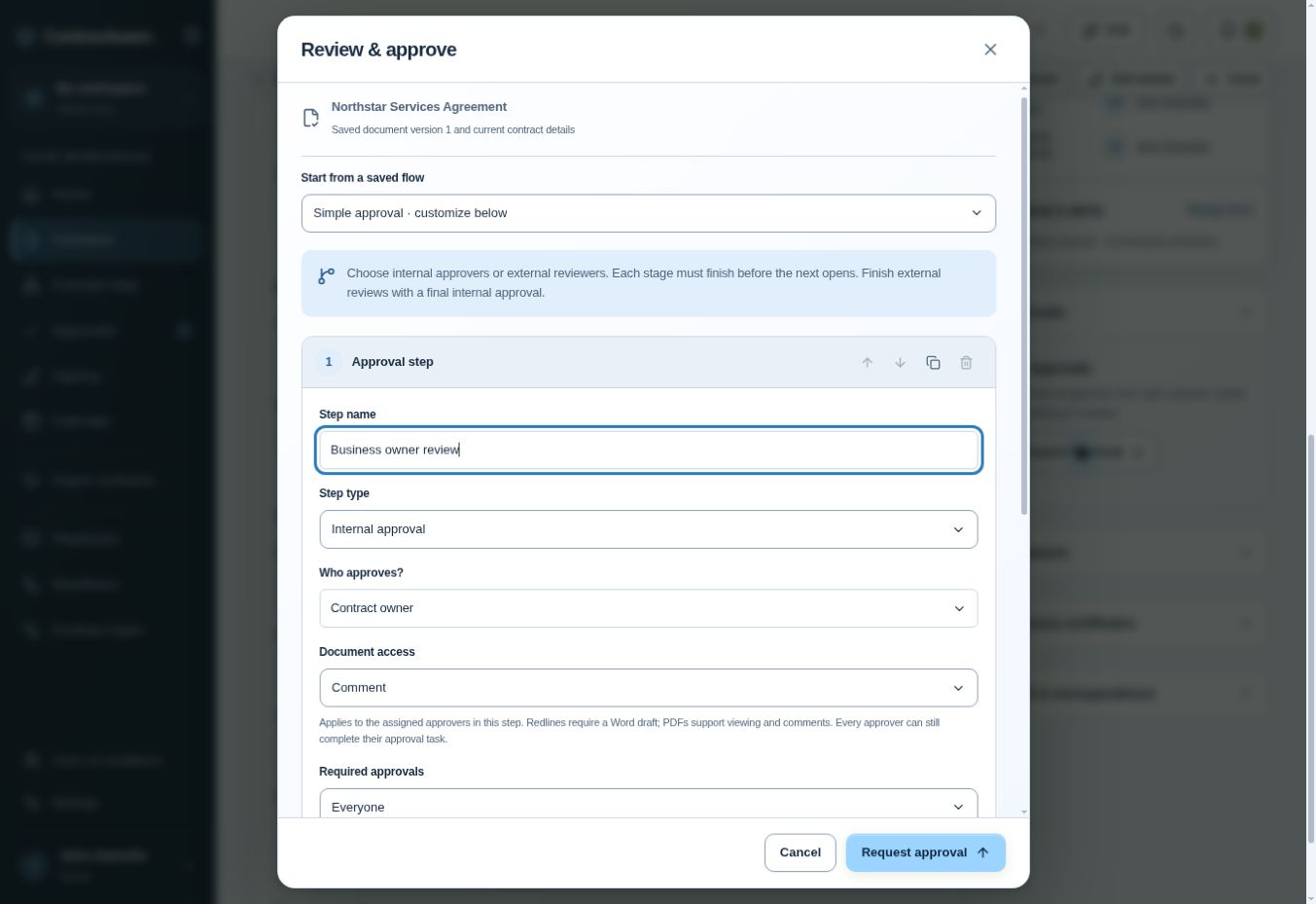 View full-size screenshot
Multi-Property Vendor & Renewal Master Schedule
Identify the agreement and affected properties, verify each date with the signed source, and assign the local input and regional decision. Replace the fictional sample rows with your own suppliers.
Preview a completed worksheet row
- Vendor or service
- Linen service
- Covered properties
- Alder Hotel and Birch Hotel
- Source document or scope to verify
- Signed group linen agreement and proposed rate schedule
- Term end and notice rule
- Oct 31, 2026 · 60 calendar days
- Notice deadline
- Sep 1, 2026
- Property input owner
- Alder and Birch hotel managers
- Regional decision or follow-up
- Regional Finance · review $6,912 estimated annual increase
Frequently asked questions
Do we need four copies of a group vendor agreement?
Keep one signed group agreement and identify each covered property. Attach the local schedules that change equipment, scope, price or dates. Give each shared notice decision an owner and each local deliverable a contact so the group can see who has to act.
Should property managers see other hotels’ pricing?
Set access for the responsibilities you actually assign. A manager may need the local rate to check invoices, while regional Finance needs the combined proposal. Test both accounts and a manager at an unrelated restaurant before inviting all properties.
How should seasonal occupancy affect an approval threshold?
Use the volume basis in your approval policy and document it. Here the group annualizes a representative month. For a seasonal operation, Finance can use approved monthly occupancy forecasts and add their individual results. Keep the billing unit and assumptions with the decision.
Which agreement should we pilot first?
Choose a shared supplier with a real notice deadline and a cross-property owner. Linen works well here because a modest unit change becomes a visible group decision. Add a restaurant-only or site-specific supplier next to test that the system can handle a different scope.