Key takeaways
- Start with a disputed invoice and the people who normally resolve it. Time how long a colleague needs to find evidence somebody else can reproduce.
- Give each signed amendment an effective date, covered service and location. One master agreement can carry several current rates at once.
- Run the same retrieval and access tests on your present drive and on the proposed repository. Compare the work it takes to keep each answer current.
Can Finance reconstruct the rate from the shared drive?
At fictional Brightwell Supply, 120 people work across headquarters and a depot. Procurement keeps the signed master services agreement under Suppliers. Facilities keeps the new depot schedule under Buildings. Finance keeps the supplier’s latest rate sheet beside the monthly invoices. In May, accounts payable receives a $121 monthly equipment charge for each location. The supplier name and invoice period match at both sites. Should Finance pay both lines?
Procurement eventually finds three signed changes to the $100 monthly rate. Amendment 1 raised both sites to $110 on January 1. Amendment 2 raised only the depot to $121 on April 1. Amendment 3 added a $6 monthly inspection fee at headquarters on May 1, leaving its equipment rate alone. Headquarters owes $116 for the two items together. An invoice line for $121 in equipment alone needs clarification even if its total looks close.
Gather the three people who handled the question. Ask each to show how they searched, which file they opened first and whom they contacted. Keep a record of each handoff. Finding all three PDFs is one part of the exercise. Explaining why the depot rate survives a newer headquarters amendment is the part a buyer should score.
Give your existing folders a fair test
Pick a supplier with an active master agreement and several signed changes. Work in a test area or use approved copies. Ask a colleague who did not negotiate the deal to find the controlling price for a named location and billing period. Start from the same home page they use every day. Record their first answer before an administrator supplies a hint or sends a direct link.
In Google Drive or SharePoint, try the improvements you would genuinely maintain: one canonical location for signed originals, a short amendment register, stable document links and named owners. For each change, record the affected site, service, effective date and source page. Leave superseded schedules accessible to the people who reconcile historical invoices. Label which terms changed so the reader can still identify the surviving terms.
Repeat the question with a different staff member. If the answer is quick to reproduce, a named owner keeps the register current, and the right people can open the evidence, the current tools may serve you well. If the owner must explain the history every time, write down that dependency. It gives you a specific problem to demonstrate to a repository vendor.
Search for the clause using the words on the invoice
Start with what the person doing the work actually knows. Give Finance the supplier’s trading name, the depot and “monthly equipment charge.” The signed schedule may call the same item an “equipment service fee.” Ask the reviewer to try both phrases in contract search, open the matching passage and identify the agreement and amendment numbers. A matching phrase on a draft is a lead that still needs checking.
Now change just the month. For March, the depot rate is $110. For April, it is $121. A search that always returns the most recent rate would produce the wrong answer to a perfectly ordinary billing question. Keep both searches in your readiness audit. Include the two sources the reviewer needs and a short explanation of why the newer document applies to only one of those invoices.
Let IT repeat the search as a member of the appropriate department and as an employee who should lack access to the chosen agreement. Use fictional pricing for this exercise. Examine the result titles and snippets as well as the files that open. The IT contract management workflow gives the access owner another practical case to test when a restricted addendum sits beside an agreement shared more broadly.
Which change governs the May invoice?
| Signed change | What it changed | What Finance can verify |
|---|---|---|
| A1 · January 1 | Equipment at both sites rose from $100 to $110 per month. | The $110 rate still applies to headquarters equipment. |
| A2 · April 1 | Depot equipment rose to $121 per month. | The $121 depot charge is supported. |
| A3 · May 1 | Headquarters added a $6 monthly inspection fee. | Expect $110 equipment plus $6 inspection at headquarters. |
Compare the work required after the fourth amendment arrives
A tidy demonstration library answers only half the buying question. Hand both teams a fresh fictional change after the demo starts. Give it a future effective date and a narrow scope, such as a July 1 change for headquarters inspections. Ask each team to attach the signed copy, preserve the May answer and record who will check the first July invoice. Observe every spreadsheet, folder permission and calendar entry somebody has to update.
For a fair comparison, assign the same person to own the change in each system and give both teams the same amount of help. Record who can make an edit, who verifies the signed source and who receives the follow-up. Have Operations look up the affected location using its own contract workflow. Its staff should be able to identify the inspection fee without learning the supplier’s entire pricing history.
Use the results to choose a bounded next step. Fix naming and ownership first when those explain the misses. Pilot a repository with the supplier family when a maintained register still requires manual reconciliation or grants keep drifting. Estimate the hours your team actually spent reconstructing the answers and maintaining each option. Those figures give you a buying argument grounded in your own work.
Read an amendment’s status before changing the master
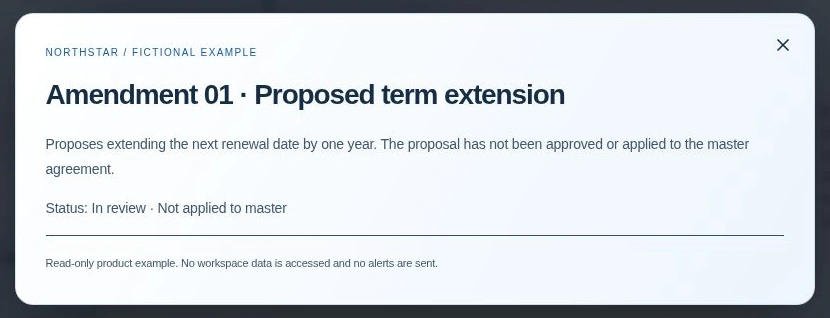
Open the Northstar example below. The proposed amendment would extend the renewal by one year, and the visible status says it is still in review. Ask a reviewer which date they would put on the calendar today and what evidence would cause them to change it. A reviewer who opens the proposal and immediately pushes the reminder out a year has demonstrated a problem a faster search alone cannot solve.
Bring the Brightwell test back to the buying decision. Give the candidate system three executed amendments and one unsigned proposal. Have a second reviewer find the May headquarters charge, the April depot rate and the document that is still under discussion. Save the source links and the reviewer’s reasoning in the worksheet. Reopen them a week later from the account of the person who would actually approve payment.
For the full workflow, read how to plan a contract repository migration.
 View full-size screenshot
Shared Drive to Central Repository Readiness Audit
Run each task in both systems with the same signed samples. Record the observed answer, elapsed time and follow-up owner. Start with this fictional supplier family.
Preview a completed worksheet row
- Test task
- Verify May headquarters equipment and inspection
- Sample record or role
- Master + A1 + A3
- Expected evidence
- A1 supports $110 equipment and A3 supports $6 inspection
- Shared drive result and time
- To test
- Repository result and time
- To test
- Owner and next step
- Finance · reconcile the two invoice lines
Frequently asked questions
When should a small team keep Google Drive or SharePoint?
Keep it when a colleague can use the current setup to reconstruct signed terms, open only the right files and assign the next action without chasing the deal owner. Include the ongoing effort to maintain the register and permissions in the comparison.
Do we have to move the entire archive to evaluate a repository?
One supplier family is enough for a first test if it includes the master, overlapping signed changes, a superseded schedule and an unsigned draft. Choose a second supplier with different access requirements before widening the pilot.
Should we remove superseded amendments to reduce search noise?
Keep the historical evidence needed to explain earlier periods. Mark which term changed, when it changed and which source governs the period under review. Someone reconciling a March invoice may need a document that no longer sets today’s price.
What is the strongest sign the shared drive is costing us time?
Watch what happens when the usual contract owner is away. If an otherwise authorized colleague finds the file but cannot identify which site, rate or period it governs, count the extra messages and rechecks needed to finish that task.