 ContraxAware
Core chapter 8 of 18
Everyday Approval Routing and Escalation
Run understandable approval routes with clear decisions, escalation and evidence.
Executive summary
- Name the decision. Legal, financial, operational and signature authority answer different questions. A useful route makes each responsibility explicit.
- Match the route to the dependency. Independent reviews may run together. A decision that needs another reviewer’s answer must wait for it.
- Control the evidence. Approval belongs to an identified document and supporting information. Material changes require an impact check before the agreement proceeds.
- Measure the actual delay. Separate incomplete requests, queue time, review effort and rework before redesigning a slow process.
Part A · The Why
Define approval authority
Legal review, commercial approval and signature authority
A contract approval process should tell each reviewer what they are deciding. Legal may assess departures from approved wording. Finance may confirm affordability and payment treatment. An operational owner may accept delivery responsibilities. The authorized signatory makes a separate commitment on behalf of the relevant entity.
Write a short decision statement for every required role. “Confirm that the service can be funded within the approved budget” is clearer than “finance approval.” Include the information needed to answer, the person accountable and the evidence expected. This turns a route into a series of understandable decisions.
Keep the authority matrix outside any individual agreement’s convenience. A person who can edit a draft may lack authority to approve its commercial terms. A reviewer’s seniority or software access does not settle the scope of their delegated authority.
Give the administrator a named policy owner for ambiguous cases. Record the question and answer when a threshold or role is unclear. If the same uncertainty recurs, improve the authority matrix so the next request can follow a stable rule.
Thresholds, risk and segregation of duties
Define the basis of monetary thresholds before automating them. Annual price, total committed value and possible renewal spend can produce different answers. State how taxes, currencies, implementation charges and optional work are treated under organizational policy. Escalate uncertain inputs instead of quietly choosing the smallest number.
In a fictional policy example, a $24,000 annual service requires finance review above $20,000. Monthly billing of $2,000 does not avoid that annual threshold. If a two-year minimum commitment applies, the decision owner must assess the policy’s treatment of the $48,000 commitment as well.
Use separation of responsibilities where policy requires independent challenge. The requester should not manufacture their own exception approval by selecting a convenient colleague. Document authorized substitutes and conflict handling. The rule should remain understandable when the usual owner is absent.
What pre-approved wording does and does not authorize
A template can establish approved language for a defined use. It does not necessarily approve the supplier, price, budget, duration, data handling or service commitment. Intake information still determines whether the agreement fits the template’s intended scope and the applicable authority limits.
Check both wording and completed variables. A standard limitation clause may depend on a fee amount, defined term or selected option elsewhere. A blank filled incorrectly can change risk without altering the template’s main paragraphs.
Record which approvals remain required when the approved wording is unchanged. This avoids two common mistakes, sending every routine draft through unnecessary legal review and bypassing commercial decisions because the document came from a template. Let the organization’s approved policy determine the appropriate route.
Choose the simplest adequate route
Sequential and parallel decisions
Sequential review is useful when a later decision depends on an earlier result. Finance may need a settled commercial proposal before confirming funding. A final internal approver may need the outcome of an external review before authorizing the signing copy.
Parallel review is useful when required decisions are independent. Finance can assess a known price while legal reviews a known clause set. Both decisions still need completion, and any change affecting the other reviewer must be reconciled before the package advances.
For example, legal may propose a new service remedy with a commercial cost. That proposal creates a dependency finance did not have at the start. The contract owner should identify the change and obtain the affected decision again rather than treating parallel completion as permanent clearance.
For a fictional timing comparison, assume finance takes two working days, legal takes three and consolidation takes one. With no queue or rework, sequential review takes six days. Independent parallel review takes four. These illustrative durations are not measured software performance.
Parallel review changes the wait, not the decisions
Fictional example in working days. Finance and legal are independent. Final consolidation takes one day.
- 2 working daysFinance review
The same required financial decision appears in both routes.
- 3 working daysLegal review
The same required legal decision appears in both routes.
- 6 working daysSequential total
Finance 2 + legal 3 + consolidation 1 = 6.
- 4 working daysParallel total
Longer independent review 3 + consolidation 1 = 4.
Assumes no queue, rework or dependency between reviews. These illustrative durations are not measured product performance.
Mandatory reviewers, substitutes and unavailable owners
Distinguish mandatory approval from optional advice. A specialist may help resolve a question without becoming a permanent gate for every agreement. Conversely, a required decision must remain required when the primary reviewer is busy. A copied email is not proof that the decision occurred.
Keep a substitution rule with the authority matrix. Name the role that can delegate, the replacement’s authority and the period covered. Record the delegation on affected work so another administrator can understand why the replacement acted.
Before launching a route, check ownership and availability. A contract assigned to a departed employee can create an invisible queue. Test how role-based assignments resolve in your environment and confirm that the intended person receives the task with usable access.
Rejection, return for changes and escalation outcomes
Give outcomes clear meanings. A rejection may end the current request. A return may ask the owner to correct specified information and resubmit. An escalation transfers an unresolved decision to an authorized person. Document your organization’s definitions and verify how the software represents them.
A useful return explains what must change, who owns the correction and what evidence will allow review to resume. “Please revise” is rarely enough. If a price schedule is missing, identify the schedule and the question it prevents finance from answering.
An escalation should preserve context and decision responsibility. A reminder asks the same owner to respond. It does not transfer authority. Neither silence nor an overdue task should become approval unless a specifically applicable, authorized policy establishes a valid outcome and the process implements it correctly.
A fictional case — the route that blamed legal
Harbor Retail’s practice team routes the fictional $24,000 annual Northstar services draft to finance and legal. The requester describes the delay as five days “in legal.” A closer review of the exercise log shows two working days waiting for missing service details, two days in a reviewer’s queue and half a day of assessment. Clarification and resubmission use the remaining half day.
The process owner first repairs intake. The request must identify the service owner, complete price schedule, relevant draft and requested start date. The team then gives reviewers a concise issue summary. None of these changes alters the required authority or implies that the Northstar proposal has been approved.
The lesson is specific. Reducing the half-day assessment would address only one tenth of the recorded elapsed time in this example. Better completeness and queue ownership may offer more practical improvement. Measure the revised process before claiming a result.
The UK Contract Management Professional Standards provide a useful public-sector reference for professional responsibilities. Adapt the ideas to your organization’s roles and authority. The framework does not impose a universal private-sector approval policy.
Keep approval meaningful
Document version and evidence reviewed
An approval record needs an identifiable document. Preserve the version reference, reviewer, decision, time and supporting material. If approval depends on a particular price schedule or risk assessment, connect that material too. A green status without this context is difficult to interpret later.
Check whether the reviewer saw all relevant attachments. The agreement’s main body may incorporate an order form, service description or security schedule. A route that presents only the first file can create an incomplete decision even when everyone responds promptly.
Write a compact review cover note. Identify what changed, the questions requiring decisions and any unresolved dependencies. Keep it factual and link it to the underlying material. The note helps reviewers orient themselves without replacing their responsibility to assess the documents.
Decision reasons and unresolved conditions
A decision should say what was approved and any limit on that approval. A reviewer might accept a proposed price subject to a documented budget allocation. Record who confirms the condition and what evidence satisfies it. Do not let a conditional decision disappear into a generic completion label.
Separate a contractual condition from an internal operating task. Counsel may need to decide whether a condition belongs in the agreement. The administrator needs to make the outstanding work visible, with an owner and a checkpoint before the relevant next step.
Keep reasons proportionate to risk. Routine approvals may need a short reference to the applicable policy. An exception needs the departure, authorized decision and scope. The goal is to preserve enough meaning that a new owner can administer the agreement confidently.
Cycle time, queue time and bottlenecks
Define the clock before comparing results. Overall cycle time may start at the first request or at receipt of a complete package. Report which definition you use. Otherwise improvements can appear simply because the measurement starts later.
Separate time waiting for information, waiting for a reviewer, active assessment and rework. Use business or calendar time consistently. Record reopened stages and their reason so returned work does not vanish from the performance picture.
Keep overlapping reviews separate when calculating total elapsed time. Two reviewers working during the same afternoon do not create two afternoons of calendar delay. Report their individual effort and the package’s elapsed time as different measures, with a clear start and end event for each.
Review a small sample of delayed agreements with the people involved. A recurring missing attachment calls for a better intake requirement. A specialist queue may need capacity or delegation. Repeated material changes after approval may point to premature routing. Match the remedy to the observed cause.
Compare similar agreement types and levels of complexity. A negotiated service agreement with several exceptions should not be judged against a routine unchanged NDA without explaining the difference. Use the comparison to improve the process, while keeping necessary review effort visible and appropriately valued.
Part B · The How
To test an approval route in ContraxAware’s contract management software, send through two otherwise identical requests on opposite sides of a spending threshold. Check who receives each one and what evidence the requester sees afterward.
Set up a basic approval route
Select reviewers and required order
The reference below shows the actual Review & approve setup for Northstar Services Agreement. It identifies Saved document version 1 and current contract details. The example shows a prepared route. Check the actual request and decision records separately to establish whether review has started or finished.
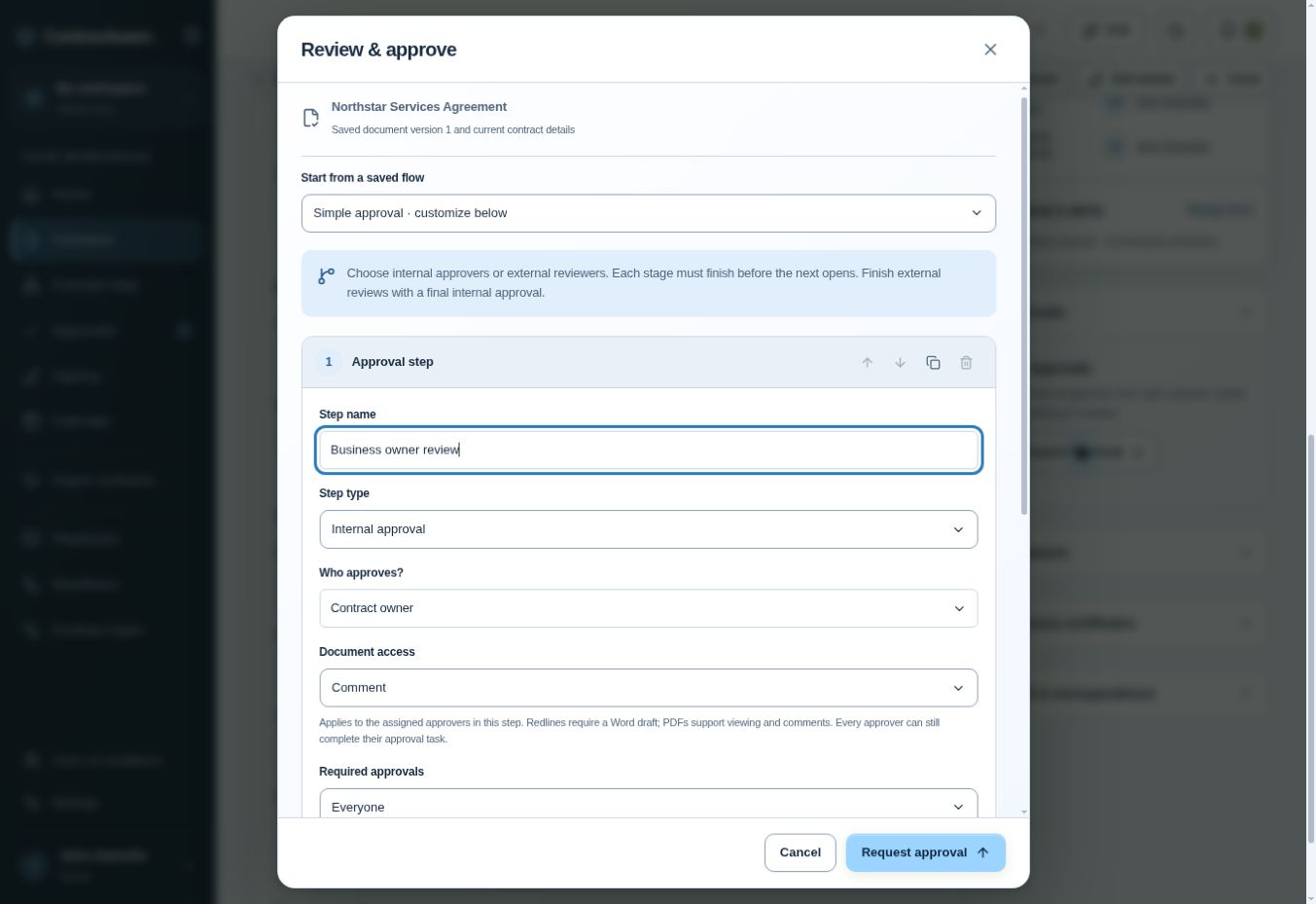
- Check the reference. Confirm the saved document and details match the intended review package.
- Inspect the starting flow. Start from a saved flow shows Simple approval · customize below in this example.
- Identify the stage. Step type is Internal approval, and Who approves? is Contract owner.
- Check participation. Document access is Comment, while Required approvals is Everyone.
Each selection answers a different question. Access governs document participation, while the approval rule governs the required decision. Follow this example as a sequential route. Its guidance states that each stage finishes before the next opens, so confirm the order matches the decisions you need.
Use clear stage names and due expectations
The visible Step name is Business owner review. In your own route, use a name that tells the reviewer which responsibility applies. Pair it with a short decision request in the supported description or accompanying review note, after verifying where that information appears.
Open Timing & conditions in your training route and inspect the available choices. Match the settings to the approved practice plan, including the due-time basis and responsible escalation owner. If an option does not support your required rule, record a manual checkpoint instead. Check the resulting task before relying on the setting.
Use the visual contract workflow designer when the process needs broader orchestration. Begin with the decision and handoff requirements, then verify the resulting configuration through a test. Chapter 17 develops conditional branches and more demanding exceptions.
Test the route with fictional accounts and no external sends
The setup footer contains Cancel and Request approval. Preparing the route does not establish that an approval request was sent. For a configuration-only exercise, inspect the fields and use Cancel after recording the intended setup. Keep real recipients out of the test.
For a full practice run, first use an authorized training environment with controlled accounts and notifications. Have the facilitator confirm every recipient, role and assignment. Then test the configured flow. Check that the designated recipient receives the task and can open the intended document before marking the handoff complete.
Approve from the reviewer perspective
On the training record, open Approvals and choose Review & respond. Match the title and saved version to your request. Post a practice comment in Discussion, select Approve, then Confirm approve. The manager can now open Signatures and select Review & prepare signatures. Check the recorded decision before continuing.
Open the document and supporting information
Switch to the intended reviewer’s training view. Confirm the agreement, saved version, assigned decision and supporting attachments. Verify that the reviewer can open the material they need and that access matches the assignment. Review contract permissions when a participant cannot see the required information.
Use a short checklist in the practice log. Does finance see the price schedule? Does legal see the relevant exception? Does the operational owner see the service obligations? A task received successfully can still be unusable if its evidence is missing.
Ask the reviewer to restate the requested decision in one sentence. If they cannot, revise the request before measuring their response time. This simple check reveals whether the route delivered a meaningful assignment or merely moved a document into another person’s queue.
Compare the reviewer’s received task with the route you configured. Check the assigned role, document reference, decision requested and access to supporting material. Record any mismatch and correct it before continuing the exercise. A configured assignment is useful only when the right person can act on the right package.
Record an authorized decision or request changes
Read the package against the assigned question and authority. For the Northstar practice price, finance checks the $2,000 monthly fee and $24,000 annual amount against the supplied fictional budget. Legal considers the designated draft issues. Neither role should claim to have completed the other’s assessment.
When information is missing, describe the required correction. A useful return might request the omitted service schedule and identify why its absence prevents a decision. Record the outcome using the verified controls available in the training reviewer view.
After submitting a practice decision, reopen its evidence. Check the reviewer identity, outcome, version and reason. If the system separates comments from formal decisions, verify both. A helpful comment should not be mistaken for the required approval response.
Run this check as the assigned reviewer, using the access they actually hold. An administrator’s broader permissions can hide a problem that the reviewer will encounter. Record the tested role and any access correction so the result can be repeated during onboarding.
Confirm that the next owner and status are visible
Observe the actual handoff after the practice decision. Identify the current owner, document reference and next required action. Confirm that the prior response remains available. A status change without a responsible next person leaves the process incomplete.
For a return, the requester should understand what needs correction. For completed review, the administrator should know whether another required decision remains. For escalation, the authorized replacement should receive the unresolved question and its context.
Handle ordinary exceptions
Follow a rejection or absent-reviewer path
When a request is rejected, identify whether policy closes it or allows a new submission. Preserve the rejection reason and reference. Do not relaunch the same package repeatedly in search of a different approver without an authorized change in circumstances.
If the reviewer is unavailable, follow the delegation rule. Record who authorized the replacement and confirm that the replacement has suitable authority and document access. Test the reassignment behavior in the training environment before relying on it for an urgent agreement.
Escalation should solve a decision problem. A manager may remove an information blocker, provide a qualified delegate or decide a permitted exception. Adding more names without clarifying their responsibility can make an already slow route harder to complete.
Repeat review after a material change
Compare the revised draft with the approved reference. Identify which decisions depended on the changed terms. A payment edit can affect finance even when the total price is unchanged. A revised service description can affect operational acceptance and legal risk.
Prepare a change summary and route the new version according to the applicable policy and product behavior. ContraxAware’s public guidance connects approval to the saved content and requires fresh approval after adopted redlines create a new version. Confirm the actual state before preparing signature.
Retain the earlier decision as historical evidence. It explains the prior position, but it should not be presented as approval of wording the reviewer never saw. Record the new version and the renewed decisions needed for the current handoff.
Preserve the approval record before signing; advanced branches are in Chapter 17
Before signature preparation, assemble the approved document, required decisions, satisfied conditions and signer-authority reference. Confirm that the signing copy matches the approved content and incorporated attachments. Resolve unexplained differences before proceeding.
Keep the final approval record easy to retrieve with the agreement. The contract approval workflows page describes the product’s broader review capabilities. Your operational evidence must establish what happened for this particular document.
Practice — route, return and reconcile
Use a fictional Northstar training copy and a facilitator-approved finance and legal authority matrix. The exercise starts with an incomplete supporting schedule. The intended outcome is a corrected package with identifiable approval evidence, not merely a completed series of tasks.
- Prepare the packet. Record the training version, $24,000 annual fee, missing schedule and required decision owners.
- Design the route. Explain whether finance and legal decisions can proceed independently. State any final consolidation requirement.
- Test the return. Have the designated reviewer request the missing schedule with a clear reason and correction owner.
- Correct the package. Add the fictional schedule, assess whether content changed and identify the revised reference.
- Repeat required review. Record the decisions applicable to the corrected package and any conditions still open.
- Verify the handoff. Identify the exact approved version, remaining work and authorized next owner before signing.
Your evidence includes the route rationale, return reason, corrected material and final decision references. A peer should be able to distinguish the first incomplete submission from the package that was actually approved. If that distinction is unclear, repair the record.
For a worked return, call the first package A and the corrected package B. These are exercise references, not product version numbers. Finance returns A because the service schedule is absent. The correction owner adds the schedule and discovers that the payment clause also changed. Their resubmission note identifies both changes and connects B to the original return.
Suppose legal reviewed A before the correction. The administrator compares the payment wording and obtains the required renewed review of B. If the usual legal reviewer is unavailable, the authority matrix identifies an authorized substitute. The administrator records the delegation, confirms the substitute can open B and supplies the original issue with the change summary.
The completed evidence must identify which decisions apply to B, who made them and which conditions remain. An old response on A stays in the history. A message saying “schedule added” is insufficient because it omits the payment change. A forwarded task is also insufficient until the authorized substitute actually receives the right package and records the required decision. This is the difference between moving work and verifying its completion.
For the advanced challenge, classify the five-day fictional delay described earlier. Two days concern incompleteness, two concern queue time, half a day concerns assessment and half a day concerns clarification and resubmission. A strong answer proposes better intake and queue ownership, retains necessary review and defines a comparable measurement period. An answer that simply removes legal misses the evidence.
John's Builder Note
I would ask one question about every approval step. What decision becomes safer or clearer because this person participates? If the answer is vague, clarify the responsibility before adding another gate. A simple route with accountable decisions is easier to learn, maintain and improve. Its value comes from the evidence it preserves as much as the speed with which tasks move.
Questions from the field
Can a reminder automatically replace an unavailable approver?
Treat reminders and delegation as separate actions. A reminder requests attention from the current owner. Replacement requires an authorized rule, a qualified person and verified access. Confirm the configured behavior rather than assuming that an overdue task transfers authority.
Should every contract receive the same approvals?
Use the organization’s approved criteria for value, risk, agreement type and exceptions. A consistent decision framework can produce different routes. Preserve the reason a route applies so a future administrator can explain why a particular specialist was required or appropriately omitted.
What if an executive asks us to skip the process?
Check that person’s delegated authority and the applicable exception procedure. Record the authorized decision and its scope, including any requirements that remain. The UK Contract Management Playbook offers a public-sector practice reference, while your organization must define its own applicable governance.
Optional knowledge check
Choose your answer, then open the explanation.
Show answer
No; commercial authority still applies. Approval of wording is separate from authority over spend, discounts, risk and execution.
Show answer
The reviewer, decision and exact document reviewed. A defensible record ties an accountable decision to the document and supporting information.
Show answer
To let independent required decisions proceed together. Parallel review can reduce waiting when the decisions do not depend on each other; it does not remove authority requirements.