
Key takeaways
- Keep the signed subscription order and its amendments together. Each order can have its own term and notice window.
- Verify seat counts, rates and effective dates before Finance uses them. A single current-value field can hide half a year of billing history.
- Give the account owner an internal review date and keep the contractual notice deadline visible alongside it.
Find the signed order that governs the account
B2B SaaS contract management software gives the people who sell, review and renew subscriptions a shared record of what each customer signed. Start the evaluation with one closed deal. Give Sales, Legal and Finance the customer’s name and ask each to find the order that sets the subscription price. Three different PDFs are a useful finding before the demo even starts.
In this fictional deal, Juniper Harbor signs a master services agreement (MSA) and Order Form OF-1042. The MSA sets the notice method. The order sets seats, price, term and the notice period. A signed expansion later changes the seat count on that order. Store all three in a central contract repository. Give each a document ID, signature status and a link to its parent. A second order for another product would get its own record and renewal terms.
Try it in a demo. Search for Juniper Harbor and open the executed expansion from the original order. Ask a colleague to identify the current seat count and show the page that supports it. Keep an unsigned expansion quote in the same test packet so you can see how easily someone could mistake it for an executed change.
Which document answers each question?
| Question | Signed source in the example | Who needs the answer |
|---|---|---|
| How do we deliver formal notice? | MSA §9 sets the delivery method and recipient. | Legal verifies the instructions. |
| Which order is renewing? | Order Form OF-1042 §§2 and 4 set price, term and notice period. | Customer success owns the review. |
| What changed on April 1? | Expansion A1 §1 adds 20 seats to OF-1042 at $40 per seat per month. | Finance applies the change to the correct period. |
Extract the price in effect on the invoice date
Order Form OF-1042 §2 grants 100 seats at $40 per seat per month from October 1, 2026 through September 30, 2027. Signed Expansion A1 §1 adds 20 seats on April 1, 2027 at the same rate through the original term end. Ask the reviewer to use contract data extraction to capture the quantity, unit price, currency, effective dates and source for each period. The proposed values need a human check against both documents.
For March, Finance should be able to verify $4,000 for the monthly subscription. For April, the same test should return $4,800. Six months at each rate gives $52,800 for the first term, before any separate charges. Multiplying April’s price by twelve gives $57,600 and quietly backdates the expansion. Ask the reviewer to show both dated rows before approving the billing handoff.
Leave the next term’s price open if the packet does not establish it. Record the question and who will resolve it. A renewal forecast may contain an estimate. The contract record should show which rate has signed support.
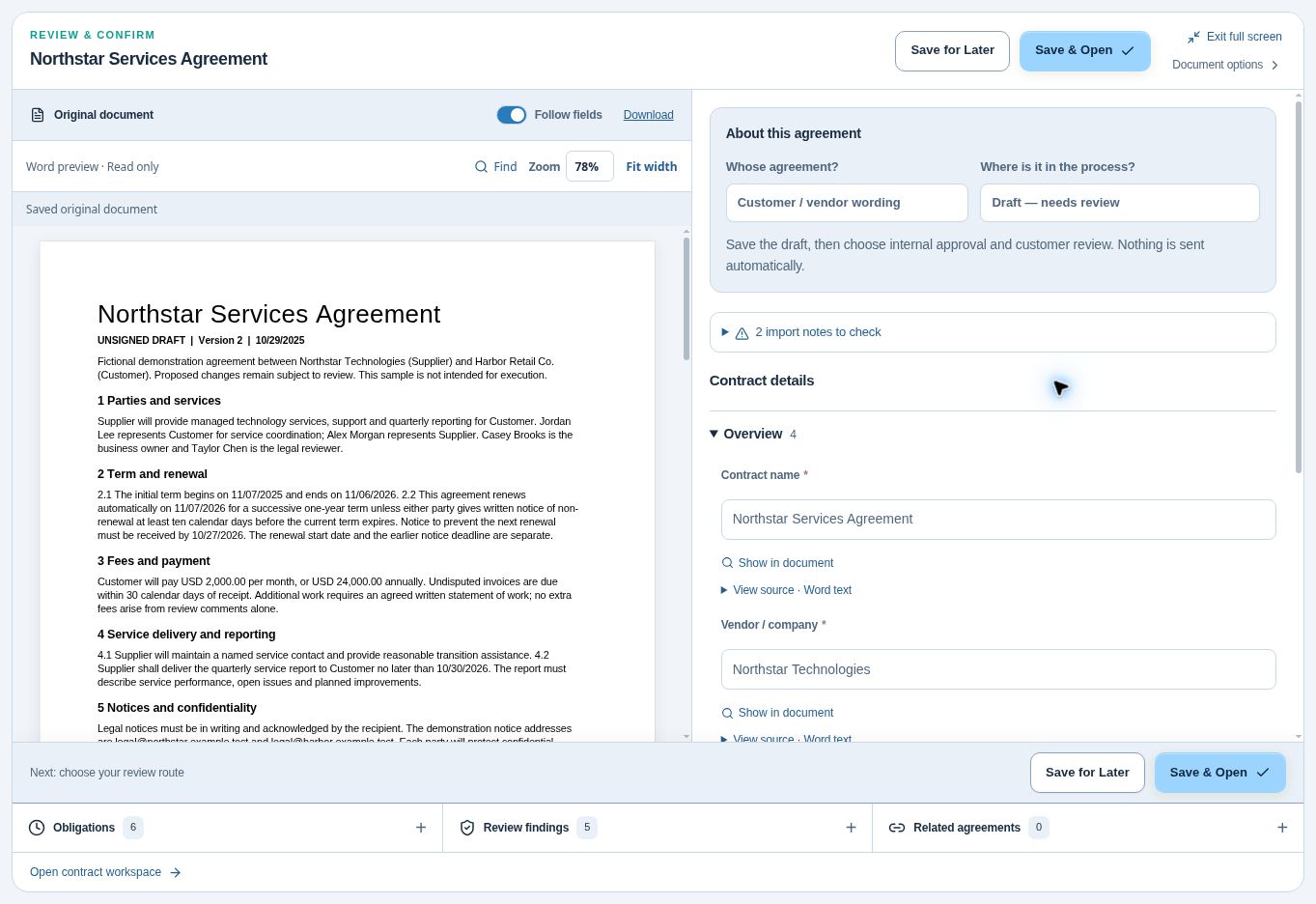 View full-size screenshot
Set the account review before the notice cutoff
In this example, Order Form OF-1042 §4 says either party’s written non-renewal notice must be received at least 45 calendar days before the September 30, 2027 term end. The expansion changes only seats. Counting back 45 days gives Monday, August 16, 2027. If the account team checks only a September renewal list, its window for this decision has already closed.
In contract reminder software, give the customer success owner an internal review on August 2. Assign a backup to check for a decision on August 12. Keep the August 16 cutoff tied to the order and the delivery instructions in MSA §9. If someone sends notice, retain the delivery evidence and record when it was received. Closing an internal reminder records the work done inside the team.
For a published example of this document structure, Common Paper’s Cloud Service Agreement ties each order form to its own subscription period and non-renewal notice date. For an actual account, use its executed documents to establish the date, recipient and method.
Follow a notice deadline and its source obligation
22 seconds. The Northstar training agreement shows how a notice deadline, an obligation owner, and source wording appear in Contract Map.
Read the video transcript
- 0:00
The Northstar agreement appears in Contract Map.
- 0:04
Selecting a tile reveals the details of a connected record.
- 0:08
The notice deadline falls before the next term begins.
- 0:12
Notice is due October 27. The next term starts November 7.
- 0:15
The obligation shows its owner, due date, and source clause.
Run a handoff test with Sales, Legal and Finance
Give the account owner, contract administrator and billing lead the same packet and worksheet. Let them work independently first. Compare the source each person selected for the April invoice and the last day for notice. If the answers differ, ask where the handoff broke down.
- Sales or revenue operations. Start from the closed deal, find the executed order and identify the named owner. Keep a reference to the contract record with the opportunity so the next account manager can find it.
- Legal or contract administration. Verify the expansion’s scope, the signed dates and the exact notice wording. Flag a missing exhibit or unclear term for review and assign the question to a person.
- Finance. Use the two effective periods to check sample March and April invoices. Keep the source order, expansion and unit price with the handoff.
- Customer success. Open the first reminder and name the decision, the customer and the next person to contact. Demonstrate how a backup finds the same record when the owner is away.
One final test. Hand the packet to someone who missed the deal call. Can they explain the $800 monthly increase and point to the August notice cutoff without asking the original salesperson? Use the free handoff worksheet to record what they found.
SaaS contract handoff worksheet
Use one row per price period or renewal action. The Worked examples tab contains the Juniper Harbor deal. Use the blank Working copy tab to test a signed customer order of your own.
Download the worksheet (.xlsx)Frequently asked questions
Can a CRM renewal date handle this example?
A CRM date can tell Sales when to start a conversation. To act on the contract, the owner also needs the signed order, applicable amendments, notice period, method and responsible person. Link the deal to that evidence and give the internal review its own date.
Which fields should we extract from a SaaS order form first?
Start with the contracting parties, order ID, subscription term, seat quantity, unit price, currency, effective period and notice language. Save the source section for each material value. Split a price into separate periods when a signed expansion takes effect midterm.
What if one customer has two subscription orders?
Keep both orders linked to the same customer and governing agreement. Verify the term end, renewal rule and amendments for each order before setting its reminders. A customer-level renewal date can hide the earlier of two notice deadlines.