Key takeaways
- A perfectly searchable but misplaced decimal can still produce a hundredfold pricing error.
- A missing page requires retrieving the source before deciding whether a clause exists.
- A twelve-file diagnostic set helps expose failure modes; it does not measure accuracy across all 400 supplier agreements.
How do you know whether AI extraction is good enough for a box of scanned agreements?
A fictional manufacturer plans to migrate 400 supplier agreements. The project lead starts with 12: three clear typed agreements, three photocopies with handwritten changes, three with dense rate tables, and three with sideways or faint exhibits. It is a deliberately tough test. It can tell the team which problems to investigate before a larger representative sample.
One original says “$18.50 per carton.” Its text layer reads “$1850 per carton.” In another packet, page 3 leads directly to page 5. An AI answer that the file contains no termination clause tells the team very little while page 4 is missing. The pricing reviewer can verify the decimal against a legible page. The records owner has to supply the missing page.
Build a small answer key
Pick fields with consequences, such as renewal notice, notice recipient, unit price and payment interval. For each of the twelve files, have a colleague record the visible value, page number, any unit or condition, and whether the page can actually be read. Give the evaluation operator the files separately from the answer key. A hard-to-read value can stay unresolved.
Choose the correction by the source defect
| Source-image check | Verified image value | Decision or next action |
|---|---|---|
| Decimal shift | Page visibly shows $18.50; text reads $1850 | Flag rate, correct sourced value, inspect similar rows |
| Missing page 4 | Page sequence jumps from 3 to 5 | Request complete packet |
| Unreadable handwriting | Renewal rider has faint marginal edit | Request legible copy and human interpretation |
Look at the image as well as the extracted text
In an approved viewer, compare a short selection from body text, a number in a table, and a page with handwriting. Verify page order and page count where possible. OCR produces machine-readable text from images; extraction then tries to identify useful facts. A misplaced decimal in the text layer and an accurately read number assigned to the wrong field require different fixes.
Count the errors that would change a payment or deadline
Record the source page, visible value, extracted value and consequence for each test. Classify a missing page separately from a misread number or a correctly read number assigned to the wrong field. Count the high-impact fields that would have changed an invoice, reminder or obligation. Track the minutes required to correct and recheck them so the migration estimate includes real reviewer time.
Send each exception somewhere useful
Import a representative supported document through ContraxAware and inspect the proposed details beside the original source. Route a missing page to the records owner and a poor image to the person who can locate or rescan the original. Preserve the original file, identify any derived copy, and hold operational deadlines or amounts until a reviewer can support them.
Check the image first
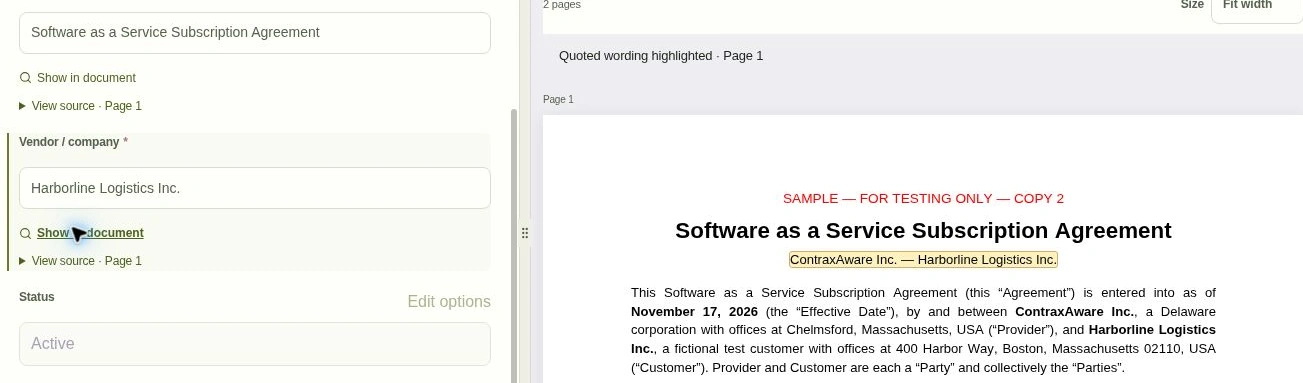
Before loading the archive into contract management software, include the twelve test files in a trial import. In Review & Confirm, compare the proposed amount with the source image. Keep unresolved fields out of downstream work and preserve the original when requesting a new scan.
The U.S. National Archives digitization quality guide offers background on checking capture quality and completeness.
During import and onboarding, keep a copy of the test pages. Try full-text contract search on a distinctive phrase from each page and compare the result with the scan, especially where a decimal point could disappear.
For the full workflow, read how to sample and validate contracts during migration.
 View full-size screenshot
Scanned-contract extraction quality test sheet
Compare results with a manual answer key. Classify the defect, assign a correction owner and verify the corrected source before releasing each field.
Preview a completed worksheet row
- Test item
- Rate table
- Reviewer’s source observation
- Visible rate is $18.50 per carton
- OCR or AI result to inspect
- Searchable text reads $1850 per carton
- Error category
- Decimal shift
- Decision for affected field
- Hold the extracted rate; record verified $18.50 with the page location.
- Correction owner
- Pricing reviewer
- Retest evidence
- Correct value, unit and page checked against the legible original.
Frequently asked questions
Does this test certify a scanning program?
It helps a team choose a migration process and review workload. The US National Archives publishes digitization quality guidance for federal records programs; its discussion of image and completeness checks is useful background.
What if a clear PDF works but a scan does not?
Record the file type and observed failure. Ask what processing the vendor supports for your input, then try the same reviewed sample again. Set a separate handling plan for files that still require manual capture.
How many documents should we sample?
Choose enough to include every common document defect and the fields a wrong answer would affect. Expand the sample when one supplier, scan batch or form repeatedly fails.
Who should resolve the correction queue?
Name a document owner for missing originals and a contract reviewer for unclear terms. Give each exception an owner, evidence requirement and follow-up date.