
Key takeaways
- Use one start event, one finish event, and a consistent time unit for each group of comparable agreements.
- Measure pickup, review, and rework separately wherever the evidence supports that distinction.
- Show the age of open requests alongside completed cycle times so stalled work remains visible.
Agree on what starts and stops the clock
Write the measure in a sentence everyone can use. For example, “For supplier service agreements signed this month, report calendar hours from acceptance of a complete request to the last required signature.” Define what makes a request complete, where the acceptance is recorded, and where the signing event comes from. Use the same time zone when comparing timestamps.
Also keep the original submission date. If a customer sends a draft on Monday and the business supplies the missing scope on Thursday, that interval matters to the customer. A complete-request clock is useful for understanding the work a review team can act on. A separate submission-to-ready measure makes friction at the front door visible. Relabeling Monday as Thursday would make the chart look better while the customer waits exactly as long.
Start with a comparable group. A standard inbound confidentiality agreement, a negotiated services agreement, and a corporate acquisition have very different decision paths. Record the number in the group. If a group is small, show its individual cases and resist declaring that one long negotiation represents a trend.
Put a time against each transfer of responsibility
For the handoff under investigation, capture the preceding owner’s ready time, the receiving owner, the first acknowledgement or other reliable evidence of pickup, and the completed decision. Use timestamps from the approval record, document history, or associated message. A due date tells you when somebody wanted a decision. It supplies no evidence that the receiver started work.
Calculate pickup delay as pickup time minus ready time. Calculate elapsed review time as decision time minus pickup time. The second measure may include interruptions and time waiting for clarification. Describe it as elapsed time unless you have separate evidence of hands-on work. When the pickup event is missing, record the whole ready-to-decision interval and mark the breakdown unknown.
Track a document returned for changes as a new review round with the same agreement reference. Keep which version went back, who needs to resolve it, and when the revised package became ready. Otherwise, a team can appear to start very quickly simply because someone reopened the clock halfway through a difficult agreement.
A four-day contract with a two-day pickup delay
In this fictional example, a facilities team requests a supplier agreement. Its scope and pricing are complete at 9 a.m. Monday. The contract manager sends a reviewable package to Finance at 3 p.m. that afternoon. The reviewer acknowledges it on Wednesday at 3 p.m. and returns a pricing decision Thursday at 9 a.m. The approved draft is sent for signing Thursday at 3 p.m. and the last required signer completes it Friday at 9 a.m.
Monday at 9 to Friday at 9 is 96 calendar hours. Of that, 48 hours elapsed before Finance acknowledged the package. Legal completed a parallel wording review between Tuesday at 9 and Wednesday at 9. Adding those 24 hours to 96 would count the same day twice. Keep both workstreams visible and identify which decision actually held up the next handoff.
A little evidence changes the proposed remedy. If Finance first saw the request on Wednesday because the role mailbox had no assigned backup, a better price-approval template is unlikely to help. If the reviewer picked it up on Monday but requested three missing quotes, improving the intake packet is a better experiment. Confirm which description fits with the receiving reviewer before changing the process.
Where the 96 elapsed hours went
- 6 hours · prepare
Monday 9 a.m. to 3 p.m. The complete request becomes a reviewable package.
- 48 hours · wait for pickup
Monday 3 p.m. to Wednesday 3 p.m. The Finance decision is waiting for acknowledgement.
- 18 hours · reach a decision
Wednesday 3 p.m. to Thursday 9 a.m. The reviewer returns a pricing decision.
- 6 hours · prepare for signature
Thursday 9 a.m. to 3 p.m. The approved version moves to signing.
- 18 hours · complete signing
Thursday 3 p.m. to Friday 9 a.m. The final required signer completes the agreement.
Use the agreement record to verify the endpoints
Use the saved draft and review decision to confirm that the reviewer was asked about the version that ultimately advanced. ContraxAware’s contract approval workflows support sequential and parallel review. Connect the decision being measured with the relevant document and required reviewers. If revised wording reopened a decision, log the extra round.
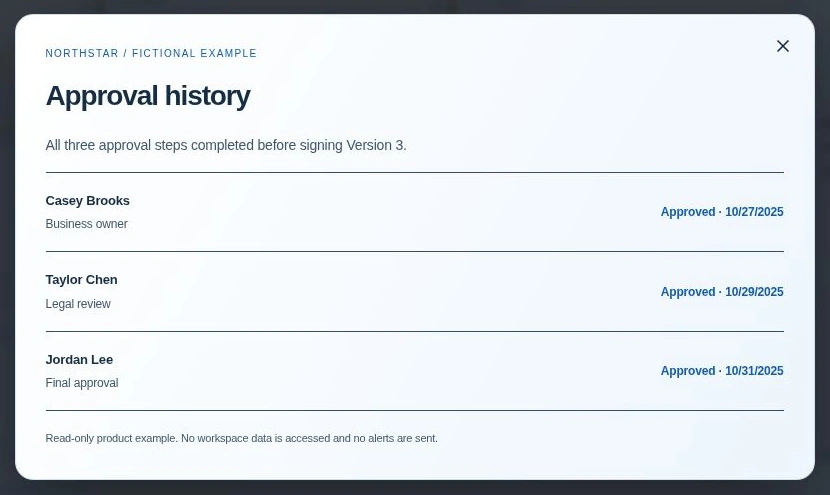
In the fictional Northstar approval history below, the business owner approved on October 27, Legal on October 29, and the final reviewer on October 31. All three decisions concern Version 3. This establishes the sequence of approvals. To explain the two days between October 27 and 29, look for when Legal received a complete package and when it acknowledged the work. The dates in this view alone cannot allocate those two days between waiting and review. Watch the short walkthrough to see how to open the dated history.
For a request-to-signature metric, confirm the last required signature in the signing record. If the source only supplies a date, calculate whole days under a stated convention or obtain a timestamp before reporting hours. Inventing 9 a.m. because a spreadsheet expects a time gives a wonderfully precise wrong answer. If execution occurred Friday and the signed file was stored Monday, track filing lag separately. See how ContraxAware follows an agreement through signing.
 View full-size screenshot
Read the decision dates in an approval history
20 seconds. This edited walkthrough opens the completed approval history of a fictional Northstar agreement and identifies the saved version covered by all three decisions.
Read the video transcript
- 0:00
Open View approval progress on version 3 of the Northstar Services Agreement.
- 0:05
The current document shows Approved with three of three steps complete. Choose Open approval.
- 0:10
The business owner approved on October 27, 2025. Legal approved on October 29.
- 0:15
Final approval followed on October 31. All three decisions apply to version 3 before signing.
Change one handoff and measure the same group again
- Review the oldest open requests as well as completed work. Record an “as of” time and the current owner. A request that has waited 18 days for budget approval will never appear in last week’s completed median.
- Choose an intervention the receiving team can own. For an uncovered mailbox, assign a duty reviewer and backup. For repeated price questions, add the approved price schedule to the definition of a complete packet.
- Set the comparison before making the change. Use the same agreement type, start and finish definitions, time unit, and exception policy. Compare pickup delay, total elapsed time, and the number of requests returned for rework.
- Check for a new queue downstream. Faster Finance pickup may simply move the wait to signature. Revisit the full elapsed interval and talk through any case that took an unexpected path.
For a small sample with durations of 72, 96, and 144 hours, report the median as 96 hours and show that it is based on three completed agreements. Include the open queue separately. For a broader view of renewal and performance measures, use the contract performance KPI guide.
Contract handoff timing worksheet
Use one row for each review round or handoff. Use a common time zone. Subtract ready from pickup for queue delay, and pickup from decision for elapsed review. Mark an unavailable time as unknown. Overlapping rows should not be added to calculate total cycle time.
Download the worksheet (.xlsx)Frequently asked questions
Should we use business days or calendar days?
Use the measure that matches the decision. Calendar time represents the elapsed wait a counterparty experiences. Business time can support staffing decisions if you define working hours, weekends, holidays, and time zones. Label the unit on every report.
How do I measure two approvals happening at once?
Keep individual ready, pickup, and decision events for both. Overall elapsed time runs from the first required start to the last decision needed for the next step. Summing overlapping approval durations inflates the result.
What do we do with a contract placed on hold?
Keep the original elapsed time, the reason for the hold, and the dates it started and ended. If you also report time excluding an authorized hold, label the adjustment and show both values. A counterparty waiting for a decision experiences the full interval.
What if a contract is withdrawn or never signed?
Give it a distinct disposition and preserve its age. Exclude it from the stated sample of signed agreements, then report withdrawals and still-open work separately. That keeps the completed measure interpretable and prevents difficult work from disappearing.