
Key takeaways
- Count agreement families and source files separately, and give every file a disposition.
- Have a colleague verify the controlling document, notice instruction, and owner against the source.
- Expand only when your users can pass the agreed tests with their ordinary access.
Days 1–5. What must the pilot prove for procurement?
Ask procurement to bring one recent question somebody had to answer by opening several folders. “Which service levels apply to the east warehouse?” is a useful test. “Can I search?” is too easy. Agree on two more questions, such as who can approve a renewal decision and whether a branch manager can open a restricted rate schedule. Write down the known answer, the source that supports it, and the person who can settle a disagreement.
Select a portfolio small enough for a person to check every agreement. Include one messy family with an amendment, one restricted file, and one draft whose name sounds suspiciously final. Decide which records are outside the pilot. A one-page charter should name the business sponsor, migration lead, source custodian, permission owner, and person who can accept the result. In a small team one person may wear several hats. Someone besides the importer should perform the final lookup.
Copy the source material into a controlled staging location and retain the originals through reconciliation. Record who may continue adding files to the old location during the pilot. A new amendment arriving on day 12 deserves a line in the inventory and an owner to process it.
Five checkpoints for the pilot owner
- Days 1–5
Name the portfolio, the roles and the questions users must answer.
- Days 6–12
Give every source file a disposition and identify document families.
- Days 13–19
Review imports against source wording and reconcile exceptions.
- Days 20–25
Test retrieval, role access, and a newly arrived amendment.
- Days 26–30
Collect acceptance evidence and decide which records can move into use.
Days 6–12. Account for files before creating records
Give each source file an inventory row. Capture its location, agreement family, document type, apparent signature status, access restrictions, and planned treatment. A master agreement can have several related records. A duplicate scan might need no second record at all. Use agreement relationships to keep a base agreement, an amendment, and a statement of work distinguishable.
In a fictional North Quay Facilities pilot, procurement supplies 22 files. Twelve are signed base agreements, four are executed amendments, three are signed statements of work, two are copies, and one is an unsigned draft. The working inventory has 22 rows. The expected production set contains 19 signed documents grouped under 12 base agreements. The copies and draft keep their source references and documented dispositions. A count of 19 by itself proves very little.
For a possible duplicate, check parties, dates, signature pages, attachments, and substantive text. If one version has a different rate appendix, return it to the custodian for identification. Leave the disputed record out of decisions that depend on the missing answer. Keep that exception on the inventory until a named person resolves it.
Days 13–19. Import and review the fields that drive decisions
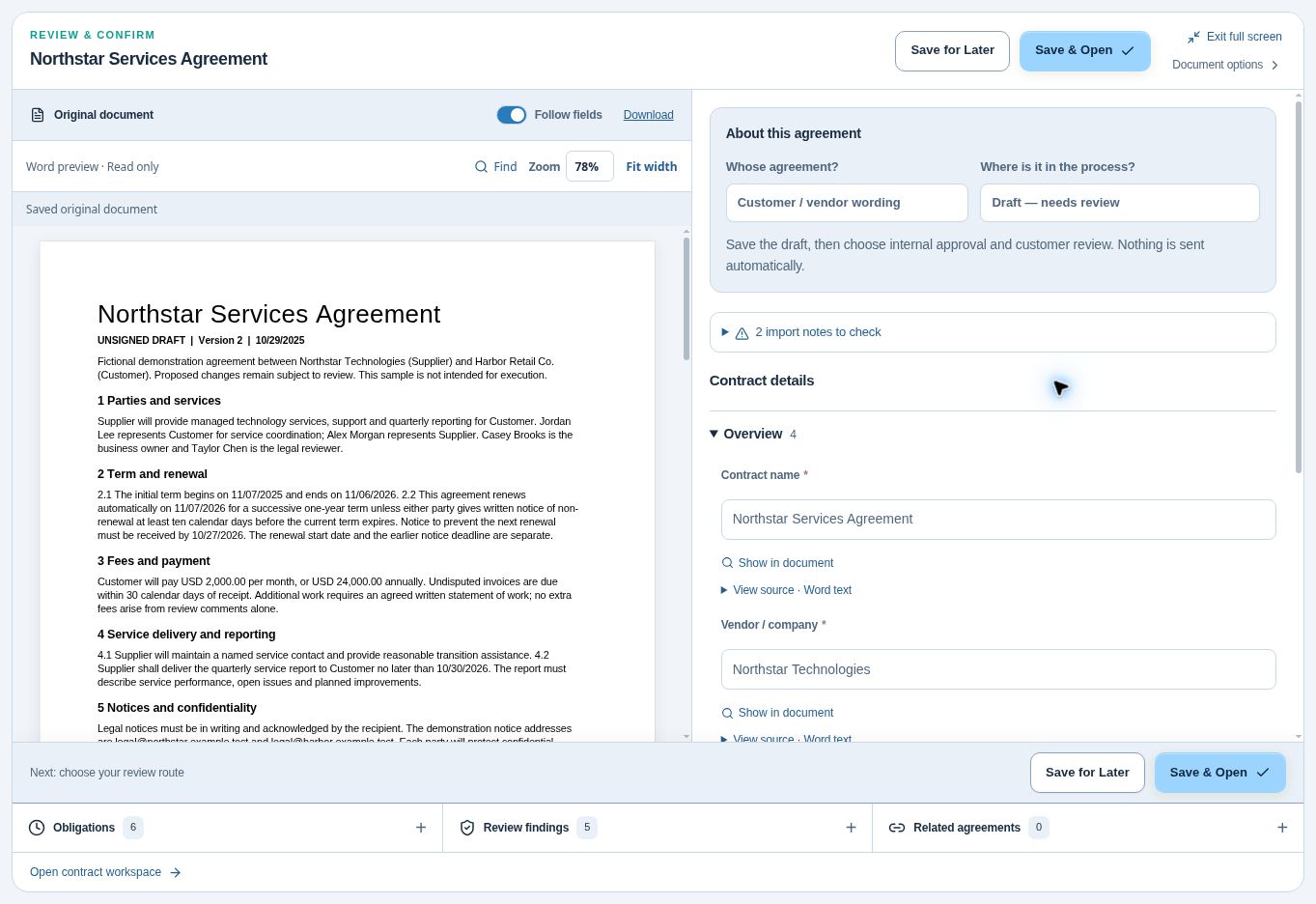
Start with one complete family and test the field mapping before bringing in the rest. In ContraxAware’s batch import workflow, use contract data extraction with source citations to check a proposed field against the signed wording. Identify whether the file is an unsigned draft or an executed agreement. Check the legal party, effective date, renewal language, and internal owner. Record the exact page or section supporting material fields. A blank with a dated follow-up can be more useful than a confident guess.
In the North Quay example, Amendment 2 changes the support hours at one warehouse. Ask a reviewer to open the signed amendment, identify the affected site, and leave the other locations’ hours alone. If the signed appendix is missing, log who will retrieve it and what decision it affects. For records with a near-term notice, the old reminder owner keeps responsibility until the new date, source, and recipient have been verified.
At the end of each batch, reconcile expected documents, records actually accepted, and open exceptions. Check retries against the inventory before importing again. A vendor’s third copy of the same MSA rarely improves the terms.
 View full-size screenshot
Days 20–25. Give a colleague the questions and step away
Ask a procurement analyst to sign into the contract management software with their usual account and answer the original questions. Have the analyst identify the governing warehouse hours, open the source page, name the responsible owner, and explain the next action. Record what they actually found. If the answer depends on knowing the importer’s preferred filename, the search test needs another pass.
Use a restricted sample document with no confidential content for the access check. An authorized role should be able to perform its job. Run the same lookup with a role that should lack access and check the direct document link as well as the search result. Have the access owner record the tested roles and outcome. If a restricted sample is visible to the wrong role, hold expansion, correct the permissions, and retest both roles.
Test one new arrival, too. Give the team a later amendment and ask who will classify it, relate it to the agreement, and review the records it changes. The contract repository also needs an owner for the next amendment that arrives on a Tuesday morning.
Days 26–30. Make the release decision explicit
Give the sponsor a short acceptance record. For this pilot, every source file needs a disposition, every material action needs verified wording and an owner, and every access test must match the approved role map. These are example acceptance criteria. Agree your thresholds before testing and keep the evidence with the decision.
Separate cosmetic findings from problems that change an operational answer. A shortened vendor display name might go into a cleanup queue. A notice deadline tied to the wrong agreement stays with the named reviewer and the existing reminder owner until corrected. The sponsor can approve a subset, record exceptions, or hold the expansion. Document exactly which agreement families the decision covers.
Give the department one place for new contracts, one way to submit corrections, and a date to review open exceptions. Schedule the next department only when somebody owns its intake. The most valuable deliverable from the pilot is a procedure a second team can repeat without its original project lead.
Repository pilot acceptance worksheet
Use one row per test. Replace the fictional portfolio, expected answers, and roles with yours before running the pilot. Retain the evidence reference and retest date when resolving a finding.
Download the worksheet (.xlsx)Frequently asked questions
Should we wait until every document is clean before importing?
Start with a complete sample family and an exception register. Move verified records into use according to the pilot rules. Identify the unresolved file, its owner, and the decisions that depend on it. A pending issue in one family need not hold every independent family.
How do we handle a missing signature page?
Record what is missing, keep the available version identifiable, and ask the custodian for the executed copy. Have the appropriate reviewer decide how the business should handle an urgent question in the meantime. Avoid presenting the incomplete file as a verified signed original.
What belongs in a second import wave?
Choose a set that tests a new but manageable condition, such as restricted pricing or several statements of work under one master. Reuse the original acceptance worksheet and add the decision the new department must make.
When does the old spreadsheet stop driving reminders?
Set a cutover for a defined set of records. The existing owner and receiving owner should agree on the source, date, recipients, and first action for each live reminder. Keep a record of what moved and retain coverage for items that are still disputed.