 ContraxAware
Core chapter 6 of 18
Standardized Templates and Basic Clause Libraries
Create reusable templates with controlled wording, accurate fields and a clear exception path.
Executive summary
- Give each template a boundary. Identify the agreement type, the company’s role, the approved source and the person who can change it.
- Map meaning as well as text. A field can merge perfectly into the wrong sentence. Check who owes the obligation, what the amount measures, and which event a date represents.
- Inspect the agreement somebody will read. Test unusual inputs, optional wording, the signature blocks and the entire rendered output.
- Start the clause library small. Two well-described provisions with owners and limits on use are safer to reuse than hundreds of paragraphs copied from old deals.
Part A · The Why
Establish template governance
Approved source, jurisdiction and intended use
An operations manager opens last year’s service agreement and types over the supplier name. Buried on page eight is a concession for a customer who paid a large deposit. The manager has unintentionally offered that concession again. A controlled template solves this problem at its source. Whoever starts a contract can see which document the organization intended them to use.
Give the starting file a short use statement. For example, an organization might approve a domestic services form for transactions where its own entity buys routine support and no customer data will be hosted. Identify the entities and jurisdictions covered by that approval and who decided the scope. A different place of performance, a regulated service or a change from buyer to seller can take an otherwise familiar deal outside it.
Store the approval with the edition of the template it covers. A general email saying “the services agreement looks fine” tells the next administrator very little unless they can identify the attached version, the intended use and the date. Record any qualifications the approver placed on the release.
Template owner, review date and retirement policy
Name a person responsible for the business contents and someone authorized to approve the legal wording. One colleague may hold both roles in a small company, provided the organization has given that person the authority. The template administrator owns the mapping and tests. Make it clear who decides whether a change is ready for others to use.
Set a regular review date and define events that trigger an earlier review. An entity rename, new delivery model, or repeated negotiation over a sentence can all justify reopening the material. On retirement, remove the edition from the path used to start new deals and preserve an identifiable copy. A previously signed agreement and a draft already under negotiation may require different treatment. Review those records individually if the change affects them.
Keep a list of open drafts generated from a withdrawn edition when the consequences warrant it. For each draft, decide whether to continue with authorized wording, regenerate it, or seek a decision from the responsible reviewer. A silent replacement can create an unexplained difference between two copies already in someone’s hands.
Difference between a template, a clause and a playbook
A template is the starting document. A clause is a reusable provision with a defined purpose and context. A playbook records what the organization wants, what alternatives an authorized person may accept, and when a reviewer has to escalate. A services template might include a reporting clause. The related playbook might tell a reviewer who decides whether quarterly reporting can replace monthly reporting.
Naming those separately tells an administrator where a requested change belongs. “Put the supplier’s name in the first paragraph” is a document mapping job. “Add a reporting requirement to this approved form” calls for a wording and template decision. “When can a manager agree to fewer reports?” is a policy question. The WorldCC Contracting Principles provide professional context for discussions about balanced terms. The organization still selects its own language and approval rules.
Where does this change belong?
A monthly reporting agreement can change in four different places. Give the change to the person who owns that decision.
- TemplateWhich document starts the deal?
Choose the approved service agreement for the company’s role, intended use and jurisdiction.
- VariableWhich amount fills the sentence?
The practice monthly fee is USD 1,250. Twelve full months amount to USD 15,000.
- ClauseWho must send the report?
The wording assigns monthly report delivery to the supplier. Check the definitions in the full agreement.
- PlaybookWho may change the frequency?
An approved decision rule identifies permitted alternatives and the person who can decide an exception.
Ask whether a proposed edit changes the starting document, a transaction fact, an obligation or the authority to depart from policy.
Separate wording from business variables
Counterparty, entity, dates and commercial values
A reusable agreement combines fixed wording and business facts. Give every variable one meaning, a source and an expected format. A date is not fully defined until you know the event associated with it. A fee is incomplete without currency and frequency. Identify the role attached to a party name. A trading name, a paying affiliate and a legal counterparty can all be different.
Write a small mapping table for yourself before configuring software. For each variable, list where a requestor supplies it and every place it appears in the document. A customer name might be used in the opening paragraph, a notice block and a signature block. One canonical value can serve all three if the underlying entity is the same. A billing address and an address for formal notices may belong to different offices. Let them vary independently when the source language requires that distinction.
Optional provisions and prohibited combinations
Treat an optional provision as a whole unit. Removing a sentence may leave a definition, a broken reference or a promise in an exhibit. Suppose an agreement offers an optional equipment installation schedule. An edition without installation still says that payment falls due on “completion under Schedule B.” Now the fee depends on an event that cannot occur as written.
Write down the combinations the business actually sells or buys. For a training example, suppose a fixed monthly service can include a monthly report or a quarterly report, while a one-time installation has its own acceptance process. Test each allowed combination in full and try a disallowed pairing. If the form cannot prevent it, the person preparing the document needs a check or a different template. Make the choice someone must review visible.
Clause context and counsel-approved alternatives
Keep the definitions and the surrounding obligations with a clause while reviewing it. “Supplier will provide a replacement within five days” reads differently when “replacement” refers to an employee, a rented tool, or a software module. The wording may also depend on another section that defines notice, acceptance or a cure period.
For each approved alternative, record which variation the organization permits and under what circumstances. One team may allow a report in a different electronic format, while a change in reporting frequency requires a service owner’s decision. Spell out that boundary. Include the date and source of the decision so a new administrator can determine whether it still applies.
Build the habit of reading a proposed change in both directions. Ask what our organization promises and what the other party promises when we buy. Repeat the exercise when we sell. A paragraph copied without the definitions page can quietly move an obligation to your own organization.
Control quality before release
Test missing and unusual values
Create a set of test values deliberately awkward enough to expose defects. Use a long entity name, punctuation, a multi-line service description, a month-end date, and a monthly fee with cents. A happy-path example such as “Acme” and “100” will rarely reveal wrapping problems, rounding mistakes or a currency symbol appearing twice.
Leave a required value blank in one test and an optional value blank in another. A required missing value should make the gap obvious to the preparer before release. An omitted optional value should produce a clean document. A hangover such as “with offices at ,” gives a reader immediate evidence that the template needs another pass. Treatment of a legitimate zero also deserves a separate test when zero is permitted.
Check cross-references, numbering and document structure
Review the draft the recipient would see, including the signature page and every referenced schedule. Search for empty brackets, drafting instructions and old names. Check headers, footers, text in tables, and defined terms that might have survived from a previous edition. Open the document at a readable page width. A clause heading stranded at the bottom of a page may conceal a significant condition on the next page.
Read a cross-reference both ways. Start at “see section 4” and make sure section 4 covers the topic the reader expects. Start at each exhibit and find the sentence that incorporates it. Confirm that any exhibit referenced in the release copy is present and identified by the right name. Correct numbering can lead to the wrong content just as easily as broken numbering can.
Define when edits require review or a different template
Agree which changes count as filling business variables and which alter approved wording. A new sales price may require commercial approval under local policy. Changing “per month” to “per installation” rewrites the deal mechanics and may call for different language entirely. Editing the role that receives a report can change who is entitled to information.
Write a short escalation example into the release instructions. The preparer can give the reviewer the edition, exact passage, proposed wording and business reason. The reviewer can then decide the individual case and separately consider a change to the standard. A negotiated exception earns a permanent place in the library only after a person with authority approves its broader use.
A fictional case about a fee that appeared twice
Juniper Field Services used a twelve-month support agreement. Its sales team collected an annual quote on the request form, but a sentence in the template described the same field as a monthly fee. A draft with a USD 24,000 annual quote appeared to promise twelve payments of USD 24,000. The form had accepted a perfectly valid number.
A contracts administrator read the draft aloud to a finance colleague before release. They calculated USD 288,000 from the sentence and traced it to a variable named “price.” The team split the design into one approved monthly-support template and a separate route for deals quoted on another basis. It labeled the field “monthly fee in USD” and added an expected annual comparison to its sample test sheet.
The owner reviewed every open draft produced from the affected template edition. Some drafts already had corrected wording, so the team documented the decision for each. A single change to the library would have been insufficient to determine what each counterparty had actually received. Test a fee sentence by doing the arithmetic it asks the reader to do.
Part B · The How
Prepare a template in ContraxAware
Select the approved Word source for the contract type
Use a fictional service arrangement for this exercise. Juniper Field Services supplies routine reporting to Cedar Lane Stores. The practice form assumes USD, a monthly billing period and a fixed twelve-month term. Write the use statement on your release sheet and select the company’s approved Word source for that contract type in your training setup. Keep the source edition available for comparison.
ContraxAware connects intake fields to Word contract templates. Before you map anything, open the intended source and inspect the first paragraph and signature page. Check which entity is the supplier. An otherwise correct set of answers can generate an agreement that points every obligation in the wrong direction if the chosen source changes company roles.
Map placeholders to the request and record fields
The teaching template uses six variables. Map the supplier legal name, customer legal name, service description, start date, end date, and monthly fee in USD. Currency and billing frequency are fixed in this particular form. For a deal that legitimately varies either, redesign the input and the wording or choose a suitable edition before preparing its draft.
- Identify each place the approved Word source needs a business value. Make a row for the field and all its intended destinations.
- Link each variable to the corresponding request or record field using the mapping available for the contract type. Give repeated uses of the same fact one source.
- Compare the mapped result with the release sheet. Look for a field linked by a similar name even though its meaning differs.
Why this matters. A service end date and a date for returning equipment could happen to match in one example. Mapping them together would corrupt a later agreement when the dates differ. Use a second test with deliberately different values.
Keep form entry and document preview aligned
Review the supplied inputs and the resulting document side by side where available. Start with the customer name. Trace it from the input to the opening description and the customer signature block. Change that test input once and check both locations again. Repeat with the supplier name and a different fee so you can see that every intended occurrence changes together.
For a first release, ask a colleague to read the finished draft without seeing the form. Have them tell you who owes what, the period of service and the monthly price. Compare their answer with the six supplied values. A mismatch can expose a bad mapping, a conflicting fixed sentence or an unclear definition. Fix the source of the discrepancy and run the test again with a freshly generated draft.
Create and review a sample agreement
Fill fictional parties, dates and pricing
Use Juniper Field Services as supplier and Cedar Lane Stores as customer. Enter “monthly field reporting for the north district” for the service. Use February 1, 2026 through January 31, 2027, with USD 1,250 per month. Twelve months at that price equals USD 15,000, assuming a full term with no tax, discount or additional charge. This separate example uses its own parties and dates.
For a second test use USD 1,250.50. Across the same twelve full months that is USD 15,006. An output of USD 15,000 would show that cents were lost somewhere. For deals with itemized services, review quantities, frequencies and totals together. ContraxAware describes how to use contract pricing tables with a draft Word agreement. Read the resulting pricing section alongside any fee already written into the body.
Inspect the generated document for missing values
Read each sentence that contains an entered value. “Juniper Field Services will deliver monthly field reporting” has a subject and an obligation. A paragraph that simply prints the name twice can look plausible until you read the whole sentence. Check that the customer and supplier each appear in the intended signature block and that their obligations remain distinct.
Search the output for the test values and any leftover placeholders. Where you find “1,250,” inspect the nearby currency and period. Then look for contradictory values in schedules and narrative paragraphs. Run the missing-value test against the required start date and keep the file inside the practice workspace until an administrator can demonstrate how the gap is found and corrected.
Verify the selected template and saved version
Retain the template edition, the six inputs, the generated draft identifier or version, and the reviewer’s verdict as one release example. Template version and agreement version are different facts. Correcting a draft can fix an immediate problem without correcting the template that will produce tomorrow’s draft. Give the person reproducing a defect enough information to tell which copy needs attention.
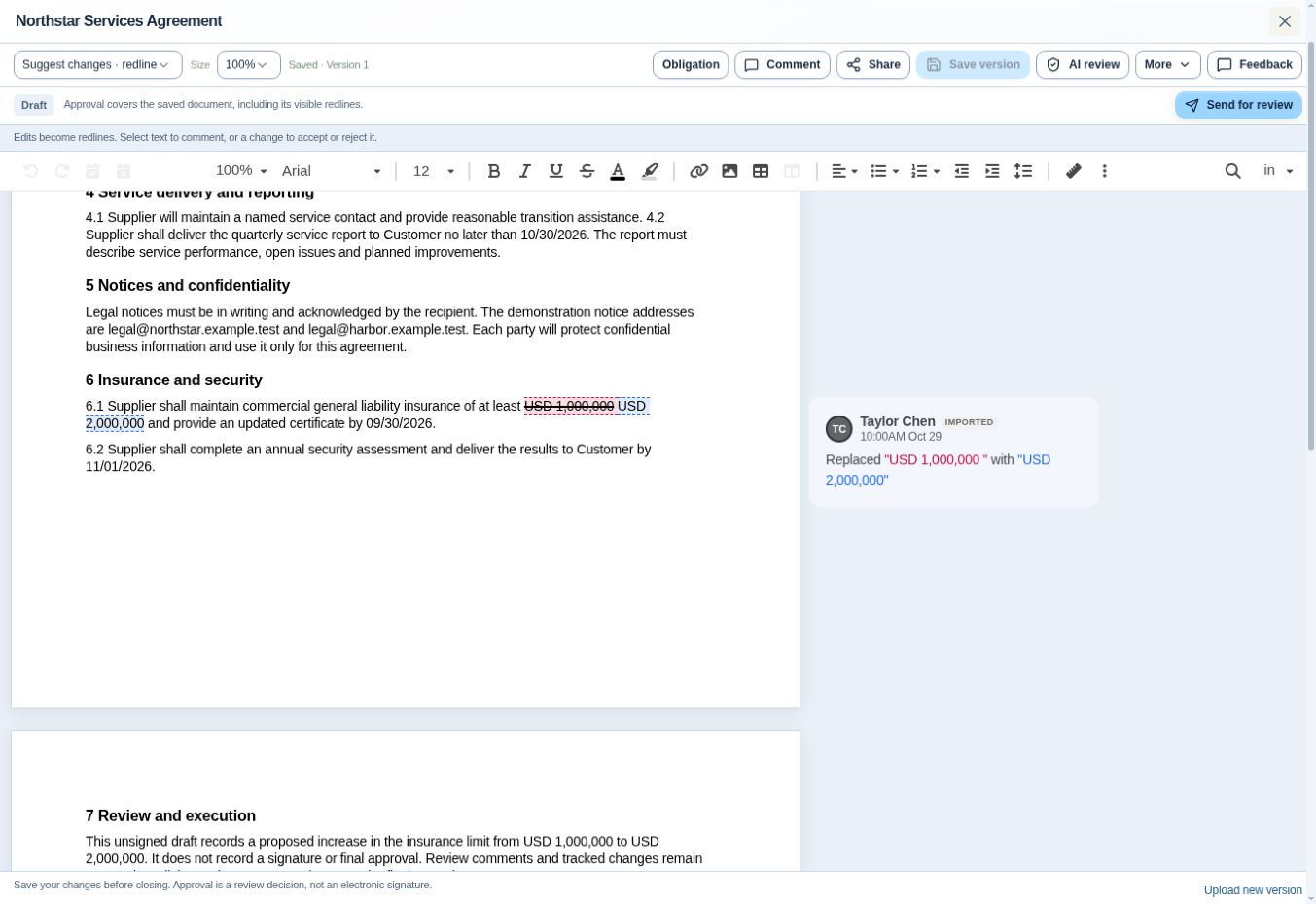
Use the separate Northstar editor capture to practice that distinction. Read Saved · Version 1 and Draft. In section 6.1, compare the deletion of USD 1,000,000 with the proposed insertion of USD 2,000,000. The change card attributes the replacement to Taylor Chen. Those details describe one saved draft and one proposed change. You would need separate authorized evidence before adding USD 2,000,000 to a template or tracking it as a final obligation.
Maintain a small clause collection
Record approved wording and its permitted use
For teaching, use two short provisions about monthly reporting. The first says, “Supplier will send the monthly service report to Customer’s designated contact.” The second says, “Customer will acknowledge receipt of the report by email.” These are fictional statements for testing roles and document assembly. Have your authorized wording owner supply the clauses your organization uses on real agreements.
Give each practice entry its topic, applicable roles, source edition and conditions of use. The first promises delivery. The second describes an acknowledgment. If an agreement treats acknowledgment as acceptance of service quality or a trigger for payment, that surrounding language changes the consequences. Ask the reviewer to inspect the related section before combining the two. A clause record should make that dependency discoverable.
Assign an owner and review date
Record the person who can maintain each entry and the person authorized to approve edits if that differs. Put the approved edition and date beside the wording. Link each reusable provision to the template editions that depend on it using whatever release register your team maintains. That register lets the team identify the small set of outputs to retest after a change.
When a user suggests replacing “monthly” with “quarterly,” record the business reason and the agreements it would affect. Give the service owner a chance to check operations and the authorized wording owner the exact proposed language. Preserve the prior approved text. A future administrator will need to explain which wording a historical draft legitimately used.
Route exceptions to an authorized reviewer; defer advanced playbooks to Chapter 18
Submit a useful exception packet. Include the original sentence, the proposed edit, who requested it, the agreement and edition, and a plain description of what would change operationally. If the customer will acknowledge within five days, somebody needs to understand how those days are counted and who monitors them. An administrator can present that question without inventing a fallback position.
Record what the reviewer decided and whether the permission applies only to this agreement. Chapter 18 develops the separate rules for fallback positions and escalation. For now, a controlled collection of provisions with clear permitted uses gives people enough structure to recognize when they have left the standard path. Contract review playbooks
Practice releasing the six-variable agreement
Give a colleague the approved source, six sample inputs, two practice clauses and a blank release sheet. Have them generate the draft and independently predict the annual figure before reading it. Keep the known-good output. Then repeat with a long party name, a fee with cents, and a missing required date. Record the actual output and whether a preparer could recognize the error before it reached a reviewer.
For the advanced exercise reverse the company’s role. Juniper now purchases a service. Ask the learner to read every use of “Supplier” in the reporting clauses and identify which organization acquires each duty. Passing evidence includes the correct document selection, all six mapped inputs, the fee calculation, and an explanation of which wording needs authorization before reuse. Simply exchanging the two company names would leave the governance decision unresolved.
John's Builder Note
I would rather maintain one template that somebody can prove works than a folder of near-identical documents nobody dares retire. Give the next administrator a test with known inputs and a known result. They can change the software, the form or the layout and still judge whether we would send the resulting agreement with our name on it.
Questions from the field
Can we use our best signed deal as the starting template?
Use it as reference material. Have the authorized owners identify deal-specific concessions, obsolete terms, attachments, and the roles of the parties before approving a clean reusable source. Preserve the signed agreement in its original context.
Should one template cover every currency and pricing model?
Only if the approved text, input definitions and tests handle each allowed combination. Two visibly distinct templates are easier to govern when different price models change how a customer pays or how a supplier performs.
Optional knowledge check
Choose your answer, then open the explanation.
Show answer
The authorized legal or policy owner. Templates carry policy and legal consequences. Their wording needs an accountable authorized owner.
Show answer
Inspect the generated document against the supplied values. A valid form is not proof of a correct document. Check field mapping and the rendered output.
Show answer
No; a playbook also defines decisions, fallbacks and escalation. Clause wording is one component. A playbook adds the rules for evaluating and handling deviations.