 ContraxAware
Core chapter 3 of 18
Metadata, Custom Fields and Contract Data Architecture
Design a small, governed data model that answers real operating questions.
Executive summary
- Start with an operating question. A field earns its place when a person can name the decision it supports, identify a reliable source and explain who will keep it current.
- Store the meaning with the value. The number 2,000 needs a currency and an interval before Finance can compare it with another charge. A date needs an event before anyone can act on it.
- Require information when it becomes knowable. A requester can usually name the business sponsor. The final effective date may emerge only after negotiation or execution.
- Measure accuracy as well as completion. A fully populated register can still send the wrong reminders. Test source evidence, edge cases and the reports built from the data.
Part A · The Why
Define the business question first
Minimum useful fields for an operating register
Pick one meeting and listen to the first question. A procurement director asks, “Which supplier decisions need my attention before the end of the quarter?” That calls for a decision date, an owner, the party, the agreement status and a source the owner can open. A field asking for a five-paragraph relationship history adds little to this meeting.
Work backward twice. What should happen when a record appears in the answer? What should happen when the date or owner is missing? The first answer defines your operating view. The second defines a separate exceptions view. Otherwise incomplete records disappear precisely when they need attention.
Keep a short record of requests you decline or defer. If three departments later ask for the same datum, revisit it with examples. This is a better basis for adding contract database fields than copying every heading from an old spreadsheet. A register with fewer dependable columns is easier for someone else to operate.
Legal entity, counterparty and department distinctions
A company group can have one recognizable brand, several legal entities and many purchasing departments. The logo does not tell you which entity signed the agreement or which budget absorbs the cost. Preserve the legal name from the governing document, then map any internal supplier code or familiar trading name as a separate reference.
The same organization might buy consulting from you and sell you equipment. Its role depends on the agreement. Record supplier or customer in the context of that relationship. Changing the organization’s master description to “vendor” everywhere would distort its role in the sales agreement.
Your organization’s signatory entity and the internal department that manages the work answer different questions. For the Northstar exercise, Harbor Retail Co. is the customer and Northstar Technologies is the supplier. A department is an internal assignment made by Harbor. It cannot be inferred from the proper name of either party.
Contract type, status and taxonomy rules
Use an agreement type to describe what the instrument does. A services agreement, order under a master and confidentiality agreement may require different fields or review steps. Use status to describe where a particular record stands. People who want a “signed services” type usually need two filters rather than another category.
Write inclusion and exclusion examples for ambiguous types. An order that incorporates a parent services agreement belongs to the order category if it sets a distinct delivery, fee or term your business must track. A document that merely supplies technical specifications may belong alongside its parent as an exhibit. Let the contract owner resolve genuinely unusual packages.
Keep the initial taxonomy short enough that two trained users classify the same sample independently. Put their answers side by side. If one person repeatedly calls an order a template and another calls it a purchase agreement, the definitions or the underlying model need work. Repeated disagreement deserves attention before retraining the entire company.
Model values that remain reliable
Dates, currency, numbers and controlled vocabularies
A date field should describe one event. A date headed “Renewal” could mean the notice deadline, the first day of the renewed term or an internal negotiation meeting. Name the event in plain English and give a concrete example in the field help. Decide whether the value is a calendar date or an event with a time and location.
Money needs three decisions. Specify what the amount measures, the currency in which it is stated, and the period or basis. USD 2,000 due each month becomes USD 24,000 across twelve scheduled months. That calculation alone says nothing about usage fees, sales taxes, cancellation rights or amounts paid to date.
Use a short controlled list where staff need consistent grouping. “Monthly,” “Quarterly” and “Annually” are workable example choices for a recurring charge. Free text belongs beside the controlled value when a stepped discount or exceptional first billing period needs explanation. Preserve the unusual wording even if it resists immediate comparison.
Parent-child relationships and source references
Choose the level at which a fact holds true. A master may establish invoicing procedures, while separate orders specify quantities and currencies. A single amount on the master can accidentally add a spending ceiling to every amount already committed under the orders. Ask which document created the commitment and whether another record already counts it.
Capture a source pointer with enough detail for another person to repeat the check. A stable document identifier or version, section heading and paragraph usually survive a different page layout better than “page two” alone. Include the amendment reference when a source value changes. Preserve which value applied to which period.
If a parent link is uncertain, record the proposed relationship and assign verification. A guessed parent can distort both financial rollups and the bundle a reviewer reads. The federal National Archives supplies a useful comparison when designing persistent descriptions and source context for documents, within its own permanent-records transfer scope. NARA metadata requirements
Unknown, not applicable and not yet verified values
Three blank cells may reflect three different conditions. A date might be missing from the source you received. A monetary charge may be irrelevant to a confidentiality agreement. A reviewer might have a proposed date and simply need to check the signed amendment. Each condition calls for a different action.
Keep the typed field able to represent absence. Then record the reason in an appropriate review status, note or issue log. A dummy date like December 31, 2099 will sort and filter as if it were a real contractual fact. A zero in an amount field can be equally misleading when all you know is that pricing sits in an unattached order.
Define what closes each state. An unknown charge might require a signed rate schedule from Procurement. An inapplicable recurring charge on a reviewed NDA can be accepted immediately. An extracted date stays provisional until a named person checks its source. A reviewer should be able to see why any outstanding field has waited.
Keep the model maintainable
Field owner, definition, source and validation rule
A data dictionary is the agreement among the people who enter, review and consume a field. Give each definition a named business owner, an allowed form, an authoritative source, a point of entry and an example. Add a case that frequently fools experienced staff. “First invoiced amount” is especially easy to confuse with “recurring monthly charge.”
Assign stewardship by subject. Finance can own the definition of a normalized recurring charge. A contract administrator can be responsible for entering the amount from the pricing clause. The agreement’s business owner may approve use of an estimate in a forecast. Record those responsibilities separately when they matter to a decision.
Separate validation from verification. A correctly formatted date may be a supplier’s signature date entered as an effective date. A field can pass a format rule and fail the business check. Build a short source review into the work that turns a proposed record into a dependable one.
Required fields at the appropriate lifecycle stage
Ask whether the person filling the form can know the answer. At intake, the requester can state what they need, which department wants it and who can answer questions. Later, the reviewer can identify the counterparty’s legal name. The execution or activation team may be the first to know which version everybody signed.
Set your minimum evidence for each handoff. Accept an unverified proposed date for review when somebody owns the question. Require a dependable notice term or a documented exception before the team starts operational reminders. If the form cannot express a conditional requirement, add it to a named reviewer’s handoff check.
A required field transfers work to a person. Watch the first three attempts to complete a new form. If users repeatedly pick the first dropdown choice to get past it, the requirement is training staff to create inaccurate data. Reconsider the question, timing or source before making another field mandatory.
Change control, reporting consistency and data-quality metrics
Changing a label can change history if people silently reuse an old field. Suppose “Annual value” once meant last year’s invoices and will now mean twelve months of contracted recurring fees. Create a distinct definition, identify dependent reports, decide which old records can be converted and retain the original basis.
Measure quality with a denominator you can explain. For example, twenty active service agreements need a verified notice field. Sixteen have verified values, two have unresolved wording and two have no source. Coverage is sixteen out of twenty, or eighty percent, for that population. Do not remove the four difficult records from the denominator to improve the slide.
Measure a second dimension by independently sampling the sixteen verified fields against the source. If one fails, the sample tells you something about verification quality. It does not justify a blanket statement about every record. Investigate whether the same mapping or source issue affects related agreements.
A fictional case at Meridian Components
Meridian’s CFO asked why the supplier report showed a sudden rise in commitments. One department used “Value” for an annual charge, another for a three-year total, and a buyer entered a master agreement’s spending ceiling. Every cell contained a number. Nobody could explain what their sum meant.
The team selected three service orders and opened the pricing clauses. The first stated USD 1,000 per month, the second USD 15,000 per year, and the third quoted CAD 8,000 per year. They recorded USD 27,000 in annual recurring charges across the first two and CAD 8,000 separately. A ceiling stayed on its own record.
Finance kept the original amounts visible and introduced a clearly named forecast calculation for its exchange-rate assumptions. The contract team could now answer which figures came from the parties and which came from Finance. The redesign reduced the number of disputed totals without asking salespeople to estimate contract value at intake.
Part B · The How
Configure contract types and fields
Create practical labels and field help
Open your authorized training setup for the contract type you use for a managed services agreement. Write out the label and help text before adding a field. For the notice cutoff, a useful label is “Nonrenewal notice must be received by.” The help can say, “Use the last date for receipt stated or established from the governing clause. Record the source.”
Compare the draft definition with the fields already present in your ContraxAware workspace. Reuse an existing field when its meaning and downstream use match. Two labels that look alike can behave differently in a saved view. Put a test record through the review meeting’s actual filters before deciding to create a replacement.
Treat the labels in this exercise as your organization’s designs. The verified import example below shows the product labels available on that screen. The repository’s product guide describes the use of contract types, custom fields and saved views. Contract management system and repository
Select the right field type and required status
Use a date for a calendar event, a numeric amount for money, a governed list for billing intervals and a person assignment for an internal owner where your configuration supports it. Keep arithmetic inputs in separate values. Putting “about $2k monthly” in one comments field gives an analyst several decisions to guess.
Start with one services record and one confidentiality record. Write down which values the requester can provide, which the administrator confirms and which become required for release. Date the decision. If a field behaves differently from your design during entry, document the result and choose a handoff check that gives the business the same control.
Keep requestor inputs simpler than administrator records
Give the requester questions they can answer from the business need. Ask who is buying, which supplier is involved and who will use the service. Reserve the interpretation of renewal notice, the controlling amendment and billing basis for people who can check the agreement.
Have a colleague submit a fictional request. Watch where they pause and ask what they thought the question meant. If they give a brand name when you need a legal name, keep their useful lead and let the reviewer verify it later. Doubling the number of text boxes rarely fixes a problem of timing or responsibility.
Validate real examples
Enter the Northstar amount, term and counterparty
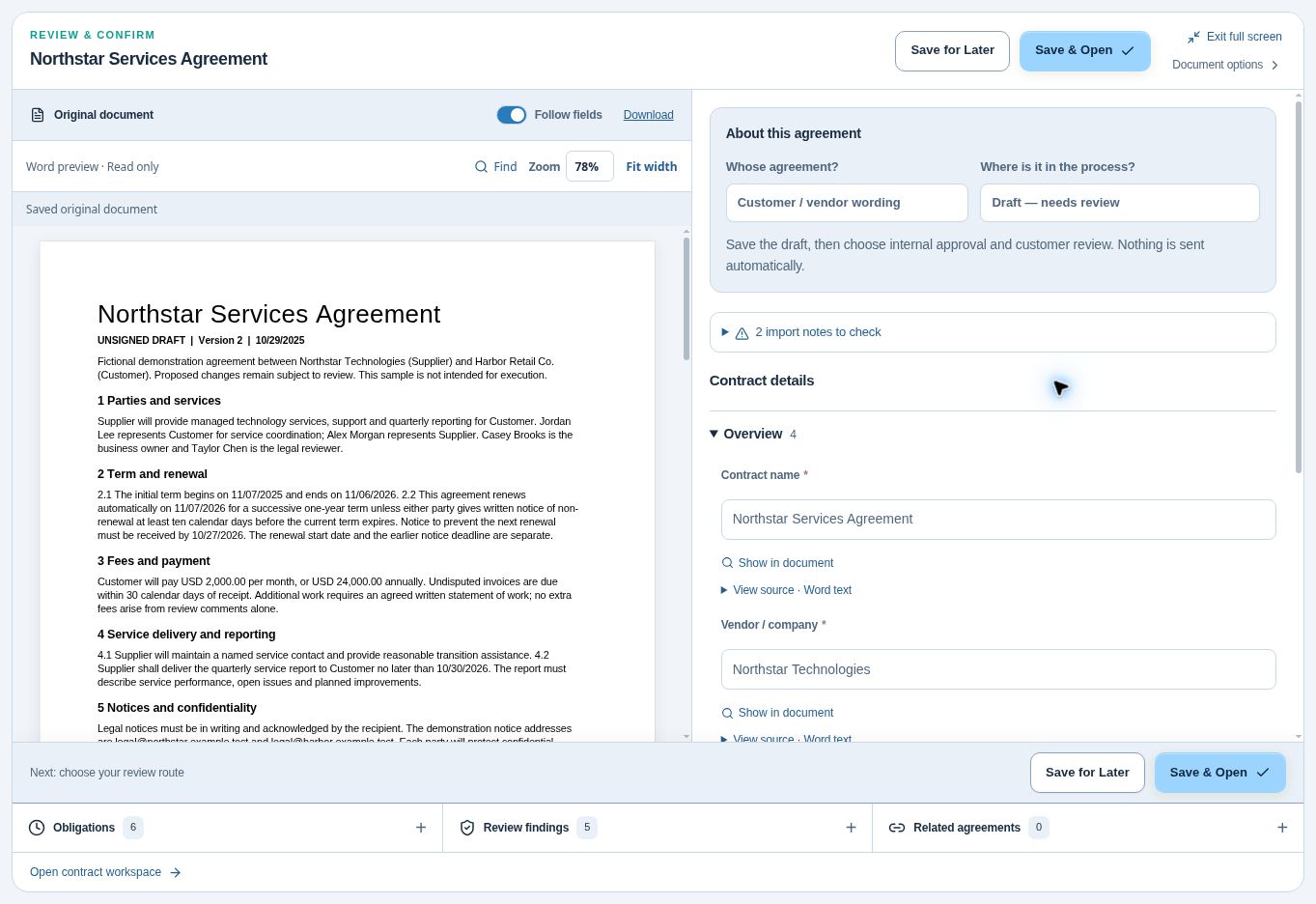
Use the Northstar Services Agreement training draft. In REVIEW & CONFIRM, compare Contract name and Vendor / company in Overview with the title and parties in the Original document. The supplier is Northstar Technologies. Under Where is it in the process?, the captured value is Draft — needs review.
Read the fee and term in the document itself. The practice record should represent USD 2,000 per month, November 7, 2025 as the initial term start and November 6, 2026 as its end. Do not equate a term start with a separate effective date unless the wording supports that interpretation. Keep the stated October 27, 2026 receipt deadline distinct.
Link each critical fact back to source wording
Record the source for the recurring charge as the Northstar draft, section 3, “Fees and payment.” The opening sentence names the supplier and customer. Section 2 supplies the term and notice mechanics. Use Show in document beneath a visible field when you need to follow that field’s supporting evidence.
Add a reviewer and verification date to the working evidence record. If a later version changes the amount, identify the new version before updating a source reference. Extraction can accelerate initial entry and still leave the reviewer responsible for understanding frequency, proposed edits and the exact agreement being checked. AI contract data extraction
What the Northstar fee can tell Finance
The fictional unsigned Northstar draft quotes a recurring service charge. Preserve the basis of every number.
- Section 3Commercial source
The pricing wording states USD 2,000 per month and USD 24,000 annually.
- USD 2,000 / monthStore the basis
Keep amount, currency and interval together. Retain the reference to the draft version.
- 12 × USD 2,000Reproduce the math
The twelve-month calculation yields USD 24,000. A shorter term or a stepped fee requires different treatment.
- USD 24,000 / yearReport the right measure
Label the figure as a proposed annual charge in this draft. Actual payments need invoice and payment evidence.
One clause can support a proposed recurring-fee comparison. It cannot by itself establish actual spend, signing or approval.
Test empty values, invalid dates and currency mismatch
Try a missing amount on the NDA. Its lack of a recurring charge should have an explainable disposition. Try the same omission on a services agreement that references a separate pricing schedule. That omission should create a follow-up for the schedule. Compare the two records side by side before signing off on your field setup.
Enter a deliberately impossible date in the training exercise and observe whether the form rejects it. Then try a plausible but wrong date such as the renewal start in the notice-cutoff field. Record how a reviewer detects the second error. Format validation alone cannot compare contractual meanings.
Test the currency separately. In a second fictional service order, enter an amount supported by a CAD clause. Confirm that a USD-only portfolio view excludes it or identifies the currency correctly. If a report combines both without conversion, change the view or its use before supplying a total to Finance.
Use the data every day
Filter and group by owner, type and upcoming decision
Build a working portfolio view for the weekly review. Select the relevant agreement type and stage, choose the decision date and group the visible records by the person who must act. Include the counterparty, source reference and next action where these help the reviewer resolve a row during the meeting.
Save the view with a name that states its purpose, such as “Services decisions due this quarter.” Test it against a known matching record, a record outside the period and an active agreement missing its decision date. Keep a companion missing-date view. Choose the report from the meeting’s question. Contract reporting and portfolio views
Review missing critical fields and assign corrections
At the meeting, pick one missing value and trace why it is absent. The source could be unavailable, the requester may never have known it, the definition may be unclear, or the record might have been migrated before the field existed. Different causes require different corrections.
Assign a reviewer, a specific source to obtain and a date to report back. A blank that affects next week’s notice is more urgent than an optional business-category field. When the evidence arrives, update the record, rerun the relevant view and verify that the item moves into the right operating population.
Revise the dictionary without silently changing meaning
Give changes an effective date and document the old and new definitions. If you split “Annual cost” into contracted recurring charge and estimated variable spend, list the reports and users affected. Decide whether to backfill old values, keep them under the former definition or mark their basis unresolved.
Test the revised report with Finance on a small known population. Retain the old report definition long enough to explain why last month’s total changed. A simpler interface is a fair reason to rename a field. A change in what the number measures deserves its own definition and a controlled transition.
Practice a twelve-field dictionary
Use the following working dictionary for the two training types. The system’s record identifier remains the stable key. Each line below names an operating field, its allowed form, its business steward and its evidence.
- Owning legal entity. Select the contracting entity from the approved entity list. Legal Operations owns the list and checks the parties clause.
- Counterparty legal name. Use the entity name as written, linked to the approved party where available. Procurement verifies the parties clause and any documented changes.
- Agreement type. Choose services agreement or confidentiality agreement in this pilot. Legal Operations classifies the instrument from the governing document.
- Lifecycle status. Use a defined stage supported by evidence, such as draft or executed. The contract administrator checks the document and signing record.
- Business owner. Choose one accountable internal person. The department manager confirms the assignment through the recorded handoff.
- Source reference. Store a durable identifier or link to the document and version. The administrator verifies that a permitted reviewer can retrieve the original.
- Effective date. Use a full calendar date established by the effectiveness clause. The contract reviewer resolves any event-based trigger and supporting evidence.
- Current term end. Use the verified ending date for this term. The contract reviewer checks the term clause and effective amendments.
- Notice receipt cutoff. Record the applicable date for receipt when the clause requires it. The reviewer checks notice and term wording together.
- Recurring charge. Enter a numeric fee for one specified billing interval. Finance verifies the underlying pricing clause or incorporated schedule.
- Currency. Select the stated currency, such as USD or CAD. Finance owns the allowed list and verifies the pricing source.
- Billing interval. Select the supported period, such as monthly or annually. Finance checks the pricing schedule and records atypical first periods separately.
For the advanced challenge, give a practice master a USD 100,000 ceiling, with one annual USD 18,000 order and one annual CAD 15,000 order. Report each order in its source currency. At an explicitly assumed planning rate of USD 0.75 per CAD, the illustrative annual total is USD 29,250. Explain why adding the ceiling would count a different economic measure.
John's Builder Note
Before I would make a field mandatory, I would put the form in front of the person expected to answer it. Ask where they would look up the answer. If their first move is to invent an estimate so they can finish the form, we have learned something about the design.
Questions from the field
Should we store both a monthly fee and an annualized amount?
Store the amount and basis that the agreement states. A separate calculated annual view is useful when its assumptions are visible. Preserve unusual periods, usage charges and currency so another reviewer can reproduce the calculation.
When should a new department get its own agreement type?
Create a separate type if the underlying documents, decisions or required data differ materially. If the difference is simply who manages the work, test a department field and the existing type first.
Optional knowledge check
Choose your answer, then open the explanation.
Show answer
A visible unverified or unknown status. Unknown is useful information. A guessed date may drive the wrong notice or renewal action.
Show answer
A defined amount and explicit currency. The amount is ambiguous without its currency and valuation definition.
Show answer
When the process needs it and the user can reasonably know it. Stage-appropriate requirements improve completeness without forcing users to invent early information.