 ContraxAware
Core chapter 10 of 18
Obligations, SLAs and Certificates of Insurance
Turn promises into owned, evidenced tasks, including a practical COI renewal and review process.
Executive summary
- Turn a promise into a test. Identify who owes what, the event that starts the clock, the evidence required and the person authorized to accept it.
- Treat a certificate as evidence. Match the insured entity, dates and limits to the applicable contractual requirement. Send coverage and endorsement questions to the qualified reviewer.
- Give exceptions an owner. A missing item, a file awaiting review and a verified deficiency need different next actions. Preserve the deadline through all three.
- Do the arithmetic before claiming a credit. Reproduce the service measurement, check exclusions and find the notice requirements before estimating a commercial remedy.
Part A · The Why
Translate wording into operational obligations
Responsible party, trigger, due date and acceptance criteria
Read a promise with the person who will use its output. A supplier may promise a quarterly service report. Ask the operations lead what they need to judge performance. A PDF with the right title may omit the response times and open incidents specified in the agreement. A useful obligation describes a deliverable that someone can actually inspect.
Write one sentence in plain English. “Northstar Technologies delivers the quarterly service report to Harbor Retail Co. by October 30, 2026. The business owner checks that it covers service performance, open issues and planned improvements.” Keep the clause reference alongside it. These are sample terms from an unsigned training draft. An operating record for a real supplier needs the applicable executed version and any changes.
Give separate promises separate rows when delivery, timing or verification differs. A certificate from a broker and a service report from an account manager can arrive a month apart. Putting both under “vendor paperwork complete” conceals the exact item that still needs attention.
Fixed dates, signing offsets and dependent milestones
A fixed date comes from an actual date in the agreement. An offset needs both a quantity and a starting event. A dependent milestone waits for another event to satisfy a condition. Write the trigger in words before entering a date. “Within 15 calendar days after written acceptance” requires the date of written acceptance. A delivery receipt supplies a different piece of evidence.
Try the rule with easy dates. In a separate practice agreement, a team accepts a deliverable on May 4. The terms count the following day as day one and give the supplier ten calendar days. The due date is May 14. If the team received the file on May 1 but accepted it on May 4, using the receipt date moves the due date three days early.
Check the clause for calendar or business days, holiday treatment, time zone and rules for receipt. If the starting event has yet to happen, leave the actual trigger open and assign someone to watch for it. A forecast date can support staffing while the contractual due date waits for evidence.
Reported completion versus independently verified completion
The person doing the work can report what they delivered. A designated verifier decides whether the evidence meets the agreed test. Preserve the date of each event. A supplier uploads its report on the due date. The owner reads it two days later and discovers one missing section. The dates tell a fairer story than one checkmark.
Use the right amount of review. An owner can verify a routine monthly agenda against two required topics. A technical acceptance test may need an engineer. Insurance wording may need the organization's risk adviser. Decide in advance who can accept an item, send it back or approve an exception. Then write down what happens during that person's absence.
Manage service levels and commercial remedies
Measurement definition, source and review cadence
A service-level agreement (SLA) establishes a measurable service commitment. For an availability target, collect the service boundary, agreed operating window, excluded periods, source of minutes and reporting frequency. For a support response target, identify what starts the timer, which clock applies and what counts as a response. An automated acknowledgment can have a very different meaning from a qualified engineer taking the case.
Use a worked example with defined assumptions. A fictional 30-day service month runs continuously for 43,200 minutes. An authorized maintenance window removes 120 minutes from the denominator under this particular clause. With 60 minutes of eligible downtime, availability is 43,020 eligible working minutes divided by 43,080 eligible minutes, or 99.86% rounded to two decimals. That falls below a 99.9% target.
Store the underlying minutes and compare using the precision in the agreement. Show the exact incident windows when they overlap. Counting two alerts for the same 20-minute outage would exaggerate downtime. A person unfamiliar with the original incident should be able to reproduce the result.
Missed performance, service credits and notice deadlines
Read the remedy paragraph before quoting a credit. Find the threshold, eligible fee, credit percentage, cap, exclusions, claim deadline and required delivery method. Some agreements require the customer to act. Identify who can send the request and who will check the supplier's response before the deadline passes.
In a fictional service schedule, eligible monthly fees are USD 4,000. The measured result earns a 5% credit if properly claimed. The candidate credit is USD 200. Tax, unrelated project fees and an annual contract total stay outside this calculation under these assumptions. Record measurement, eligibility, claim and application as separate events so Finance can see what is still contingent.
Give the supplier a specific period and incident list to review. If the parties disagree on twenty minutes of downtime, preserve both calculations with the underlying evidence. The authorized owner can often settle a narrow disagreement faster than a general complaint that the service was poor.
Evidence, dispute resolution and authorized enforcement
Assemble the applicable version, performance report, measurement inputs, notes of exclusions and the actual notice record. Include the applicable time zone and the address or channel required by the agreement. A discussion in a weekly meeting may keep people informed while a contractual notice still needs to reach a different recipient.
When someone proposes withholding payment or stopping service, route that decision to the people authorized under the agreement and company policy. The contract administrator can establish the chronology, calculate the amount under competing interpretations and identify who must act by when. A disputed credit belongs on the exception list until its treatment is known.
The UK Cabinet Office's playbook offers a public-sector reference for organizing performance and commercial reviews. US federal procurement groups certain responsibilities, including reviewing contractor insurance plans, in FAR 42.302. Private organizations can use these sources to think about assignments and delegation. Their own agreements and authority policies govern their decisions. UK Contract Management Playbook · FAR 42.302
Manage COIs and insurance renewal
Required coverage, limits, insured entity and policy period
Start a certificate of insurance (COI) review with the contract's insurance schedule. Record the supplier's legal entity, required lines of coverage, amounts and basis. A limit per occurrence and an aggregate limit apply differently. A large number in the aggregate column alone cannot establish that a required amount applies to each occurrence.
Name the entities precisely. The insured named on the evidence may be a parent, a subsidiary or a company using a trading name. The certificate holder may be the customer receiving the certificate. Additional insured status raises a separate coverage question. Bring entity mismatches and requested additional insured treatment to the qualified reviewer with the executed clause and any referenced schedule.
Track the policy period separately from the date the supplier must provide renewal evidence. An agreement could require an updated certificate before an existing policy period ends. Record the two dates with their meanings. For multiple policies, use the relevant expiry for each requirement. A general liability renewal does not automatically refresh an automobile policy.
Certificate evidence versus policy and endorsement review
A certificate summarizes information about listed policies. The underlying policy and applicable endorsements determine coverage. For example, language on the standard ACORD liability certificate directs readers to the policy provisions or endorsements for additional insured status. The Texas Department of Insurance publishes a specimen that shows the named insured, policy dates, limit fields and certificate holder in different places. ACORD certificate specimen
Read the specimen once with your risk adviser. Ask which evidence the adviser expects for each common requirement and which questions need escalation. A producer can clarify an apparent entity mismatch. An authorized reviewer can determine whether supplied policy language satisfies the agreed terms. An administrator should record that decision and the evidence reviewed without making a coverage determination on the adviser's behalf.
Protect confidential policy information. Request only the material needed to decide the outstanding question, share it with authorized reviewers and follow the organization's retention rules. Never alter an issued certificate to fit a database field. Preserve what arrived and get corrected evidence through the approved channel.
Expiring, missing or insufficient evidence and escalation
Give each exception a next action. For expiring evidence, ask the responsible supplier contact when renewal documents will be available. For missing evidence, confirm what was requested, the contractual deadline and the recipient. For insufficient evidence, name the exact gap, such as a mismatch in legal entity or an endorsement the reviewer needs.
Expiry and evidence quality describe different conditions. A current certificate can still have an unresolved coverage question. An expired certificate shows what was provided for a previous period. By itself, an empty folder establishes a documentation gap. The qualified reviewer decides what can be concluded about actual insurance and whether to request more information.
A fictional case of three green supplier files
A regional food distributor had three loading contractors marked current because all three folders contained a recent PDF. A new administrator reopened the checks against the signed agreements. One named the correct operating company and included all evidence requested by Risk. One named a sister company. The third listed a current liability policy but omitted the requested supporting endorsement.
The administrator recorded three dispositions. One file passed. The second went to the supplier to establish the relationship between the names. The third went back for the specific missing evidence. Operations received a named owner and follow-up date for each open item. Risk retained authority over work restrictions and exceptions.
At the next monthly review, the team reported three certificates received, one requirement verified and two evidence gaps under review. Management could see why a perfect document collection rate had produced an incomplete risk review. When corrected evidence arrived, each reviewer recorded the date and rationale separately. That history also gave the next administrator a practical example of an acceptable submission.
Part B · The How
A certificate expiring on Friday gives the team two jobs. Someone must request a replacement, and someone must check that the new certificate meets the agreement. Record both responsibilities in the contract management system.
Build obligations in ContraxAware
Link the obligation to source wording
Start with the fictional Northstar Services Agreement. On the import reference screen, locate Obligations along the bottom. Its count identifies entries in that sample. A separate redline capture shows the proposed change in clause 6.1. It replaces USD 1,000,000 with USD 2,000,000. The document remains a draft at this point.
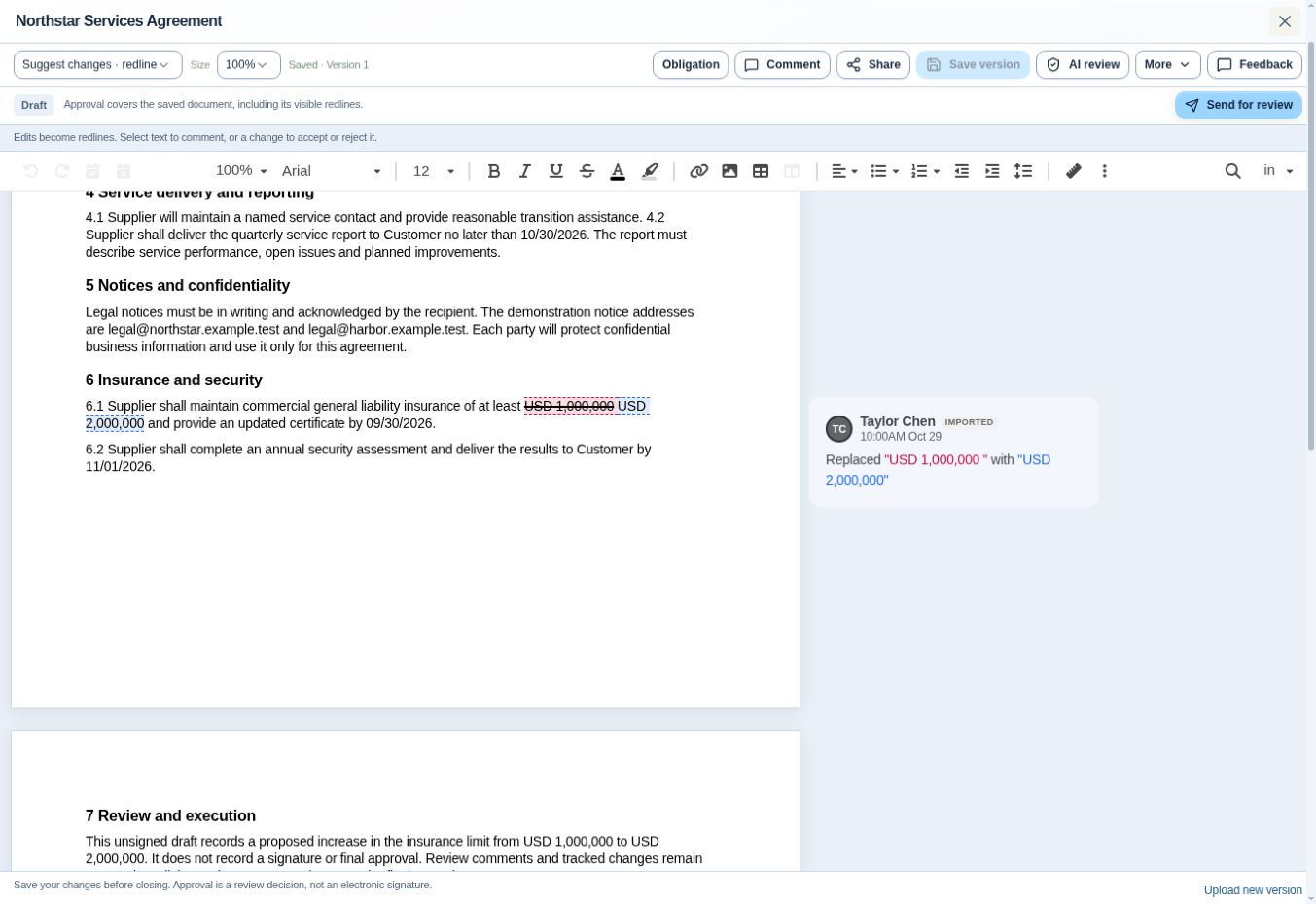
- Read the source. In the sample, find clause 6.1 and inspect both amounts. Identify the higher amount as a proposal. Keep any associated insurance task in training review until the final wording is established.
- Write a useful obligation. Use “Obtain Northstar renewal insurance evidence” as the practice title. Include the agreement, clause, version reviewed, supplier name and evidence needed to resolve the open limit.
- Check the reference. Ask a colleague to find the clause from the information you recorded. If they land on an earlier draft, add enough detail to identify the right source.
Assign owner, verifier, due basis and supporting files
Choose the person who will obtain the supplier's evidence and the person qualified to review it. Casey Brooks is the sample business owner. Assigning Casey commercial follow-up does not confer insurance authority. Identify a training risk reviewer by role and give that person the clause, the evidence and the question awaiting a decision.
Apply the date basis from the source. The sample uses September 30, 2026 for updated certificate delivery. It supplies no policy expiry in the visible redline. Enter an expiry only when the relevant policy evidence provides one. In a training note, record the source of the delivery date and what still needs verification.
Use the platform's obligation record and supporting files to keep evidence with the agreement. Give drafts, supplier submissions and reviewer decisions descriptive names. Use the product guide to relate fixed dates, event-based obligations and verified completion to a specific setup. Contract obligation management
Test a dependent task using verified completion
Create a separate fictional practice dependency. A supplier reports evidence delivered on September 25. Your test calls for an internal follow-up two calendar days after the verifier accepts it. Leave verification outstanding and inspect the follow-up. Its contractual start is still undetermined.
Record a simulated acceptance on September 28. Under the exercise rule, September 29 is day one and the follow-up falls on September 30. Compare the result to your expected date. If the system or worksheet dates the task September 27, investigate which event was used before applying that rule to another agreement.
Run the COI workflow
Record the contractual insurance requirement and certificate expiry
Use the Northstar draft to practice flagging uncertainty. For a completed comparison, use a separate fictional signed training schedule, Cedar Site Services LLC, with a USD 1 million per-occurrence requirement and a named additional insured endorsement requirement. Label this exercise so nobody confuses its settled terms with Northstar's open negotiation.
- Describe the requirement. Record Cedar's entity, the coverage type, the per-occurrence basis and the requested endorsement. Reference the signed training schedule.
- Date the evidence. Give the sample policy a December 31 expiry. Set December 1 as the internal follow-up date for this drill. Mark which date comes from policy evidence and which comes from your team's timetable.
- Check responsibility. The department administrator requests the document. The risk reviewer decides whether what arrives satisfies the stated requirement.
Request and attach the replacement COI
Prepare a short request naming Cedar Site Services LLC, the relevant agreement, the upcoming policy period and the evidence required. Include the return channel approved by your organization. Explain the requested timing so the supplier can flag a problem before the current period ends.
Attach the replacement to the same agreement and obligation. Preserve its received date and source. Keep the prior period's evidence available under your retention policy. Record the new submission as received and awaiting review. For a dress rehearsal, use fictional files and training recipients. Record when a request would be delivered without involving a real supplier.
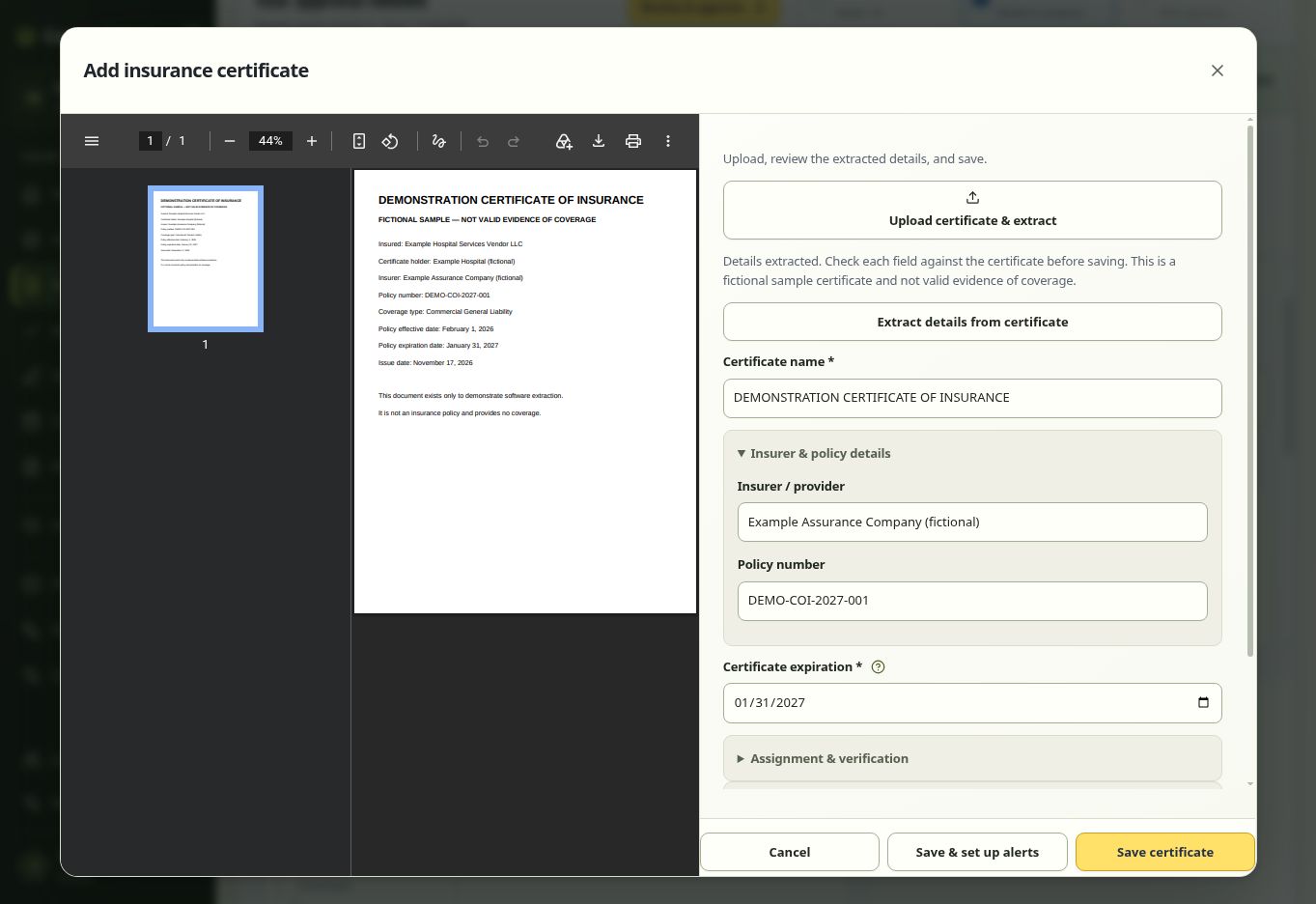
This separate hospital software demonstration shows how to check a certificate once its details have been extracted.
- In Add insurance certificate, compare Certificate name with the document title on the left. Both read “DEMONSTRATION CERTIFICATE OF INSURANCE.”
- Under Insurer & policy details, compare Insurer / provider and Policy number with the PDF. The example identifies Example Assurance Company (fictional) and DEMO-COI-2027-001.
- Check Certificate expiration against the policy expiration printed on the document. Both show January 31, 2027. The November 17, 2026 issue date describes a different event.
- When the entry is ready, choose Save & set up alerts to continue to reminders or Save certificate to save the entry. The document itself says it is demonstration material.
Have the qualified reviewer verify details and record deficiencies
Give the reviewer a short comparison. For each contractual requirement, identify the corresponding item of evidence, result and unresolved point. In the Cedar exercise, the supplied certificate lists USD 1 million per occurrence, but the insured is Cedar Holdings Inc. and the requested endorsement is missing.
Record both deficiencies separately. Ask Cedar to supply evidence showing how the contracting entity satisfies the requirement and to provide the requested endorsement for review. Retain any rationale the reviewer gives. An approved temporary exception should identify the approving authority, reason, expiry and conditions. It should remain distinguishable from a verified match.
Read an insurance review from request to decision
Cedar Site Services LLC is a fictional supplier. Its signed training schedule calls for USD 1 million per occurrence and an additional insured endorsement.
- USD 1 millionRequirement
Risk identifies the contracted entity, limit basis and required endorsement in the signed schedule.
- 2 gapsSubmitted evidence
The certificate shows the right limit but names a sister company. The requested endorsement is missing.
- 1 gap remainsCorrected submission
Replacement evidence identifies the right entity. The reviewer keeps the endorsement question open.
- Record acceptanceReview decision
Once satisfactory evidence arrives, the qualified reviewer dates the decision and records the next policy expiry.
A certificate’s arrival, a reviewer’s decision and the next expiry are separate events. Preserve the evidence for each.
Operate compliance reviews
Notify the department owner and escalate overdue items
Set a practical escalation sequence with the people who will receive it. In the Cedar drill, the department administrator follows up first. If the agreed internal follow-up date passes without a response, the department manager helps secure a response. An unresolved issue approaching the risk decision date goes to the contract manager and qualified reviewer.
Set thresholds to match the contract and business exposure. Record who owns the next action after each handoff. One short message containing the agreement, the gap, the cutoff and the requested decision is more useful than five identical reminders. Watch the queue through one test cycle to confirm that the intended person can actually act.
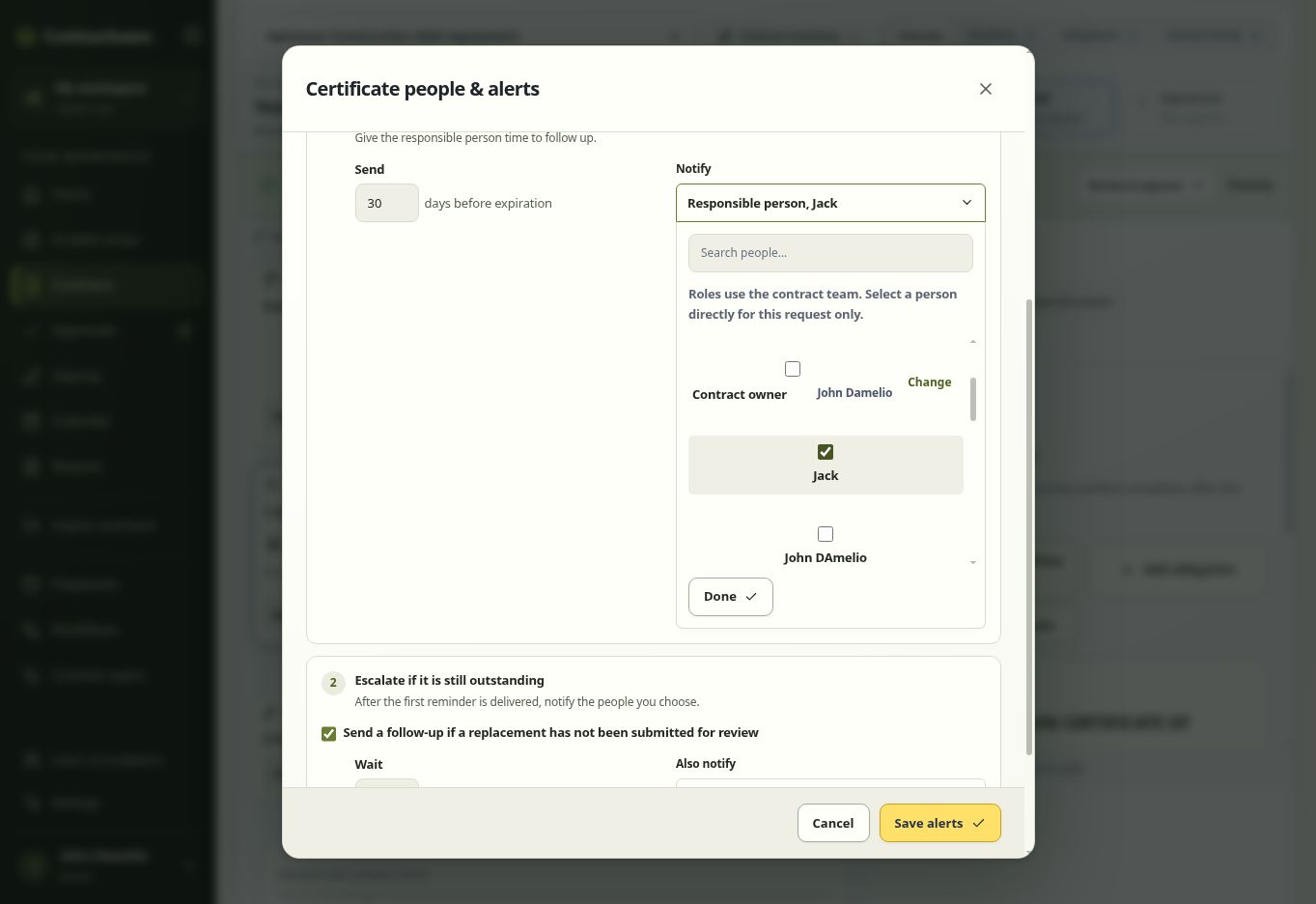
In the separate Certificate people & alerts example, Send shows 30 days before expiration. Open Notify, review the selected recipients and click Done. Under Escalate if it is still outstanding, the selected follow-up applies when a replacement has yet to be submitted for review. Check the intended delay and recipients before clicking Save alerts. A received replacement with a coverage question still needs a human review.
Keep reported and verified completion distinct
At the weekly review, ask two questions. What arrived since the last meeting? Which requirements did a reviewer accept? Count submissions from the first answer and verified obligations from the second. Keep waiting-for-review items visible alongside overdue supplier responses so a slow internal review cannot be mistaken for poor supplier performance.
For a simple view, start the week with eight open evidence requests. Five suppliers respond. Reviewers accept three and find two deficient. The workload after review is three awaiting a supplier's first response and two needing correction. The three accepted items can leave the active queue with their review evidence attached.
Record the resolution and update the next review or expiry
When corrected Cedar evidence arrives, retain the original submission and associate the replacement with the same open issue. Have the qualified person record which document resolved each gap, who reviewed it and when. Confirm the next meaningful date from the replacement. Avoid copying the previous policy's expiry forward one year by habit.
Close the individual review period after the acceptance criteria are met. Keep recurring obligations and future checks visible. If a reviewer accepts one coverage line and leaves another unresolved, preserve both outcomes. A portfolio report should tell the business owner exactly which services or risk decisions still need attention.
Practice the handoff from supplier to reviewer
Give a colleague the Northstar redline and the Cedar training evidence. Ask for a two-row handoff. Northstar needs an authorized decision on final insurance wording. Cedar needs corrected entity evidence and an endorsement review. Each row should name a person, a next action and a date basis.
For the advanced challenge, give the colleague a replacement Cedar certificate showing the right entity and amount while still omitting the requested endorsement. A sound answer closes the entity question, assigns the remaining issue and preserves the qualified review. A single “complete” entry loses the open decision. Tracking contract obligations
John's Builder Note
When I design a completion step, I ask who can defend the checkmark. The uploader can defend “I sent this file on Tuesday.” The reviewer can defend “I compared it with this requirement and recorded these gaps.” Give them each one clear action and preserve both answers. That saves more time than a dashboard full of green dots.
Questions from the field
What if the broker says the endorsement is on its way?
Record the message and promised delivery date. Keep the outstanding document assigned and route any decision about proceeding to the authorized risk owner. When the endorsement arrives, have the designated reviewer examine the actual wording.
Can one certificate support several contracts?
Yes, if the relevant reviewer determines that the evidence applies to each requirement. Reference the same evidence where permitted and record a separate conclusion for each scope, entity and insurance schedule. A replacement file can trigger several reviews with different outcomes.
Optional knowledge check
Choose your answer, then open the explanation.
Show answer
No; check it against the requirement through the assigned review. Receipt of a file is not verification. A qualified reviewer checks the evidence and records deficiencies.
Show answer
The finalized applicable contract terms after authorized review. A proposed redline is not necessarily the agreed requirement. Track the final source and its effective status.
Show answer
The verified completion event defined by the rule. Use the agreed trigger and preserve evidence of verification; estimates can start dependent work too early.